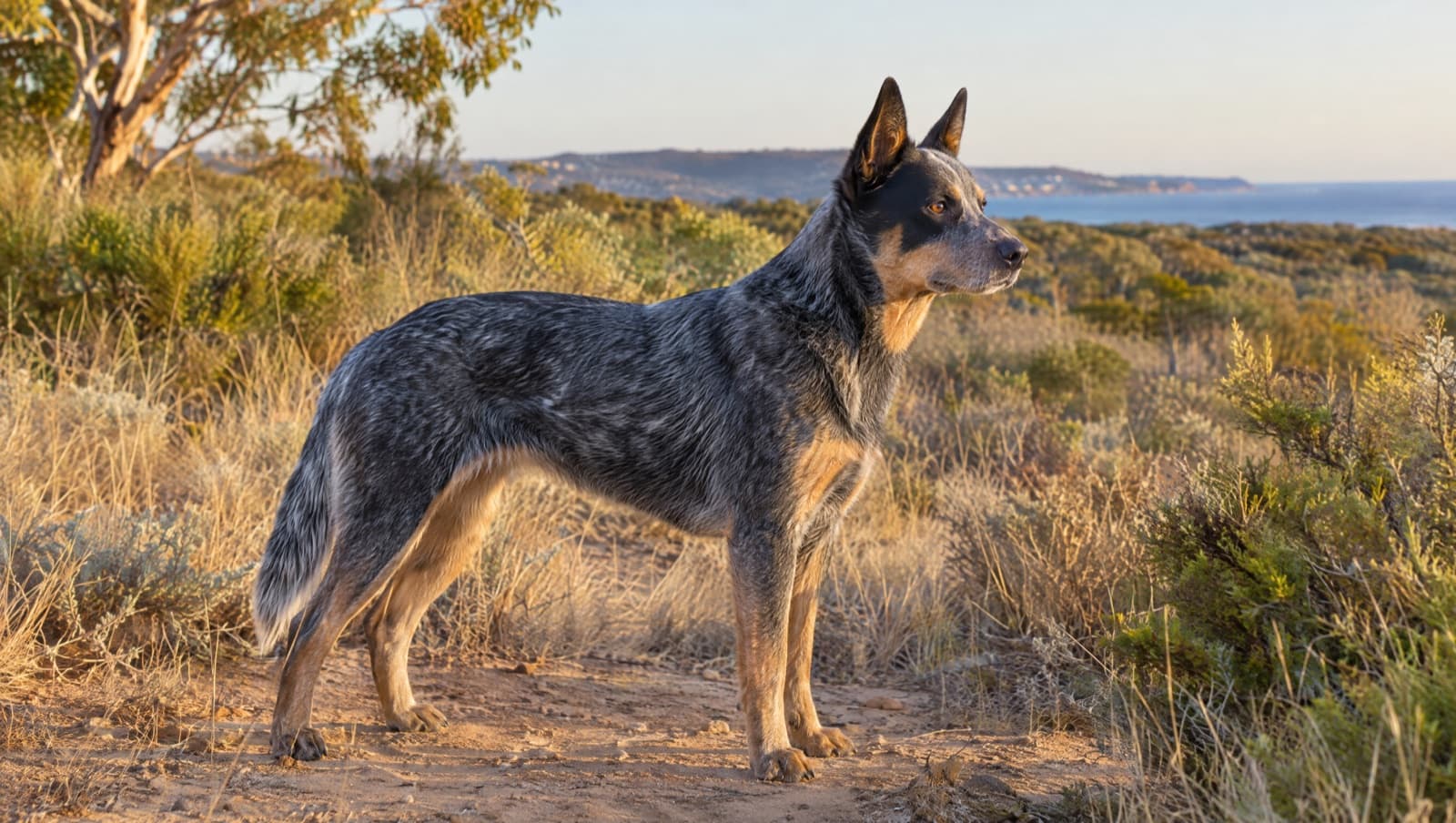
The short answer
The main genetic health risks for Australian Cattle Dogs are congenital deafness (about one in ten of the breed, so a BAER test is recommended for every rescue dog), progressive retinal atrophy and primary lens luxation (both inherited and DNA-testable eye conditions), hip and elbow dysplasia (moderate breed rate, weight management critical) and working-dog joint injuries such as cruciate tears from high-impact exercise. In Perth the everyday dangers are environmental rather than tick-borne: the summer heat, snakes in the warmer months, and 1080 baiting in bushland reserves. Paralysis-tick risk is low in WA, worth thinking about only before travelling east. The single most important early-care move is a BAER hearing test at the first vet visit if the rescue has not done it. Pet insurance with full accident-illness cover pays off the maths on the breed; get it before any condition appears. This is general information, not veterinary advice.
Why Cattle Dogs carry breed-specific health risks
Australian Cattle Dogs were developed in the 1800s by crossing herding dogs with the wild Dingo, then refining the result for stock work in extreme conditions. The breed's genetic foundation is relatively small and concentrated, which means certain heritable conditions appear at elevated rates. The piebald (extreme white-spotting) colouring that produces the breed's distinctive blue or red speckled coat is also linked to congenital deafness, the breed's defining health concern.
Modern responsible breeders test for the major heritable conditions before breeding: BAER hearing, hip and elbow scoring, eye certificates, and a DNA panel for conditions such as prcd-PRA and primary lens luxation. A rescue heeler of unknown breeding benefits from the same checks early in its new home.
The most authoritative sources on Cattle Dog health for Australian owners are the Australian Veterinary Association, the RSPCA Knowledgebase, and, for the hip, eye and congenital-deafness screening schemes, the Orthopedic Foundation for Animals health databases.
1. Congenital deafness and BAER testing
Congenital deafness is the defining health concern of the breed. Roughly one in ten Australian Cattle Dogs are deaf in one or both ears from birth. The condition is genetic, linked to the piebald colouring that produces the speckled coat pattern, and dogs with more white in the coat are at higher risk.
The challenge with deafness in heelers is that the dog compensates so well, visually and behaviourally, that owners often do not realise. A dog deaf in one ear functions almost entirely normally. A fully deaf dog watches faces for cues, responds to vibration and visual signals, and behaves like a normal dog at home. The deafness only shows in specific scenarios: not responding when called from behind, sleeping through loud noises, or startling when approached unseen.
BAER (Brainstem Auditory Evoked Response) testing.
BAER is the definitive hearing test. It is non-invasive: small electrodes on the dog's head measure the brain's response to standardised sound. It takes 15 to 30 minutes, with light sedation sometimes used for a restless dog, and the result is definitive for each ear (normal, deaf in one ear, or deaf in both). BAER testing is available at Perth specialty practices and some general clinics with the equipment, and it typically costs $200 to $400. Every rescue heeler should have a BAER test at the first vet visit if the rescue has not already done it.
Living with a deaf or partially-deaf Cattle Dog.
- Reward-based training using hand signals. Deaf heelers learn hand signals as readily as hearing dogs learn voice cues. Most owners use simple, consistent signals.
- Vibration-based attention cues. A foot stomp on a wooden floor, a tap on the shoulder, or a vibrating collar (not a shock collar) all work as an attention cue from a distance.
- A clear recall signal. Train an obvious arm wave or thumbs-up as the recall cue.
- Visual safety habits. Always wake the dog by stepping into view first, never by sudden touch, and teach children to do the same.
- Off-leash safety. A deaf heeler off-lead is more vulnerable to traffic and dog encounters because it cannot hear an approaching threat, so most owners keep off-lead time to fully fenced areas.
Deaf Cattle Dogs make wonderful pets, and many Perth rescue placements specifically advocate for them. Knowing the dog's hearing status from day one is the key.
2. Hip and elbow dysplasia
Hip and elbow dysplasia rates in heelers are moderate. Because the conditions affect working ability significantly, selective pressure against them has reduced rates in working lines specifically, while show-line dogs may carry them at slightly higher rates. Both are developmental conditions where a joint forms improperly and leads to arthritis over time: the hip is the more common of the two, the elbow less so but still worth knowing.
Signs:
- Reluctance to run or jump in young heelers
- Bunny-hopping gait (both back legs together)
- Stiffness after rest, particularly in the morning
- Front-leg lameness or stiffness, which can point to the elbow
- Progressive lameness in middle age
- Reluctance to climb stairs or jump into the car
Treatment options in Perth:
- Conservative management. Weight control, joint supplements (glucosamine, chondroitin, omega-3), controlled exercise and anti-inflammatory medication on your vet's advice. Suits mild to moderate cases.
- Femoral head ostectomy (FHO). A less expensive surgical option at $4,000 to $7,000 per hip, which works well for a heeler-sized dog.
- Total hip replacement. The gold standard for severe cases, at $10,000 to $14,000 per hip at Perth specialty hospitals.
The single biggest preventable factor is weight. An overweight heeler loads already-affected joints far harder, while a lean heeler lives with mild dysplasia comfortably for years.
3. Progressive retinal atrophy (prcd-PRA)
Progressive retinal atrophy in Cattle Dogs is specifically progressive rod-cone degeneration (prcd-PRA), an inherited disorder causing gradual vision loss. It starts with night blindness and progresses over months to years to full blindness, with onset typically in middle age (5 to 9 years).
Signs:
- Reluctance to move around in low light, usually the earliest sign, often noticed on evening walks or in dim rooms
- Bumping into furniture in dim conditions
- Dilated pupils in normal light
- Gradual loss of confidence in unfamiliar places
- Progressive vision loss over months, eventually full blindness
Detection and management:
A DNA test identifies dogs at genetic risk before clinical signs appear. Reputable breeders test parents and avoid breeding two carriers together, and an adopted heeler of unknown breeding can be tested as part of the breed-specific DNA panel ($150 to $300). There is no cure, but affected dogs adapt remarkably well to gradual vision loss, and the slow progression gives them time to learn the home layout. Management is about environmental consistency:
- Keep furniture in consistent positions and do not rearrange the room
- Use scent markers near hazards such as the top of the stairs
- Keep to consistent walk routes the dog has memorised
- Speak the dog's name before you approach, to avoid startling it
- Keep the dog on lead in unfamiliar places
4. Primary lens luxation (PLL)
Primary lens luxation is an inherited condition in which the fibres that hold the eye's lens in place weaken and break down, so the lens slips out of its normal position. The Australian Cattle Dog is one of the breeds predisposed to it. When the lens luxates forward it can block normal fluid drainage and cause a painful rise in pressure, which is a genuine eye emergency and can threaten sight if it is not treated quickly.
Signs to treat as a same-day vet visit:
- A suddenly painful eye, with squinting, tearing or pawing at the face
- A cloudy or hazy appearance to the eye
- Redness, or an eye that looks different in size or shape to the other
- A sudden change in vision or bumping into things
There is a DNA test for the gene associated with PLL, which responsible breeders use and which is worth running on an adopted heeler of unknown breeding as part of the breed panel. Early veterinary treatment gives the best outcome, and your vet may refer you to a veterinary ophthalmologist. Because the signs overlap with other eye emergencies, any sudden eye pain or cloudiness in a heeler is a prompt veterinary assessment rather than something to watch and wait on.
Browse Cattle Dogs available in Perth rescue
Rescue heelers arrive with a baseline vet check. A BAER hearing test should be a priority at the first vet visit for the new home.
See Available Cattle Dogs →5. Cruciate ligament injuries and working-dog joint stress
Active Cattle Dogs are at elevated risk for cranial cruciate ligament (CCL) tears compared to less active breeds, simply because the high-impact exercise they need stresses the knee joints. The injury typically happens during a sudden direction change, a sudden stop, or a bad landing from a jump.
Signs:
- Sudden hind-leg lameness, often during or after vigorous play
- Reluctance to bear weight on the affected leg
- Sitting skewed to one side to avoid pressure on the knee
- Stiffness after getting up
- Sometimes a clicking in the knee joint
Treatment options in Perth:
- TPLO (Tibial Plateau Levelling Osteotomy). The gold-standard surgical repair, $6,000 to $9,000 per knee at Perth specialty hospitals, with a 12 to 16 week recovery.
- Extracapsular repair. A less expensive alternative at $4,000 to $6,000.
- Conservative management. Strict rest, anti-inflammatories and physiotherapy on your vet's advice. Less reliable for an athletic dog.
About half of dogs that tear one cruciate ligament tear the other within 12 to 18 months, so the history on the first knee informs decisions on the second. Elbow dysplasia, patellar luxation (a slipping kneecap, less common in heelers than small breeds) and moderate older-age cancer rates round out the conditions worth knowing; have any new lump in a dog over 6 checked.
6. Heat, snakes and 1080: the Perth environment
This is where a Perth heeler's health plan differs most from an east-coast one. The genetic conditions above are the same anywhere in the country; the environmental dangers are not.
Summer heat and the double coat.
Perth has a Mediterranean climate, with long runs of mid-30s to 40-degree summer days, low humidity, and the afternoon “Fremantle Doctor” sea breeze for later relief. Heelers cope with heat better than heavy-coated or flat-faced breeds, because the breed was developed for hard, hot Australian country, but a driven dog will still push itself past safe limits. Exercise in the cool of early morning or after sundown, always carry water, provide shade and a cool indoor space, and test the footpath or sand with the back of your hand first, because hot ground burns paw pads. Watch for heavy panting, drooling, wobbliness or collapse, and get to a vet immediately. The short double coat insulates against both heat and cold, so do not shave it; shaving removes the insulation and exposes the skin to sunburn.
Snakes and 1080 baiting.
Dugites, gwardars and tiger snakes near water are active around Perth's bushland corridors, wetlands and the Swan and Canning river foreshores in the warmer months, roughly September to April. A quick, curious heeler that chases or disturbs a snake can be bitten, which is a life-threatening emergency, so teach a firm leave-it, keep the dog under control near long grass and water, and get to a vet immediately if you suspect a bite. The second WA-specific hazard is 1080 (sodium fluoroacetate) baiting: the state's Western Shield program lays fox and feral-cat baits across many reserves and bushland, and the WA Government advises treating every baited area, signposted “1080 POISON”, as dangerous to pet dogs at all times. 1080 is lethal to dogs, including from eating a poisoned carcass, so check for signage before bushland walks and keep your dog leashed and under control in reserves.
Parasites: what is routine, and the tick note.
Fleas, intestinal worms and mosquito-borne heartworm are present in Perth's warm climate, so keep routine prevention going on your vet's advice. The Australian paralysis tick, though, is an eastern-seaboard species and is not established in WA, so local paralysis-tick risk is low. The one time to think about it is before you travel east with your dog, to the Queensland, NSW or Victorian coast, when you should ask your vet about a tick-prevention product for the trip. Current parasite guidance is covered by the RSPCA Knowledgebase and the Australian Veterinary Association; your own vet tailors a plan to your dog.
The Perth pet insurance maths for Cattle Dogs
Insurance for heelers is genuinely good value. The conditions the breed faces are expensive enough that the maths works out positive over the dog's lifetime, and the breed's long lifespan means more years in which a major event can occur.
A heeler that develops hip dysplasia plus a torn cruciate plus an eye emergency over a 14-year lifespan can rack up $12,000 to $30,000 in vet bills. Full insurance over the same period costs roughly $9,000 to $14,000 in premiums, and even one major event covered makes the policy worthwhile.
- Get coverage before any condition appears. All Australian insurers exclude pre-existing conditions, so a joint or eye issue noted at the first vet visit becomes uninsurable from that point.
- High annual limit ($15,000 or more). Orthopaedic surgery and emergency eye care hit lower limits fast.
- Full accident and illness cover. Accident-only is not enough.
- Check orthopaedic and eye cover. Particularly relevant for this breed.
Major Australian providers include Bow Wow Meow, PetSure, Petplan Australia and RSPCA Pet Insurance. The Australian Veterinary Association pet insurance guide covers what to look for in a policy.
Perth specialty and emergency vets
For a breed-related condition you may need a referral to a specialist. Perth has multi-specialty veterinary referral hospitals offering ophthalmology, orthopaedics, cardiology and internal medicine, and your regular vet refers you to the one that fits the case. For an after-hours emergency such as a suspected snake bite or an acute eye problem, Perth is served by genuinely 24/7 emergency hospitals including Perth Vet Emergency at Cannington, The Animal Hospital at Murdoch University at Murdoch, and WAVES at Success. Know your nearest emergency hospital before you need it, not during a crisis.
The year-by-year health plan
- Year 1: Baseline vet visit including weight and joint assessment. BAER hearing test if not done by the rescue. Breed DNA panel (prcd-PRA and primary lens luxation) as a priority. Pet insurance in place from day one. Routine flea, worm and heartworm prevention started.
- Years 2 to 5: Annual vet check. Watch for vision changes (early PRA) and any sudden eye pain (possible lens luxation), plus joint stiffness. Weight management is critical for the joints.
- Years 6 to 9: Twice-yearly vet check from age six. Senior blood panel. Eye exam at every visit. Check any new lump.
- Years 10 and up: Quarterly check-ins. Quality-of-life conversations. Pain management for the joints. Vision and mobility support if PRA has progressed.
Frequently Asked Questions
How long do Cattle Dogs live?
Average lifespan is 12 to 16 years, with some individuals reaching their late teens. The breed is one of the longer-lived medium dogs and is often cited in longevity work for working breeds. Weight management, consistent exercise, joint care from middle age, and a prompt response to any eye or hearing change all extend life. In Perth, keeping the dog cool and hydrated through the hot summers and avoiding snake and 1080 hazards on bush outings matter alongside the genetics. This is general information, not veterinary advice.
What is BAER testing and why does it matter for Cattle Dogs?
BAER (Brainstem Auditory Evoked Response) testing is a brief specialist procedure that measures a dog's response to sound. Congenital deafness affects roughly one in ten Australian Cattle Dogs, in one ear or both, linked to the piebald (extreme white-spotting) colouring that produces the breed's blue or red speckled coat. A heeler compensates so well by watching faces and feeling vibration that deafness often goes unnoticed without testing. BAER tests are typically $200 to $400 at Perth specialty practices. Reputable breeders test all puppies, and a rescue heeler should be tested early in the new home if the rescue has not already done it. Deaf heelers make excellent pets with hand-signal training; the key is knowing the dog's actual hearing status.
How common is hip dysplasia in Cattle Dogs?
Hip dysplasia rates in heelers are moderate, lower than in many large breeds but high enough that responsible breeders score parent hips and elbows before breeding. Signs include reluctance to run or jump, a bunny-hopping gait, stiffness after rest, and progressive lameness in middle age. Treatment ranges from weight management plus joint support for mild cases to surgery for severe ones, roughly $4,000 to $7,000 per hip for a femoral head ostectomy and $10,000 to $14,000 for a total hip replacement at Perth specialty hospitals. The single biggest preventable factor is weight, because a lean heeler lives comfortably with mild dysplasia for years.
What eye conditions affect Cattle Dogs?
Two inherited eye disorders matter most. Progressive retinal atrophy (PRA), specifically progressive rod-cone degeneration, causes gradual vision loss that starts with night blindness and progresses over months to years. Primary lens luxation (PLL) is a condition in which the lens slips from its normal position, which can be painful and can cause sudden vision problems and is an emergency when it happens acutely. Both are DNA-testable, which is useful for an adopted heeler of unknown breeding, and reputable breeders screen for them. There is no cure for PRA, but affected dogs adapt well to slow vision loss; PLL may need prompt veterinary treatment. Any sudden eye pain, cloudiness or vision change is a same-day vet visit.
Is pet insurance worth it for a Cattle Dog in Perth?
Yes. The breed faces specific genetic risks (deafness, PRA, primary lens luxation, hip and elbow dysplasia) plus a working-dog injury rate from high-impact exercise. A heeler that needs hip surgery plus an emergency eye procedure plus a torn cruciate repair over a 14-year lifespan can rack up $12,000 to $30,000 in vet bills, while full insurance over the same period costs roughly $9,000 to $14,000 in premiums. Get coverage before any condition appears, because pre-existing exclusions are universal across Australian insurers. Compare policies on exclusions, waiting periods and annual limits rather than price alone.
Keep reading
Adoptable Cattle Dogs in Perth
Live listings with a baseline vet check from rescue.
Cattle Dog Adoption Perth
Where to find one, working vs show line, real cost vs breeder.
Why a Cattle Dog Needs a Job
The Perth job menu that keeps a working dog settled in a pet home.
Perth Adoption Resources
Guides on adopting, costs, council rules and settling a rescue dog in Perth.