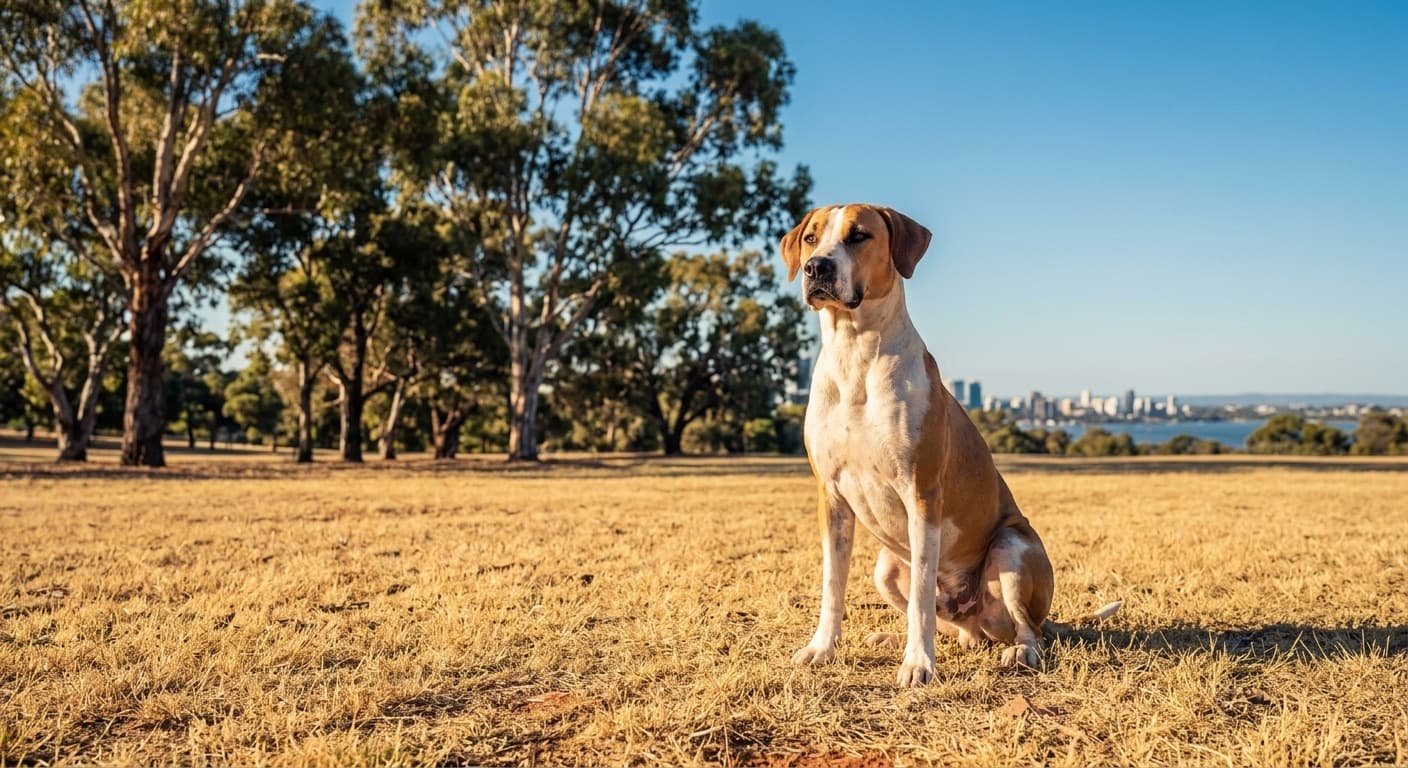
The short answer
The Bull Arab is a working crossbreed. No university or veterinary study we found gives a lifespan for the Bull Arab, so ask your vet what to plan for. The health picture is really about being a large, deep-chested, active dog: the one emergency to know cold is bloat, and the ongoing cautions are hip and elbow dysplasia, cruciate injury and weight. Because it is a mixed type, there is no formal breed health scheme, so screening depends on the individual dog and its parents. The short coat and normal muzzle help it cope with Perth's hot, dry summers, but exercise belongs in the cool hours, and a dog that chases things needs watching around snakes and baited bushland. Paralysis ticks are a low local risk in Perth. Adopt with eyes open and you have a sturdy companion.
Perth's real emergencies: heatstroke, bloat and snake bite
Three emergencies matter most for a big active Bull Arab in Perth, and all of them move fast. Heatstroke is the seasonal one: a high-drive dog will keep going past the point of sense, and on a hot Perth day that is genuinely dangerous. Warning signs are heavy panting that does not settle, bright red gums, thick drool, weakness, stumbling, vomiting or collapse. Move the dog into shade and cool it with room-temperature or cool water on the fur and skin, then get to a vet straight away, because the RSPCA Knowledgebase treats heatstroke as an emergency needing veterinary attention immediately. Bloat (gastric dilatation-volvulus) is the year-round one for this deep-chested build: a swollen or hard belly, unproductive retching and restlessness mean an immediate trip to an emergency hospital. Snake bite is the warm-months one: if your dog has been near a snake, or suddenly collapses, trembles, vomits or has dilated pupils after a bush or foreshore walk, keep it as still and calm as you can and go straight to an emergency vet. Do not wait to see if any of these settle. The RSPCA Australia summary at RSPCA on protecting pets from heat stress is worth keeping on your phone.
For 24/7 emergency care, Perth options include Animal Emergency Service (Cannington and Osborne Park), The Animal Hospital at Murdoch University, and WAVES (Success).
A working crossbreed
It is worth starting with what is known, and what is not. The Bull Arab was developed in Australia as a working dog from several breeds, rather than selected for extreme physical features. Even so, no university or veterinary study we found reports Bull Arab health or lifespan.
The flip side of that mixed heritage is that there is no formal breed health scheme for the Bull Arab, no registered parent-screening the way there is for a recognised purebred. So you cannot rely on a certificate: what matters is the individual dog, its parents where known, and a good baseline vet check after adoption. The health conversation for a Bull Arab is mostly the general large-active-dog conversation, not a long list of breed-specific conditions.
Bloat: the one emergency to know
If you learn one thing from this guide, make it the signs of bloat. Gastric dilatation-volvulus (GDV), commonly called bloat, is an emergency to know in a large dog, and Cornell University's College of Veterinary Medicine says large, deep-chested dogs are most at risk of bloat. The stomach fills with gas and can twist on itself, cutting off blood supply, and it becomes rapidly life-threatening without emergency surgery.
The signs to know are a swollen or hard belly, unproductive retching (trying to vomit but bringing nothing up), restlessness and pacing, excessive drooling, and obvious distress. If you see these, do not wait: treat it as an immediate emergency and get to a Perth 24/7 emergency hospital straight away, calling ahead so they are ready. As sensible precautions for a deep-chested dog, feed smaller meals rather than one large one, and avoid heavy exercise right before and after eating. Knowing the signs before you ever need them is one of the most life-saving things a Bull Arab owner can do.
Joints, cruciate, weight and the everyday checks
As a large, active dog, the Bull Arab can develop the joint issues common to big breeds. Hip and elbow dysplasia, where the joint forms improperly during growth and wears unevenly into arthritis, occur in large dogs including Bull Arabs, and an active working life adds wear over time. Because the breed is a crossbreed with no registered parent-screening, there is no dysplasia score to check the way there is for recognised purebreds. The other joint risk is the cranial cruciate ligament, the dog equivalent of a human ACL, which large athletic dogs tear during a sudden turn or hard stop.
Weight is the biggest lever you control, because every extra kilo loads the joints, so keeping a Bull Arab lean and well-muscled matters. Favour regular, sensible exercise over occasional hard bursts, and see your vet for stiffness, limping, a bunny-hopping gait, reluctance to move or difficulty rising. If serious orthopaedic care such as cruciate surgery is ever needed, a Perth specialist referral hospital is where advanced imaging and surgery happen, on referral from your GP vet.
The other everyday checks are ordinary. The short coat is low-maintenance, but watch for skin irritation, hot spots and allergies, especially through the warm months, and give a thin-coated dog shade from the strong WA sun. Check and clean the ears regularly, particularly for a dog that swims at the beach or river, and keep an eye on the eyes for redness or discharge. None of these are breed-specific, and most are easily managed when caught early.
Meet an adoptable Bull Arab in Perth
Rescue Bull Arabs usually arrive desexed, vaccinated and microchipped. Browse live listings from WA rescues.
See Available Bull Arabs →The Perth seasonal layer: heat, snakes and 1080, not ticks
Perth has a Mediterranean climate, with hot, dry summers and mild, wet winters, and for a Bull Arab the seasonal risk that matters most is heat. The breed copes better than flat-faced or heavy-coated dogs thanks to its normal muzzle and short coat, but it is still a large, high-drive dog that can overheat if worked hard on a hot day. On hot Perth summer days, the afternoon sea breeze does little for a dog already running hot. On those days, exercise in the cool of early morning or late evening, skip the middle of the day, carry water, test the footpath and the beach sand with the back of your hand before walking, and never leave a dog in a hot car or a shadeless yard. The mild, wet winter is the time to safely burn off this breed's considerable energy, and a run in a council-listed off-lead area, found through your council's dog exercise areas page such as the City of Stirling index, keeps a Bull Arab fit and lean.
Two WA hazards come with the warm months and with the bush. Snakes: The Town of Victoria Park says the dugite is the most common snake in the Perth region and is usually most active from early spring to early autumn (October to April), and the Town of Cottesloe advises keeping pets away from snakes (both read November 2026). A curious, chase-driven dog is exactly the dog that disturbs one, and a bite needs an emergency vet fast. 1080 baiting for foxes and feral cats runs across many WA reserves and bushland areas under the state Western Shield program, and DBCA says pet owners should "avoid taking domestic animals into areas managed for foxes or feral cats", and that areas it baits "should always be considered unsafe for domestic pets"; dogs are "highly susceptible" to 1080 (DBCA, read 16 November 2026), so a lead is not enough: check DBCA's map of 1080 poison risk areas and keep your dog out of them. A dog that finds a bait, or scavenges a poisoned carcass, can be fatally poisoned. Keep your Bull Arab out of baited areas, and see the DBCA 1080 baiting page before heading into the bush.
If you have read a Queensland or coastal NSW dog-health article, you will have seen paralysis ticks treated as a year-round, life-or-death threat. In Perth that framing does not apply. The RSPCA Knowledgebase says the paralysis tick is generally found on the eastern seaboard, from North Queensland down to Victoria, so a dog that lives and walks in Perth is at lower risk than a dog on the Queensland or NSW coast. The residual risk is about travel: if you take your Bull Arab east, ask your vet about tick prevention before the trip and do daily tick checks while you are there. Ask your vet about flea, worm and heartworm prevention suited to where you actually live and travel. For plain-language guidance, the RSPCA Knowledgebase is a reliable, non-commercial starting point.
Perth vet care: who handles what
Day-to-day care is any Perth GP vet. Take the dog in for an introductory check within a fortnight of adoption, and get a baseline weight, body-condition score and joint and ear check on the file from the start. A Bull Arab does not need a breed specialist for ordinary care. You will also register the dog with your local council under the Dog Act 1976, the WA law that requires a dog to be microchipped and registered from three months of age. Registration is done with your council at the statewide WA Government rate, with a much lower fee for a desexed dog, so check the current amount with your own council; the WA Government dog ownership hub sets out those responsibilities, and our Perth dog registration guide walks through the steps.
For emergencies and specialist referrals, Perth has several 24/7 emergency hospitals. Animal Emergency Service runs 24/7 hospitals at Cannington and Osborne Park, The Animal Hospital at Murdoch University runs a 24-hour emergency service alongside weekday referral care, and WAVES at Success provides 24/7 emergency care. Your GP vet refers you when a case, such as bloat surgery or cruciate repair, needs specialist input.
Budgeting and insurance
Routine yearly costs for a Bull Arab in Perth (food for a big dog, an annual check, dental care, parasite prevention, council registration) add up every year, so ask your vet for a written estimate, with food and any treatment costing more simply because it is a large dog. The potential big-ticket events, bloat surgery, orthopaedic care such as cruciate repair, and emergency treatment for a snake bite or poisoning, can each be expensive at an emergency or referral hospital.
That is the case for pet insurance with this breed: less about frequent claims and more about a buffer against the occasional large emergency. Enrol while the dog is young and healthy, before any issue becomes a pre-existing exclusion, and compare a few Australian providers on cover, annual limit and excess. For the full adoption picture and everyday life with the breed, see our companion guides, Bull Arab Adoption in Perth and the exercise and prey-drive detail in our Bull Arab exercise and prey drive guide.
Frequently Asked Questions
Are Bull Arabs a healthy breed?
There is little breed-specific research. The Bull Arab is an Australian working crossbreed rather than a narrowly standardised show dog, and no university or veterinary study we found reports its health or lifespan. So ask your vet what to plan for. The important caveat is that it is a large, deep-chested, active dog, so the cautions are the general large-breed ones: bloat, hip and elbow dysplasia, cruciate injury, and the wear that comes with size and activity, plus the skin and ear issues any dog can have. Because it is a mixed type with no formal breed health scheme, health depends on the individual dog and its parents rather than a certificate. A rescue Bull Arab usually arrives desexed, vaccinated and microchipped, and a lean, well-exercised dog with good routine care has the best odds.
What is bloat and are Bull Arabs at risk?
Bloat, or gastric dilatation-volvulus (GDV), is an emergency to know in a large dog, and Cornell University's College of Veterinary Medicine says large, deep-chested dogs are most at risk of bloat. The stomach fills with gas and can twist, cutting off blood flow, and it is rapidly life-threatening without emergency surgery. Signs include a swollen or hard belly, unproductive retching or trying to vomit without bringing anything up, restlessness, drooling and obvious distress. If you see these, treat it as an immediate emergency and get to a Perth 24/7 emergency hospital straight away. Feeding smaller meals rather than one large one, and avoiding heavy exercise right around mealtimes, are sensible precautions for a deep-chested dog.
Do Bull Arabs get hip and elbow dysplasia?
They can, as any large, active breed can. Hip and elbow dysplasia are developmental conditions where the joint forms improperly during growth, leading to uneven wear and arthritis over time, and an active working life adds to the joint load. Because the Bull Arab is a crossbreed with no formal parent-screening scheme, there is no dysplasia certificate to check the way there is for some registered purebreds. Keeping the dog lean is one of the most protective things you can do, since every extra kilo loads the joints. See your vet for stiffness, limping, a bunny-hopping gait or difficulty rising, and advanced imaging or orthopaedic surgery, if it ever comes to that, happens at a Perth specialist referral hospital.
What is a cruciate injury and are Bull Arabs prone to it?
The cranial cruciate ligament is the dog equivalent of the human ACL, and large, athletic dogs like Bull Arabs can tear it during a sudden turn, skid or hard stop, particularly when carrying extra weight. The signs are sudden hind-leg lameness and reluctance to bear weight on that leg. Complete tears often need surgical repair, which Perth specialist surgeons handle through the referral hospitals. Weight control and steady, regular exercise rather than occasional hard bursts are the practical ways to lower the risk in an active crossbreed.
What skin and ear issues should I watch for?
Nothing breed-specific and dramatic, but the usual dog checks apply. The short Bull Arab coat is low-maintenance, but skin allergies, hot spots and irritation can occur, especially through the long, warm Perth summer, so watch for itching, redness or hair loss. A pale-skinned or thin-coated dog can also burn on exposed skin in strong WA sun, so shade matters. Check and clean the ears regularly, particularly in a dog that swims at the beach or river, because moisture trapped in the ear canal leads to infections. Keep an eye on the eyes for redness, discharge or cloudiness. None of these are unique to the breed, and most are easily managed when caught early with routine care and a vet visit when something looks off.
How does a Bull Arab handle the Perth summer?
Better than a flat-faced or heavy-coated breed, because the Bull Arab has a normal muzzle and a short coat, but it is still a large, high-drive dog that can overheat if worked hard on a hot day, and Perth summers are long and dry. A high-drive dog will keep going past the point of sense, so the heat is the main seasonal danger. Exercise in the cool of early morning or late evening, skip the middle of hot days, provide constant shade and water, and test hot bitumen and beach sand with your hand before walking. Never leave any dog in a hot car or a shadeless yard. Heavy panting that will not settle, bright red gums, thick drool, weakness or collapse are signs of heatstroke; move the dog into shade and cool it with room-temperature or cool water on the fur and skin, then get to a vet straight away, because the RSPCA Knowledgebase treats heatstroke as an emergency needing veterinary attention immediately.
Do Bull Arabs in Perth need paralysis tick prevention?
For a dog living in Perth, the local paralysis-tick risk is low. The RSPCA Knowledgebase says the paralysis tick is generally found on the eastern seaboard, from North Queensland down to Victoria, so a dog that lives and walks in Perth is at lower risk than a dog on the Queensland or NSW coast. The time to think about it is travel: if you take your Bull Arab east, ask your vet about tick prevention before the trip and do daily tick checks while you are there, running your hands over the whole body and down to the skin through the short coat. Ask your vet about flea, worm and heartworm prevention suited to where you actually live and travel.
Should I get pet insurance for a Bull Arab?
It is worth considering, mainly because of the size rather than a long list of breed diseases. A large dog means larger bills when something does go wrong, and the big-ticket risks for this breed in WA, bloat surgery, joint or orthopaedic treatment such as cruciate repair, and emergency care for a snake bite or poisoning, can each be expensive at a Perth emergency or referral hospital. Enrol while the dog is young and healthy, before anything becomes a pre-existing exclusion, and compare a few Australian providers on chronic and hereditary cover, the annual limit and the excess. Insurance is less about frequent claims and more about a buffer against the occasional big emergency.
Does a rescue Bull Arab come with health checks?
Yes. A Bull Arab adopted through a WA rescue usually comes desexed, vaccinated and microchipped; Dogs' Refuge Home's fee also covers flea and worming and a behaviour assessment, and RSPCA WA gives you the dog's vet treatment history (read 16 November 2026). Treat the first month as a baseline: see your own vet, establish records, have the joints and general condition assessed, confirm the microchip is registered to you, set up parasite prevention suited to Perth, register the dog with your local council under the Dog Act 1976, and score body condition. From there, an annual check, a lean weight and awareness of the bloat, heatstroke and snake-bite signs cover most of what this crossbreed needs.
Keep reading
Bull Arab Adoption in Perth
Where to adopt, what it costs, and why this Australian working breed reaches WA rescue.
Bull Arab Exercise & Prey Drive in Perth
The exercise needs, the prey-drive reality, snakes and 1080, secure containment and socialising a working breed.
Adoptable Bull Arabs in Perth
Live listings of Bull Arabs and Bull Arab crosses, with filters for age, size and compatibility.
Perth Dog Adoption Resources
Every Perth guide in one place: adoption, registration, desexing, dog parks and breed care.