The short answer
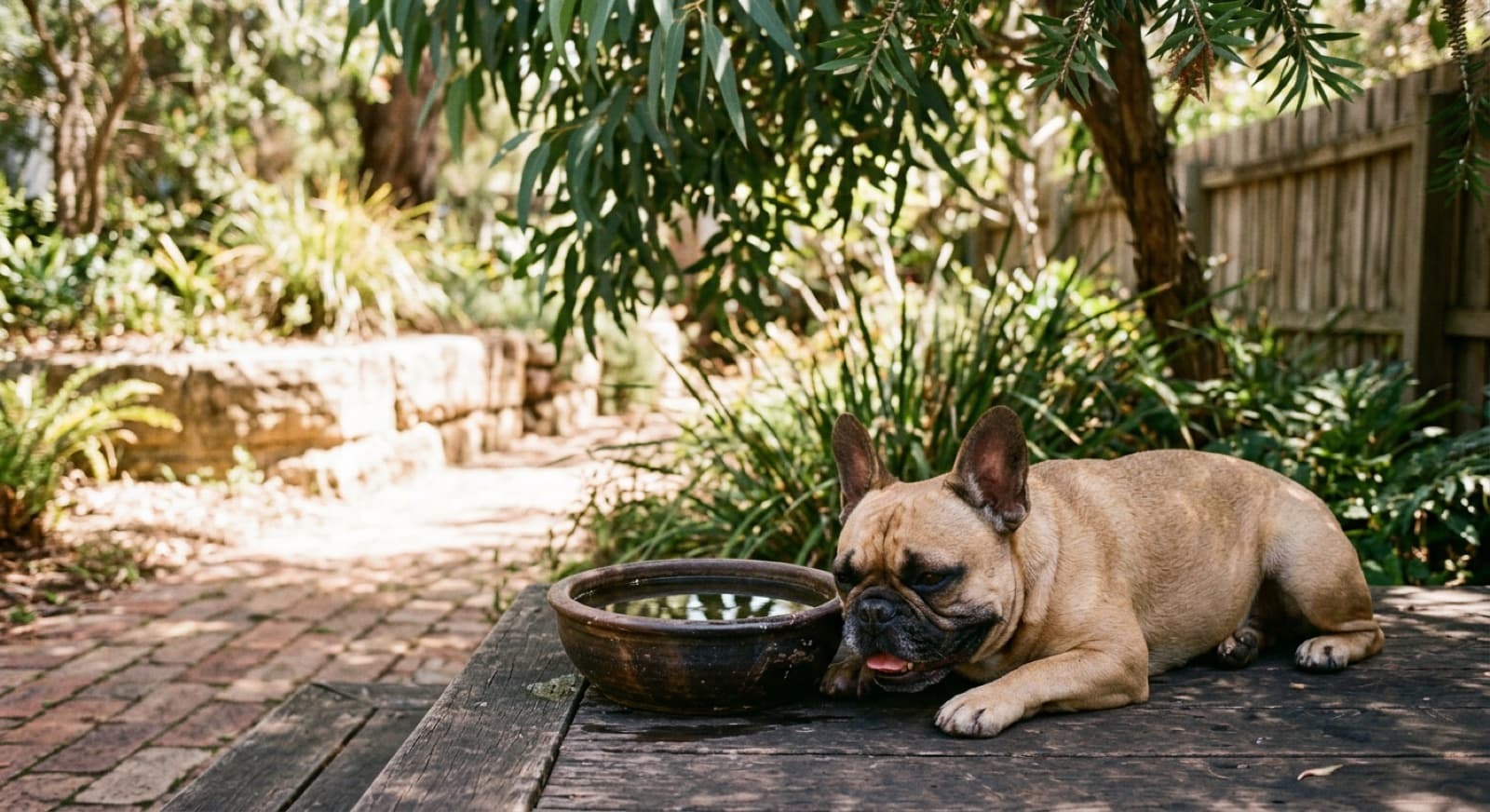
A French Bulldog's flat face means it cannot pant efficiently, so it overheats far faster than a normal dog and can die of heatstroke on a day another breed would tolerate. Keep a Frenchie safe in the Melbourne summer with strict rules: never exercise it in the heat (walk only in the cool of early morning or evening, or skip the walk on hot days), never leave it in a car even briefly, keep it in cool or air-conditioned space with constant water on hot days, and learn the heatstroke signs (frantic panting, drooling, a bright red or bluish tongue, distress, collapse) as an immediate emergency. Frenchies also cannot swim and drown easily, so never leave one unsupervised near water. This is general information, not veterinary advice.
Why a Frenchie cannot cool itself
Dogs do not sweat to cool down the way people do; they cool almost entirely by panting, moving air quickly over the moist surfaces of the mouth, tongue and airway so that heat sheds by evaporation. It is an effective system in a dog with a normal muzzle and a clear airway. A French Bulldog does not have that. Its compressed skull crowds the same soft tissue into a much smaller space, narrowing the airway, so it simply cannot move enough air to pant effectively.
The consequence is that on a warm day a Frenchie's body temperature rises while its main cooling system is barely coping, and it can climb to dangerous heatstroke levels remarkably fast. A day that a Kelpie or a Labrador would handle with a drink and some shade can be life-threatening for a Frenchie. This is not an exaggeration or an abundance of caution; brachycephalic breeds are genuinely over-represented in fatal heatstroke, and the Australian climate makes it a year-in, year-out risk.
The signs to act on immediately
Learn these, because minutes matter. Signs of heatstroke in a Frenchie include:
- Frantic, laboured or noisy panting that does not settle.
- Heavy drooling, often thick and ropey.
- A bright red, or worse a bluish or purple, tongue and gums. A bluish or purple colour (cyanosis) means the dog is not getting enough oxygen and is a dire emergency.
- Restlessness, distress, weakness or staggering, vomiting or diarrhoea, and in severe cases collapse or seizures.
If you see these, act at once: move the dog into shade or air conditioning, wet it with cool (not icy) water, concentrating on the belly, groin and paws, put a fan on it if you can, offer small amounts of water, and get to a vet urgently, phoning ahead so they are ready. Do not use ice-cold water, which can constrict blood vessels and slow cooling. Crucially, a dog can seem to recover and then deteriorate, and internal damage may not be visible, so a vet assessment is essential even if the dog perks up. The RSPCA Knowledgebase and the Australian Veterinary Association have first-aid guidance, but heatstroke is always a vet emergency.
The non-negotiable rules
- Never exercise a Frenchie in the heat. Walk only in the cool of the early morning or evening, and on a hot day skip the walk entirely, since the breed needs little exercise anyway.
- Never leave a Frenchie in a car, even for a minute, even with the windows down. Parked cars are one of the most common causes of fatal heatstroke, and a Frenchie has almost no margin.
- Provide cool space on hot days. Air conditioning is ideal; failing that, the coolest room in the house, tiles rather than carpet, a fan, a cooling mat, and water in more than one bowl.
- Watch Melbourne's forecast. Plan around heat spikes; a 35-degree day, or even a humid high-20s day with exertion, is a stay-inside day for a Frenchie.
- Use a harness, not a neck collar. Pressure on an already-compromised airway from a collar makes breathing harder; a well-fitted harness spreads the load.
- Keep the dog lean. Every extra kilo makes both the breathing and the heat tolerance worse.
Browse French Bulldogs available in Melbourne rescue
The right home for a Frenchie is one prepared for its heat and breathing needs. Live listings from Melbourne shelters and Victorian rescues, with foster carer notes on temperament and health.
See Available French Bulldogs →Water: a hidden danger
It surprises many new owners, but French Bulldogs cannot swim. They are top-heavy with a dense, muscular front end and short legs, and their flat face cannot stay above the waterline while they paddle, so a Frenchie that falls into a pool can drown very quickly. Never leave a Frenchie unsupervised near a swimming pool, dam, spa or any water it could fall into, keep pool areas securely fenced, and if a Frenchie is ever going to be in or near water, it should wear a well-fitted dog life jacket and be watched the entire time. Do not assume the dog will find its way out; most Frenchies cannot.
Everyday breathing care
Beyond the heat, a few habits keep a Frenchie's breathing as easy as possible. Keep the dog lean, because weight loads the airway. Avoid exertion and stress on warm or humid days, and give the dog quiet recovery time after any excitement. If your Frenchie breathes very noisily even at rest, tires quickly, or has episodes where it struggles to get air, that is a conversation for your vet, who can assess whether corrective airway surgery to widen the nostrils and shorten the soft palate would help; for many affected Frenchies it makes a real difference. The wider health picture, including the breathing anatomy behind all of this, is covered in the French Bulldog health guide.
None of this makes a Frenchie a bad choice; it makes it a specific one. A rescue French Bulldog in a home that understands the heat and breathing rules and follows them is a safe, happy, deeply loving companion. The rules are simply the price of the breed, and they are not optional.
Frequently Asked Questions
Why do French Bulldogs overheat so easily?
Because a dog cools itself mainly by panting, and a flat-faced dog cannot pant efficiently. Panting works by moving air quickly over the wet surfaces of the mouth and airway to shed heat by evaporation, but a French Bulldog's crowded, narrowed airway cannot move enough air to do this well. So on a warm day a Frenchie's temperature climbs while its main cooling system is barely keeping up, and it can reach dangerous heatstroke levels far faster than a normal-muzzled dog would. This is the single most important safety fact about the breed in the Australian climate.
What are the signs of heatstroke in a French Bulldog?
Frantic or laboured panting, heavy drooling, bright red or a bluish or purple tongue and gums, restlessness or distress, weakness, staggering, vomiting or diarrhoea, and in severe cases collapse. A bluish or purple tongue means the dog is not getting enough oxygen and is an immediate emergency. If you see the signs, move the dog to shade or air conditioning at once, wet it with cool (not icy) water especially on the belly and paws, offer small amounts of water, and get to a vet urgently, calling ahead. Heatstroke can be fatal and can worsen after the dog seems to recover, so a vet check is essential even if it perks up.
Can French Bulldogs swim?
No, and this is a genuine drowning hazard. French Bulldogs are top-heavy with a heavy front end and short legs, and their flat face means they cannot keep their nose and mouth above the water while paddling. A Frenchie that falls into a pool can drown quickly. Never leave a Frenchie unsupervised near a pool, dam or any water it could fall into, fence pool areas securely, and if a Frenchie is ever going to be around water, it must wear a well-fitted dog life jacket and be supervised the entire time. Do not assume a Frenchie can dog-paddle its way out; most cannot.
How should I exercise a French Bulldog in summer?
Gently, briefly, and only in the cool of the early morning or evening, never in the heat of the day. A Frenchie needs only modest exercise, so on a hot day it is completely fine, and far safer, to skip the walk entirely and provide indoor enrichment instead: a puzzle feeder, a snuffle mat, some training games, or a lick mat. Check the pavement with the back of your hand before any walk, because hot ground burns paws and radiates heat up at a low dog. If your Frenchie is struggling to breathe on a walk, stop, rest it in shade and cool it down; do not push a brachycephalic dog through exertion.
Can I leave a French Bulldog in the car for a few minutes?
Never, not even for a minute, not even with the windows cracked. A parked car heats up astonishingly fast, and a Frenchie, which already cannot cool itself well, will succumb to heatstroke faster than almost any other dog. Cars are one of the most common causes of fatal heatstroke in dogs, and for a brachycephalic breed the margin for error is close to zero. If you cannot take the dog with you out of the car, leave it safely at home instead.
Keep reading
French Bulldog Health Issues
The breathing, spinal, skin and eye picture, and the vet budget.
French Bulldog Adoption in Melbourne
Where to find a rescue Frenchie, real costs vs a breeder, and what to expect.
Adoptable French Bulldogs in Melbourne
Live listings with foster carer notes on temperament and health needs.
Melbourne Adoption Resources
Guides on adopting, costs, council rules and settling a rescue dog in Melbourne.