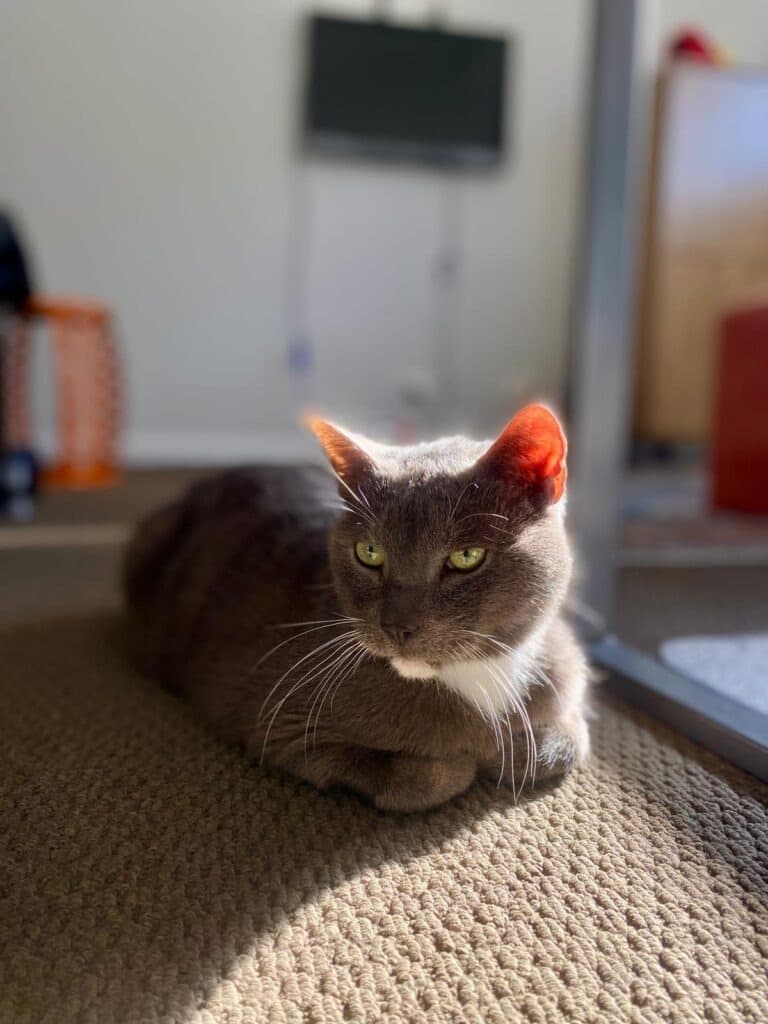
Prince Henry
13 years 3 months • Russian Blue
Get notified about new cats in Melbourne
We will email you when new rescue cats become available in Melbourne, so you can be among the first to meet them.
The straight answer first: there is no such thing as a hypoallergenic cat. The Australasian Society of Clinical Immunology and Allergy (ASCIA) puts it plainly: because all cats have sebaceous glands, all cat breeds can cause allergies. The main cat allergen is a sticky substance from glands in the skin that clings to dander, dust and the whole home, and every cat makes it.
What does vary is the individual cat. Some people with mild allergies find they react less to one cat than another, and some breeds, such as the Sphynx, Russian Blue, Siberian, Devon Rex and Cornish Rex, have a reputation among allergy sufferers. The cats below come from those breeds, so treat this page as a shortlist of cats worth meeting, not a promise that any of them is safe for you.
The only reliable test is time with the specific cat, in person, before you commit. If your allergies are more than mild, or you have asthma, talk to your doctor first.
What actually causes cat allergies
Most people assume cat allergies come from fur. They do not. ASCIA describes the main cat allergen as a sticky substance made by sebaceous glands in the cat's skin, which glues itself to dander (tiny flecks of skin), dust and every surface in the home. When a cat grooms, it spreads more of it around.
That is why coat length is a poor guide. A long-haired cat is not automatically worse, and a hairless Sphynx is not automatically safe: it still has skin, still makes the allergen, and without a coat that allergen transfers straight onto skin and furniture, which is one reason the breed needs regular baths.
It is also why a breed label cannot promise anything. How much allergen a cat spreads varies from one cat to the next, so two cats of the same breed can affect the same person very differently.
Why some breeds have a reputation
People with allergies often ask about the Sphynx, Russian Blue, Siberian, Balinese, Oriental Shorthair, Devon Rex and Cornish Rex. Some of that reputation comes from coat: the Rex breeds have fine, sparse coats that shed little, so less loose hair and dander is spread around the house. Some of it is owners reporting that they personally react less.
Those reports are real experiences, but they are not a guarantee, and they are no substitute for testing your own reaction. Treat the breed as a reason to meet a cat, then let your reaction to that individual cat decide.
These breeds turn up in rescue as pedigrees and, more often, as crosses, so you do not need a breeder to meet one. A rescue cat comes desexed, vaccinated, microchipped and vet-checked, and its foster carer can tell you how much it sheds and how it handles being groomed.
Testing your reaction before you adopt
Spend real time with the specific cat before you commit. Visit it at the rescue or in its foster home, and plan to stay a while rather than giving it a quick pat. Pat and hold the cat, let it rub against your hands, and sit in the same room breathing the same air.
Reactions do not always show straight away, so if the first visit goes well, ask whether a second visit is possible. Many rescues understand the allergy question and will work with you, because a placement that fails over allergies is hard on everyone, the cat most of all.
Be honest about the result. If you react noticeably, it is far kinder to walk away before adopting than to bring a cat home and have to return it.
Reducing allergen in your home
Even with a cat you tolerate well, a few household habits make a real difference. A HEPA air purifier in the rooms you use most, especially the bedroom, captures some of the airborne allergen. Keeping the bedroom cat-free gives you one lower-allergen space to retreat to.
Routine cleaning matters more than any single product. Wash the cat's bedding regularly, vacuum with a HEPA-filter vacuum, and choose easy-clean surfaces and washable covers where you can, since soft furnishings hold on to allergen.
Regular grooming, ideally by someone in the household who is not allergic, removes loose dander before it spreads. Some cat foods are designed to reduce allergen in a cat's saliva; ask your vet whether one is suitable before switching, and treat it as one part of a plan, not a cure.
Living with a cat when you have allergies
Plenty of people with mild cat allergies share their homes with cats happily, so an allergy is not automatically the end of the idea. What works is a realistic plan: a cat you have tested your reaction to, plus cleaning, filtration and grooming habits that you keep up rather than doing once.
Keep an eye on how your symptoms track over time. If they get worse or start to interfere with daily life, that is a conversation for your doctor, who can advise on treatment and whether living with a cat remains sensible for you.
Otherwise a cat chosen with allergies in mind costs the same as any rescue cat. The adoption fee, typically $150 to $250 for an adult, still covers desexing, vaccination, microchipping and a FIV check.
Source: Australasian Society of Clinical Immunology and Allergy (ASCIA): Pet allergy.
What "hypoallergenic" really means for a Melbourne adopter
No cat is truly hypoallergenic. The main feline allergen, Fel d 1, is carried in saliva and skin secretions and spreads through the coat during grooming, so every cat produces some. Certain breeds and individuals shed less allergen than others, but reactions vary enormously from person to person, and a coat length has less to do with it than people assume. Treat any "allergy-friendly" label as directional, not a guarantee.
The honest test is time spent with the actual cat. Melbourne shelters such as RSPCA Victoria and Lort Smith run meet-and-greet visits, which are far more informative than a breed label when you or a family member has allergies. If anyone in the household has significant asthma or allergy history, talk to your GP or an allergist before adopting.
Finding lower-allergen cats through rescue
You do not need to buy from a breeder to find a cat that suits an allergy-sensitive home. Rescues take in cats of every type, including breeds and mixes reputed to shed less allergen, and foster-based groups such as Second Chance Animal Rescue can tell you how a specific cat behaves in a real household. Ask carers directly whether visitors with allergies have reacted around the cat.
Adopting also comes with the standard Melbourne inclusions: an adult cat fee of $145 to $400 covers desexing, vaccination, microchipping, and an FIV check. If you buy or rehome privately instead, remember the Pet Exchange Register rule that every cat advertisement must display a microchip number and a PER source number.
Managing allergens once the cat is home
Practical measures do more than breed choice. Regular brushing to remove loose hair and dander, keeping the cat out of bedrooms, frequent washing of bedding, and a good vacuum all reduce the allergen load in a Melbourne home. Wiping the coat with a damp cloth between grooms can help too. For guidance grounded in evidence rather than marketing, the RSPCA Knowledgebase is a sound starting point, and your local vet can advise on the individual cat.
Hypoallergenic Cat FAQ
Tap a question to expand