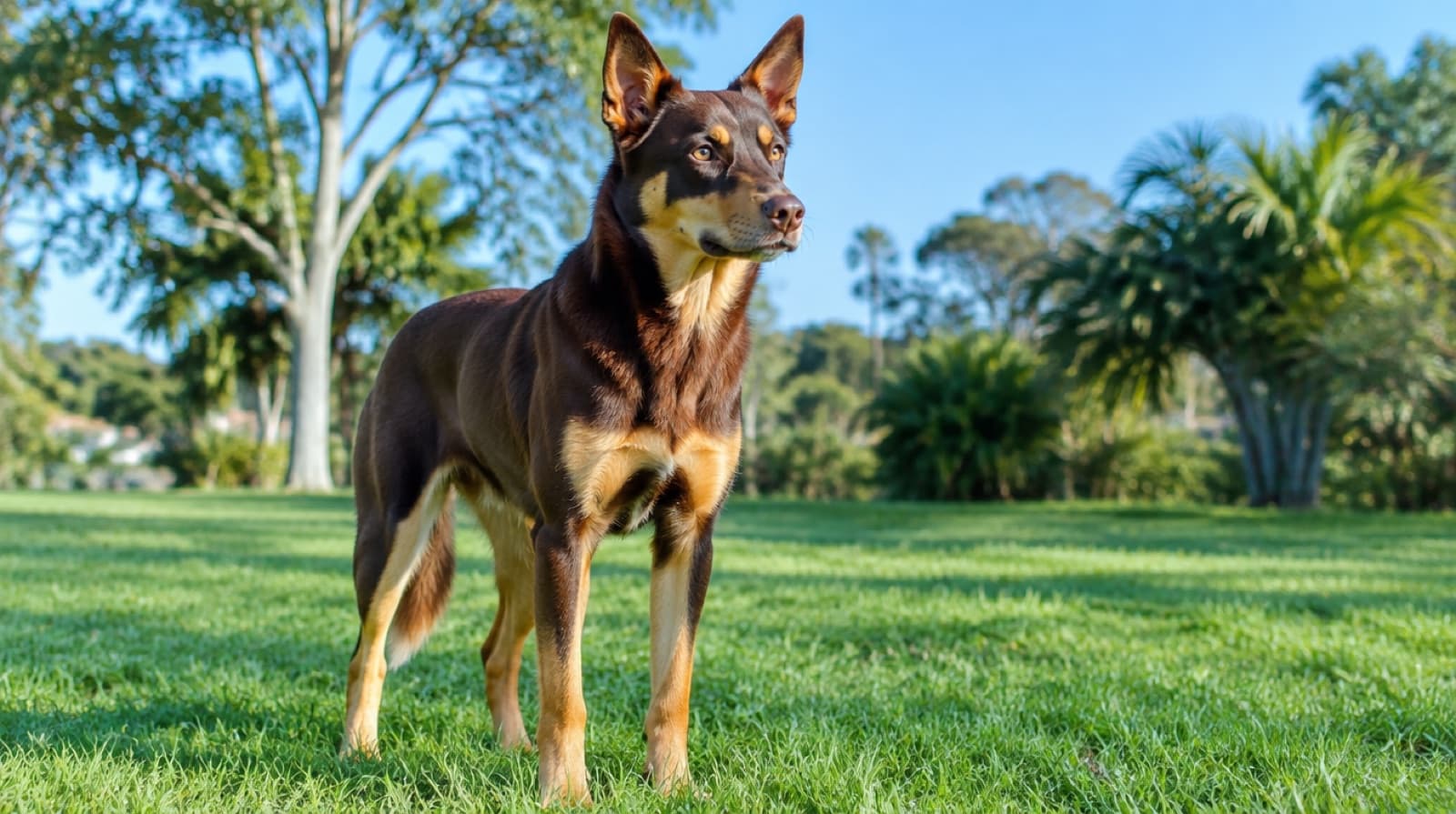
The short answer
Kelpies appear in Hobart rescue regularly through the Dogs' Homes of Tasmania at Risdon Vale and the state's foster-based rescues. An adult Kelpie costs $450 to adopt from the Dogs' Homes of Tasmania ($550 for a puppy) with the vet work done, against anything from a few hundred dollars for a farm-bred pup to several thousand for show lines from a breeder. Most rescue Kelpies are 1 to 4 year-old working-line dogs or crosses, surrendered because their drive was underestimated or a rural family moved into town. The breed is the highest-drive of the major Australian working dogs and one of the most demanding pet dogs to own. A Hobart suburb works only with serious commitment to exercise, mental work and escape-proof fencing, in every kind of weather. Flats almost never work for young Kelpies. Ask a Hobart vet whether tick prevention is needed where you walk, and pet insurance is genuinely worth it.
Why so many Kelpies are in Tasmanian rescue
Kelpies were developed in 19th-century Australia to muster sheep across vast properties in harsh conditions. The breed combines stamina with intelligence, independent decision-making and athletic ability. Modern working Kelpies are still bred mostly on rural properties for stock work, and Tasmania has no shortage of those; show-line ANKC Kelpies are a smaller separate population bred for conformation. Both end up in rescue more often than the breed's passionate following would suggest.
Energy and drive underestimation (the most common reason).
The Kelpie's working drive surprises new owners more than any other Australian breed. A nine-month-old Kelpie has the energy of a full-time stock dog with adult-sized capability and adolescent self-control. Families who bought a Kelpie expecting “a smart, loyal Aussie dog” without researching the working-drive reality often surrender within the first year. The dog matures into a slightly calmer adult by 3 to 4 years, but the energy and drive stay substantial for life.
Farm-to-town moves.
A meaningful share of Tasmanian rescue Kelpies come from rural working homes that relocate to Hobart or Launceston. The working dog cannot adapt to suburban life without a substantial new outlet, so the family rehomes or surrenders. These dogs are often well-started on stock and need experienced, active adopters or dog-sport homes. Foster-based rescues are usually best placed to match them.
Escape and destructive behaviour.
Under-stimulated Kelpies escape, dig and destroy. Many arrive at the Dogs' Home as strays after repeated escape attempts, the original owner is contacted, and the family often surrenders rather than retrieve a dog they can no longer manage. This stray-to-rescue pipeline accounts for a real share of rescue Kelpies.
The destructive adolescent phase.
Kelpies without adequate exercise plus mental work plus job structure become destructive in adolescence (6 to 24 months). The breed's intensity means the behaviour is often more pronounced than in other working breeds. Families that get through it end up with extraordinary adult dogs; many do not.
Working line vs ANKC show line
Two distinct registries and breeding lineages sit behind the one breed name.
Working Kelpies.
Registered with the Working Kelpie Council of Australia. Bred and selected on stock-work ability rather than appearance. They tend to be leaner, longer-legged and more varied in colour (black, red, blue, cream, tan, chocolate, sometimes with white markings). Energy and drive sit at the highest end of the breed range. Most rural working dogs in Australia are working-line, and in Tasmanian rescue, working-line Kelpies and crosses dominate the intake.
ANKC Kelpies.
Registered with the Australian National Kennel Council. Bred for the show ring and selected on the conformation standard, with a narrower colour range (black, red, blue, fawn, black-and-tan, chocolate). Slightly stockier and slightly calmer overall, though still high-energy. Less common in Tasmanian rescue than working-line dogs.
The two registries operate separately, and the breeding pools have not been formally crossed for decades. For an adopter the distinction matters in one practical way: working-line Kelpies need more outlet than ANKC dogs. Many rescue Kelpies are crosses, often Kelpie x Border Collie, Kelpie x Cattle Dog or Kelpie x Staffy. A cross often dilutes the working drive somewhat, and the foster or shelter notes describe individual energy and temperament far better than any breed-type label.
Where to actually look in Hobart
- Dogs' Homes of Tasmania. The Hobart Dogs' Home at Risdon Vale is the city's shelter, run by a registered charity that takes no State Government funding and also runs homes at Launceston, Devonport and Burnie. Kelpies and Kelpie crosses come through regularly, and every dog is temperament tested, health checked, desexed, vaccinated, microchipped and treated for fleas and worms before it is offered. Adoptions are by appointment, seven days, and you view all the available dogs rather than reserving one, so bring the whole household, including an existing dog, if you plan to adopt that day. Renters need a letter from the landlord, and a home that already has two dogs needs a council kennel licence first. Listings at dhot.com.au.
- RSPCA Tasmania. The state body has no adoption centre in or near Hobart (its only care centre is at Devonport), but it lists adoptable animals from across the state online, and working breeds appear there. Browse via rspcatas.org.au.
- Foster-based working-breed rescues. Tasmania's smaller volunteer rescues place dogs in foster homes and run slower, more matched processes, which is particularly useful for a high-drive breed. A foster carer who has lived with the dog for weeks can tell you exactly how it copes with confinement, other pets and being left alone, which is the single most useful thing to know before you commit to a Kelpie.
- Council pounds. Stray and surrendered dogs from the City of Hobart and the surrounding councils end up at the Dogs' Home, which also reunites strays with their families, and a fair few of those strays are Kelpies picked up after an escape, so the Risdon Vale listings are the practical place to watch.
The honest cost comparison
Real first-year costs in Hobart:
| First-year cost | Rescue Kelpie | Breeder Kelpie |
|---|---|---|
| Adoption fee or purchase price | $450 adult or $550 puppy at the Dogs' Homes of Tasmania | A few hundred dollars for farm stock to several thousand for show lines |
| Desexing | Included | $350 to $600 |
| Microchipping | Included | Paid separately |
| First-year vaccinations | Included | $150 to $250 |
| Initial vet check | Included | $100 to $200 |
| Council registration (reduced fee if desexed and microchipped) | Set by your council (much cheaper for a desexed dog) | Set by your council (much cheaper for a desexed dog) |
| Year 1 food (medium breed) | $700 to a little over a thousand | $700 to a little over a thousand |
| Parasite prevention (flea, worm, heartworm, tick where your vet advises) | $350 to $600 | $350 to $600 |
| Initial gear (bed, lead, long line, crate, bowls, harness, winter coat) | $300 to $500 | $300 to $500 |
| Escape-proof fencing upgrade if needed | $500 to $3,000 | $500 to $3,000 |
| Reward-based training class | $200 to $400 | $200 to $400 |
| Pet insurance (recommended) | From $800, more for a high-cover policy | From $800, more for a high-cover policy |
| Year 1 total (excluding council fee) | The adoption fee plus the everyday costs above | Several thousand dollars more, with the vet work still to pay |
The fencing line is the largest variable. Plenty of older Hobart yards need at least gate-latch upgrades, and many need height extensions, dig prevention or a rotten paling or two replaced to be Kelpie-secure. Pet insurance is genuinely worth it for a hard-exercising working dog. Budget the fencing before you adopt rather than after the first escape. The breed's health picture is in our national Kelpie breed guide.
Browse Kelpies available in Hobart rescue
Live listings from Hobart shelters and Tasmanian rescues. Foster carer notes describe each dog's drive level and household fit before you apply.
See Available Kelpies →What to expect from a rescue Kelpie
A typical Hobart rescue Kelpie is:
- 1 to 4 years old. Adolescents (1 to 2) are the most common bracket from energy-underestimation surrenders.
- 14 to 22 kg adult weight. Working Kelpies tend to the leaner end (14 to 18 kg); ANKC dogs and crosses can be larger.
- Mostly house-trained, sometimes needing a refresh for the new home routine.
- Lead-trained with variable manners. Many adolescent Kelpies pull strongly or are reactive to other dogs; reward-based training fixes most of this within months.
- Extremely high drive that needs a serious outlet. The defining trait. Even calmer rescue Kelpies need more exercise plus mental work than almost any other breed.
- Sometimes anxious or reactive. Kelpies are sensitive dogs; harsh handling in a first home produces wary or reactive adolescents who need patient rebuilding.
- Strong bond potential. Kelpies bond hard to their family and chosen handler once settled, one of the deepest bonds you can build with a dog.
- Escape-artist tendency. Most rescue Kelpies have a track record of escape attempts in a previous home. Plan for it from day one.
The first month is intense as the dog decompresses and tests the new environment. The 3-3-3 rule applies: three days to decompress, three weeks to start showing personality, three months to fully settle.
The first week home: a realistic plan
Day 1:
- Bring the dog home during daylight hours, and Kelpie-proof first: nothing chewable in reach, the fence line inspected and reinforced, gates latched, a warm dry bed out of the draught
- Keep the dog on lead in the yard for the first 24 hours while you assess escape risks
- Skip introductions to extended family and other dogs for now
- A short, quiet walk once the dog has had a look around, and a towel at the door if it is raining
Days 2 to 3:
- Two walks daily, 30 to 45 minutes each, whatever the weather is doing, and dry the dog off afterwards
- Begin reward-based training (name response, sit, recall on lead)
- Introduce mental work with a puzzle feeder at mealtimes
- Keep up close yard supervision; do not leave a new Kelpie alone in the yard for at least the first week
Days 4 to 7:
- Longer walks; some off-lead time at the fenced John Turnbull Dog Park at Lenah Valley
- First vet visit for a baseline weight and joint check, and a flea, worm and tick prevention plan suited to Hobart
- Start building short alone-time periods; Kelpies are prone to separation distress in a new home
- Sketch out a “job” plan (a dog-sport class, structured outings, a training program)
Kelpies and Hobart living
- House and yard. A Kelpie strongly benefits from a securely fenced yard of decent size and a dry indoor space to come in to. Flats without a yard almost never work for young Kelpies. Plenty of Hobart homes are rented, and older weatherboard houses with small yards are the norm, so a small yard can work if the owner commits to serious off-property exercise. If you rent, get the landlord's permission in writing before you apply, because the Dogs' Home asks for the letter.
- Fencing. The single most important consideration. Kelpies are escape artists, so 1.8 metre fencing with no climbable features and secure gates is the realistic standard, and the older timber fences on many Hobart blocks need checking for gaps and rot before the dog comes home.
- Off-leash areas. The City of Hobart lists every off-lead park and beach, and the hours that apply, on its dog exercise areas page, and the fenced John Turnbull Dog Park at Lenah Valley is the safe place to let a Kelpie run loose. Beaches are off-lead only in the evening and early morning, and most bushland reserves are on-lead on managed tracks, so check before you go.
- Dog sports. Agility, scent work, flyball, herding clinics and obedience all suit Kelpies, and the breed excels at every one. Joining a club gives the dog a serious outlet plus a structured social environment, which matters more for this breed than for almost any other.
- Bushwalking and water. Hobart sits between kunanyi and the Derwent, and a Kelpie's endurance makes it a natural companion on the mountain tracks, but kunanyi and Wellington Park have their own rules and most bushland reserves are on-lead on managed tracks, so the off-lead running happens at the dog park rather than in the bush. A swim is a fine outlet on a mild day. Dry the dog off after a wet outing, and ask a Hobart vet whether tick prevention is needed where you walk.
Hobart weather, wet coats and where you can run a Kelpie
Hobart is where this guide parts company with a mainland one. The year-round heat and tick emergency that shapes a mainland Kelpie's life does not apply in a cool temperate city, and a Kelpie, bred to work through frost and rain on a property, is close to its element here. What Hobart asks of you is different.
Cold, wet and dark. Winters are cold and wet, with frosts in the suburbs and snow on kunanyi, and the walking hours shrink. A fit working-bred Kelpie shrugs off the cold as long as it is moving, but a wet dog left to dry in a cold yard is a miserable one, so towel the coat off after a wet walk and give the dog a dry bed inside. A thin, old or very short-coated Kelpie will appreciate a coat on a frosty morning. The real winter risk for this breed is not the weather itself but the temptation to skip the exercise because of it; a Kelpie that misses a week of real work in July finds its own entertainment. Summers are mild, with the odd hot day and strong sun, so the usual shade-and-water sense applies without the mainland urgency.
Ticks and parasites. The paralysis tick that dominates mainland east-coast dog care is a coastal mainland species, and Tasmania's tick risk is lower, but it is not zero in every part of the state, so ask a Hobart vet whether tick prevention is needed for the places you walk, especially if the dog works long grass and bush. Fleas and intestinal worms still need year-round cover, and the RSPCA Knowledgebase has sound general guidance on both.
Where you can walk. The City of Hobart publishes the full list of off-lead, on-lead, restricted and prohibited areas on its dog exercise areas page. John Turnbull Dog Park at Lenah Valley is fenced, with a smaller section for small or nervous dogs, and parts of the Queens Domain, Wellesley Park and Short Beach are off-lead too. Beaches run on a clock: off-lead in the evening and early morning, on-lead in the middle of the day, with the hours changing between daylight saving and winter. Most bushland reserves are on-lead on managed tracks only, and kunanyi and Wellington Park have their own rules. If something goes wrong after hours, Animal Emergency Service at Moonah runs after hours on weekdays and around the clock at weekends, so know the route before you need it.
Registering your Kelpie in Hobart, and avoiding scams
Tasmania's dog law is the Dog Control Act 2000. A dog must be registered with your council by six months of age and microchipped from six months (the government has proposed bringing the microchip age down to 12 weeks, so check the current rule), and you must tell the council within 14 days if the dog changes hands, moves or dies. Each council sets its own fee, and a desexed dog pays a fraction of the entire-dog rate, so a rescue Kelpie, already desexed and microchipped, registers at the low end. The current City of Hobart table is on the council site. Restricted breeds under the Act are the dogo Argentino, fila Brasileiro, Japanese tosa, pit bull terrier types and the Presa Canario; the Kelpie is not on the list, so there is no permit or restriction attached to the breed itself.
On scams, Tasmania has no breeder register of the kind some mainland states run, so there is no source number to look a seller up against. That makes the old rules matter more: see the puppy with its mother at the seller's property, get the microchip number and vaccination record in writing, and never pay a deposit or a transport fee for a dog you have not met, least of all for a puppy supposedly on the mainland that needs a ferry or a flight. A cheap or free Kelpie on Gumtree or Facebook with a story is the classic setup the ACCC's Scamwatch warns about. Adopting through the Dogs' Home or a verified Tasmanian rescue avoids the problem entirely.
Frequently Asked Questions
Can you actually find a Kelpie in Hobart rescue?
Yes, regularly. Kelpies and Kelpie crosses are one of the more common working-breed surrenders in Tasmania, a state where a great many dogs still start life on a farm. They come through the Hobart Dogs' Home at Risdon Vale, run by the Dogs' Homes of Tasmania, through foster-based Tasmanian rescues, and occasionally through RSPCA Tasmania's state-wide listings. Most are adolescents and young adults, roughly 1 to 4 years, surrendered because their working drive was underestimated or because a rural family moved into town. A settled older Kelpie is the easier dog for most homes.
What is the difference between a working Kelpie and an ANKC Kelpie?
Two separate registries and lineages. Working Kelpies are bred for stock work and registered with the Working Kelpie Council of Australia, selected on stock-work ability rather than appearance, so they tend to be leaner, longer-legged and more varied in colour. ANKC (Australian National Kennel Council) Kelpies are bred for the show ring, selected on the conformation standard, with a narrower colour range and a slightly stockier build. Both share the same baseline drive, but working lines sit at the higher end. In Tasmanian rescue, working-line Kelpies and crosses are far more common than ANKC dogs.
How much does it cost to adopt a Kelpie in Hobart?
The Dogs' Homes of Tasmania charge $450 for an adult dog and $550 for a puppy of six months or under, with desexing, vaccination, microchipping, flea and worm treatment, a health check and a behaviour assessment already included. Foster-based rescues set their own fee and show it on each listing. A breeder Kelpie pup costs anything from a few hundred dollars for working stock at a farm gate to several thousand for show lines, before any of that vet work. On top of the adoption fee you pay council registration, which is a fraction of the entire-dog rate for a desexed dog, so a rescue Kelpie registers at the low end. The adopted dog usually arrives with an assessed temperament and often some training already in place.
Are Kelpies good apartment dogs in Hobart?
Almost never for a young Kelpie. The breed is the highest-drive of the major Australian working dogs and needs a genuinely serious daily outlet: 90 minutes or more of physical exercise, 30 minutes of mental work, ideally a job. A confined flat with no yard produces destruction and escape attempts, and a Hobart winter adds a second problem, because short daylight hours and wet weather tempt owners to skip the exercise a Kelpie cannot do without. Older settled Kelpies (8 and up) with very committed owners can sometimes work, but a young Kelpie in a Hobart flat is usually a setup for surrender.
Why do Kelpies have a reputation as escape artists?
Because they earn it. Working Kelpies were bred to find their way through and over difficult country following stock, and that translates to jumping, climbing and digging ability that surprises new owners. A 1.5 metre fence is not enough; many Kelpies clear it easily. The realistic standard is 1.8 metres or more with no climbable features and secure gates the dog cannot lift, and the older timber fences on many Hobart blocks need checking for gaps and rot. Budget the fencing before you adopt rather than after the first escape.
Are Kelpies good for first-time owners?
Almost never. The breed combines very high drive with high intelligence, a sensitive temperament and escape-artist tendencies, and first-time owners usually lack the experience to read early signs of under-stimulation or to set the home up correctly. If you are new to dogs and set on a Kelpie, look at an older, calmer dog from rescue rather than a young working-line one, commit to reward-based training from week one, and budget the time for daily real exercise plus mental work, whatever the Hobart weather is doing.
How can I tell if a Kelpie advertised online is a scam?
Tasmania has no breeder register of the kind some mainland states run, so there is no source number to check. Rely on the basics instead: see the puppy with its mother at the seller's property, get the microchip number and vaccination record in writing, and never pay a deposit or a transport fee for a dog you have not met, least of all a puppy supposedly on the mainland that needs a ferry or a flight. A cheap or free Kelpie on Gumtree or Facebook with a story is the classic setup Scamwatch warns about. Adopting through the Dogs' Home or a verified Tasmanian rescue avoids the problem entirely.
Keep reading
Adoptable Kelpies in Hobart
Live listings with foster carer notes on drive and family fit.
Kelpie Breed Guide
The breed guide: cerebellar abiotrophy, hip dysplasia, eye conditions, and what a working dog needs day to day.
Best Family Dogs in Hobart
The family-friendly rescue dogs available across Hobart right now, settled older Kelpies among them.
Hobart Adoption Resources
Guides on adopting, costs, council rules and settling a rescue dog in Hobart.