The short answer
Purebred Russian Blues almost never appear in Adelaide rescue. Nearly every cat we list from South Australian rescues is a domestic short-hair or long-hair. So set an alert, stay open to a plush grey Russian-Blue-type cross, and apply fast when one appears. Adoption costs a fraction of a breeder price, and the cat arrives already desexed, vaccinated and microchipped, which the Dog and Cat Management Act 1995 requires anyway. If you buy instead, ask for the microchip number first. Either way, a Russian Blue is a quiet, gentle, reserved cat that suits a calm home and indoor life beautifully.
What a Russian Blue is
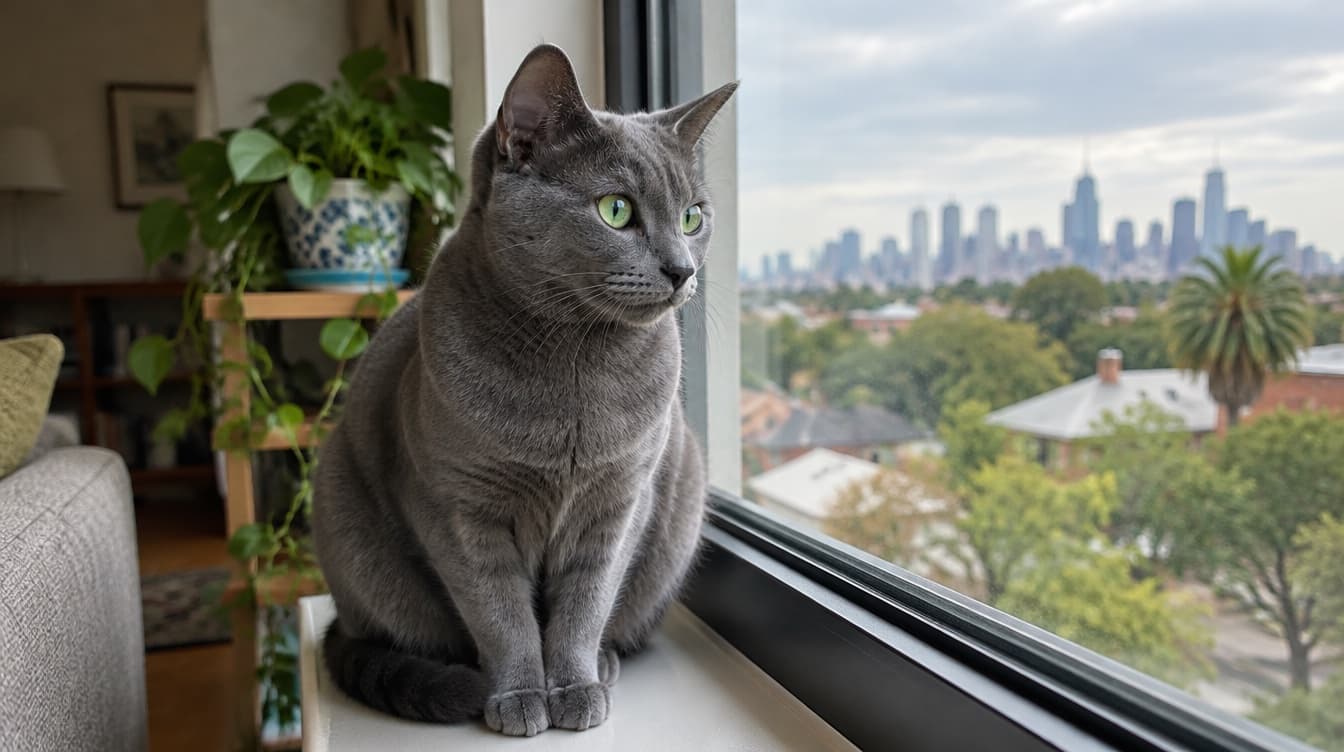
The Russian Blue is an elegant, fine-boned, medium-sized cat best known for its short, dense, plush double coat in an even blue-grey with a silvery sheen, and its vivid green eyes. The coat stands out from the body rather than lying flat, which gives the breed its distinctive soft, velvety look. It is a graceful, quietly athletic cat, more poised than boisterous.
Temperament is gentle and reserved. Russian Blues are typically quiet, calm cats that bond deeply with their own people but are shy and cautious with strangers, often retreating when visitors arrive. They dislike noise and upheaval and prefer a settled, predictable routine, which makes them devoted companions for a quieter household. They are intelligent and playful with the people they trust, but they are not demanding or loud, and they are content with a calm indoor life.
What Adelaide rescue listings actually show
LocalPetFinder pulls cat listings from South Australian rescues into one place, so we can see what is genuinely available rather than guessing. The picture is consistent. Nearly every cat listed is a domestic short-hair or domestic long-hair, and a purebred Russian Blue almost never appears. That is not a gap in our coverage. It is what Adelaide rescue looks like.
This matters for how you search. If you hold out for a papered Russian Blue through rescue, you may wait a very long time. If you widen the search to plush grey and blue domestics and crosses, you will see suitable cats regularly. Many grey domestic short-hairs have the quiet, gentle, affectionate nature people love in a Russian Blue. If the low-allergen reputation is part of the appeal, read our guide to lower-allergen cats in Adelaide, and set an alert so you hear about a match the day it is listed.
Shelter breed labels are also best guesses. A plush grey cat with green eyes may be listed as a Russian Blue cross, a British Shorthair cross, or simply a grey domestic short-hair. Judge the individual cat, its temperament and its coat, rather than the word on the listing.
How Russian Blues end up in rescue
A Russian Blue is a deliberate purchase, which is the main reason so few reach shelters. When one does, the reasons tend to repeat:
- Life changes. A move to a rental that will not take pets, a new baby, an allergy, a relationship breakdown, or an owner who becomes unwell or passes away.
- A mismatch of household. A shy, noise-averse cat placed in a loud, chaotic or very busy home can withdraw and stress, and some owners decide a calmer home would suit it better.
- Underestimated shyness. Owners wanting an outgoing, lap-on-demand cat are sometimes surprised by how reserved the breed is with strangers, though it is devoted once it trusts you.
None of these are the cat's fault. A gentle, already-vetted adult Russian Blue or cross placed in a calm, patient home is often the easiest cat in the shelter to settle, once it has had time to trust you.
Where to adopt a Russian Blue or blue-grey cross in Adelaide
There is no Russian-Blue-only rescue we can verify in South Australia, so the plan is to watch the general cat rescues and act quickly. These are the main groups rehoming cats around Adelaide:
| Rescue | Good to know |
|---|---|
| RSPCA South Australia | The state body, with a steady flow of adult cats and kittens, all desexed, vaccinated and microchipped. |
| Animal Welfare League SA | A large South Australian shelter rehoming many cats each year, with a long-running foster network. |
| Paws and Claws Adoptions | A foster-based Adelaide rescue, so listings often come with detailed notes on how shy or confident the cat is. |
Many of these rescues also appear on PetRescue, the national listing site, and LocalPetFinder brings Adelaide listings together so you do not have to check each site by hand. Be wary of any group calling itself a Russian Blue rescue that asks for money before you have confirmed a real address, a current adoptable-cat list and that the cat is microchipped. For the full process, from application to bringing a cat home, read our best cat rescues in Adelaide guide.
What it costs: adopt versus buy
Adopting is far cheaper than buying, and the cat arrives already vetted. An Adelaide rescue adoption fee is a fraction of a breeder price, and it already covers desexing, an F3 vaccination, microchipping, a FIV check, worming, flea treatment and a vet check. Because the Dog and Cat Management Act 1995 requires every pet cat in South Australia to be desexed and microchipped, a rescue cat has that legally required work done for you, which is why a rescue cat usually works out cheaper than a free kitten you then have to desex, vaccinate and microchip yourself.
A purebred Russian Blue kitten from a breeder costs far more, commonly well into four figures, and you still pay for the vet work afterwards. Records are handled through Dogs and Cats Online, South Australia's state-wide database, and unlike a dog a cat does not have to be registered under the Act, though some councils set their own cat by-laws. The one cost that does not change between adopting and buying is the ongoing care: quality food, a little enrichment, and routine vet visits across a long life, because the breed is typically healthy and long-lived. Our Adelaide cat rescue guide walks through what a rescue fee includes.
If you have been searching “Russian Blue kitten for sale Adelaide”
Plenty of people land here after looking for a Russian Blue kitten to buy, and it is worth slowing down before you pay. South Australia does not run a public pet advertising register the way Victoria does, so you carry out the checks yourself.
- Ask for the microchip number. Under the Dog and Cat Management Act 1995 a cat sold or given away in South Australia must already be desexed and microchipped, with records in Dogs and Cats Online.
- Meet the kitten in person, ideally with its mother, and never pay a deposit by bank transfer for a kitten you have not seen.
- Be alert to look-alikes. A plush grey domestic kitten is easy to advertise as a purebred Russian Blue, so a genuine breeder should welcome your questions and show you the parents.
- Check anything that feels off against the ACCC Scamwatch, which records pet deposit scams where the kitten does not exist.
A rescue cat removes the scam risk entirely: it is real, you can meet it, and it is already desexed and vetted. If a papered Russian Blue matters to you, go to a breeder you can verify in person. If what you want is a quiet, plush grey companion, rescue is the safer and cheaper path.
South Australian rules for a new cat owner
The governing law is the Dog and Cat Management Act 1995, with records handled through Dogs and Cats Online. The parts that affect you:
- Desexing. A cat born after 1 July 2018 must be desexed by six months of age, unless a vet grants an exemption. A rescue cat is already desexed.
- Microchipping. Microchipping is compulsory for cats in South Australia, and a cat sold or given away must already be chipped. Update the record into your name through Dogs and Cats Online.
- Registration. Unlike a dog, a cat does not have to be registered with the council under the Act, so there is no single Adelaide-wide cat registration fee.
- Council cat by-laws. Some South Australian councils set their own rules on cats, such as containment, a curfew or cat limits. Check your local council, which suits this indoor-loving breed well.
Indoor living and Adelaide weather
A Russian Blue is one of the best breeds for indoor living, and it should live indoors or with safe contained access. It is a calm, quiet, home-loving cat that is perfectly content with a cat tree, a sunny window, a scratching post and gentle daily play, and it does not crave the outdoors the way some cats do. Indoor living protects a shy, trusting cat from cars, dogs and theft, and gives a noise-averse breed the settled environment it prefers. Our Adelaide cat rescue guide and the Adelaide cat adoption hub cover setting up a safe, calm indoor home.
Adelaide's climate suits the Russian Blue well. The short, dense double coat handles the hot, dry summers reasonably, though you still keep your cat inside in the coolest room with water and airflow on the extreme days over 40 degrees, and never leave it in a car or a closed-up sunroom. The coat gives good comfort through the mild winters. Paralysis ticks, a serious concern on the New South Wales and Queensland coast, are not an Adelaide problem, so heat is the only season to plan around.
A quick word on health
The Russian Blue is one of the healthier pedigree cats, without the strong breed-specific inherited disease burden of some others, and it is typically long-lived. The main things to watch are the same as for any cat: keeping the weight down, since the breed can be prone to putting on condition if overfed, along with routine dental care and regular vet checks. A rescue cat has had a vet check, and a cross is usually robust, but talk to the rescue and your own vet about the individual cat, and the RSPCA Knowledgebase is a good plain-language starting point on cat health.
Browse adoptable Russian Blue cats in Adelaide
A purebred Russian Blue rarely comes up, so set an alert. Quiet, plush grey crosses with the same gentle nature appear far more often.
See Available Russian Blue Cats →Choosing the right Russian-Blue-type cat
For a first Russian Blue, an adult is usually the safer bet. You can see the real temperament, how shy or confident the cat is, and how it settles, and the rescue can describe how it is with people and other animals. Kittens are endearing but their final character is still forming. When you meet a cat, check three things:
- Temperament. A gentle, calm cat that warms up to you over a visit is the Russian Blue trait you want, more than the exact coat colour.
- Your household. Be honest about how calm and quiet your home is, because a settled environment is what this breed needs most.
- Allergies. If the low-allergen reputation drew you in, spend real time with the cat first, because reactions vary and no cat is a guarantee.
Keep an open mind about a plush grey domestic rather than chasing a papered pedigree. The Adelaide cat resources cover the rest of the journey.
Frequently Asked Questions
Where can I adopt a Russian Blue near me in Adelaide?
Watch the main South Australian rescues and set an alert, because a purebred Russian Blue very rarely comes up. RSPCA South Australia, the Animal Welfare League SA and Paws and Claws Adoptions all rehome cats, and any of them could list a Russian Blue or a blue-grey cross. Across the Adelaide rescues we aggregate, nearly every cat listed is a domestic short-hair or long-hair, so your realistic target is a quiet, plush blue-grey cat with Russian Blue traits. Be application-ready and apply the day a suitable cat appears.
Why are Russian Blues so rare in Adelaide rescue?
Because almost all rescue cats are domestic cats, not purebreds. Across the Adelaide rescues we track, the listings are overwhelmingly domestic short-hairs and long-hairs, and purebred Russian Blues almost never appear. A Russian Blue is a cat people seek out and buy deliberately, so far fewer reach shelters. When one is surrendered it is usually because of a move, an allergy, a relationship breakdown, or an owner whose circumstances changed, not anything wrong with the cat. A Russian Blue cross or a plush grey domestic is a much more likely find, and for a pet home it is often the easier cat to live with.
How much does it cost to adopt a Russian Blue versus buy one in Adelaide?
Adopting through an Adelaide rescue costs a fraction of a breeder price, and the fee already covers desexing, an F3 vaccination, microchipping, a FIV check, worming, flea treatment and a vet check. Because the Dog and Cat Management Act 1995 requires every pet cat to be desexed and microchipped anyway, a rescue cat has that legally required work done for you. A purebred Russian Blue kitten from a breeder costs far more, and you still pay for the vet work afterwards. Records are handled through Dogs and Cats Online, and unlike a dog a cat does not have to be registered under the Act, though some councils set their own cat by-laws.
Is there a Russian Blue rescue in South Australia?
We cannot verify a currently-active, Russian-Blue-specific rescue operating in South Australia, so treat any single-breed name with caution until you have confirmed it yourself. People do search for one, but the dependable route is the general Adelaide cat rescues, an alert for grey and blue cats, and telling each rescue you are open to a Russian Blue cross. Before sending money to any group, confirm it has a real physical presence, a current adoptable list and that the cat is microchipped, and never pay a deposit by bank transfer for a cat you have not met.
How do I check a Russian Blue kitten advertised for sale in South Australia?
South Australia does not run a public pet advertising register the way Victoria does, so you do the checks yourself. Ask for the kitten's microchip number, and confirm the seller is registered through Dogs and Cats Online, because under the Dog and Cat Management Act 1995 a cat sold or given away must already be desexed and microchipped. Meet the kitten in person with its mother, and be aware that a plush grey kitten is easy to pass off, so a genuine breeder should welcome your questions. Never pay a deposit by bank transfer for a kitten you have not seen, because the ACCC Scamwatch records pet deposit scams where the kitten does not exist.
Are Russian Blues hypoallergenic?
No cat is truly hypoallergenic, but the Russian Blue is one of the breeds often reported to be easier for some allergy sufferers, along with a few others. The idea is that the breed may produce somewhat less of the Fel d 1 protein that triggers most cat allergies, and the dense coat may hold more of it against the skin. None of that is a guarantee, and reactions vary a lot from person to person, so if allergies are the reason you are drawn to the breed, spend real time with the individual cat before you commit. Our guide to lower-allergen cats explains the caveats in full.
How much grooming does a Russian Blue need?
Very little, which is one of the breed's attractions. The Russian Blue has a short, dense, plush double coat that stands out from the body, and a weekly comb is usually all it needs to keep it in good order and remove loose hair, with a little more during a seasonal moult. There is no matting to manage and no daily routine, unlike a longhair. The breed is clean and fastidious by nature, so grooming is a quick, easy part of ownership rather than a commitment.
Is a Russian Blue cross as good as a purebred?
For a pet home, often better. A cross or plush grey domestic with Russian Blue in the mix usually keeps the quiet, gentle, reserved-but-devoted temperament and the beautiful blue-grey coat, and a mixed background tends to bring hybrid vigour. The Russian Blue is already a fairly healthy breed, and a cross is typically robust. Papered lineage matters for showing and breeding, which is not what adoption is for. For a calm, affectionate companion to share your home, a Russian-Blue-type rescue cat gives you the look and nature you want with fewer of the demands and the cost.
Are Russian Blues shy or affectionate?
Both, which is the heart of the breed's character. A Russian Blue is typically quiet, gentle and reserved with strangers, often slipping away when visitors arrive, but devoted and affectionate with its own people once it trusts them. It tends to be a calm, undemanding cat that dislikes noise and chaos and prefers a settled, predictable home. That makes it a wonderful companion for a quieter household, and a poor match for a loud, chaotic one. Ask the rescue how the individual cat behaves, because confidence varies from cat to cat.
Do I have to register a Russian Blue cat in South Australia?
Not with the state the way a dog must be. Under the Dog and Cat Management Act 1995 a cat born after 1 July 2018 must be desexed by six months of age and microchipped, and records are handled through Dogs and Cats Online, but a cat does not have to be registered under the Act the way a dog does. Some South Australian councils do set their own cat by-laws, such as containment rules or cat limits, so check your local council. A rescue Russian Blue arrives desexed and microchipped already, so make sure the microchip record moves into your name.
Is a Russian Blue a good indoor cat for an Adelaide home?
Yes, a Russian Blue is an excellent indoor cat, arguably one of the best suited to it. It is a calm, quiet, home-loving breed that is happy in a settled indoor environment with a cat tree, a sunny window and gentle play, and it does not crave the outdoors the way some cats do. Indoor living protects a reserved, trusting cat from cars, dogs and theft, and the short double coat copes with Adelaide's climate well, though you still keep it cool and hydrated on extreme-heat days. Many South Australian councils encourage or require cat containment, so an indoor Russian Blue fits the local rules comfortably.
Keep reading
Adoptable Russian Blue Cats in Adelaide
Live listings of Russian Blues and plush grey crosses from South Australian rescues.
Best Cat Rescues in Adelaide
The verified South Australian shelters and foster rescues to set alerts with.
Cat Adoption in Adelaide
Every adoptable cat and all the breed guides for Adelaide in one place.
Adelaide Cat Adoption Resources
Guides on adopting, costs, indoor living and South Australian cat rules.