The short answer
You can adopt a Pug on the Gold Coast, but be patient and be honest about the breed. A Pug is a small, sturdy, deeply affectionate toy companion, roughly six to eight kilograms, famous for its wrinkled flat face and its love of human company. That same flat face makes the Pug brachycephalic, so adopting one is a real commitment to potential breathing care, careful heat management, and other breed-linked health needs. Purebred Pugs are in high demand, so the few that reach rescue go fast. Set alerts across Animal Welfare League Queensland, RSPCA Queensland, the foster-based rescues and PetRescue, be application-ready, and stay open to a Pug cross or an older dog. Adoption runs about $300 to $600 for an adult, all-inclusive, against several thousand dollars from a breeder. Adopting is cheaper and lets a rescue tell you the actual health picture of the dog you are getting. In the hot, humid South East Queensland climate, heat management is the daily job.
What a Pug actually is
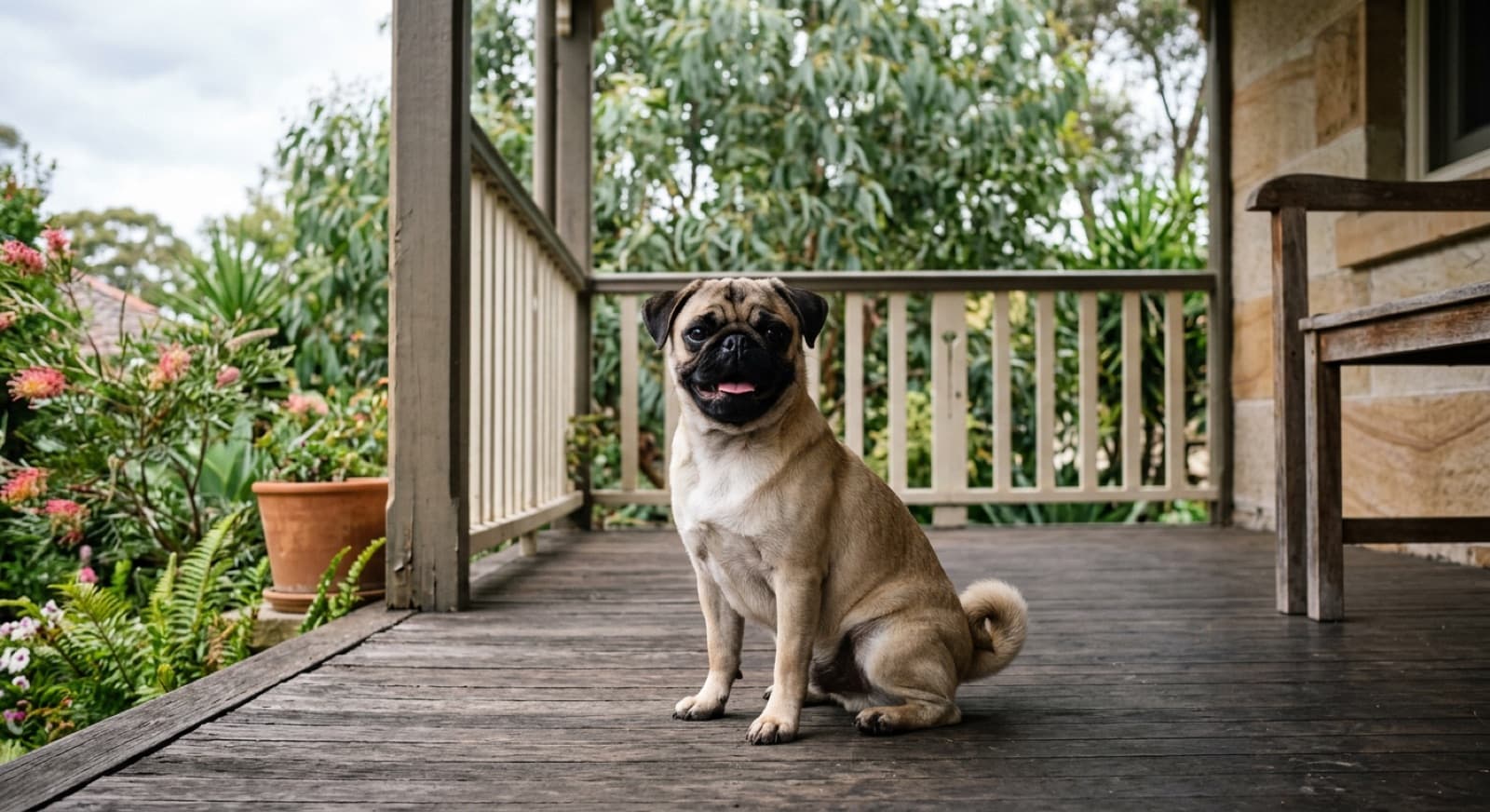
Before you go looking, it helps to be clear on the basics. The Pug is one of the oldest toy companion breeds, developed in China as a lapdog for royalty and later carried into Europe, where it became a favourite house dog. It is a small, cobby, muscular dog, usually around six to eight kilograms, with a large round head, a short flat muzzle, deep facial wrinkles, big dark eyes and a tightly curled tail. Coats are typically fawn or black, short and smooth, and the breed sheds more than its small size suggests. That distinctive squashed face is the whole point of the Pug's look, and it is also the root of the breed's health profile, which is why this article treats health as central rather than as a footnote.
The temperament is what wins people over. Pugs are affectionate, comical, even-tempered and intensely people-focused, and they want to be with their humans constantly. They are playful and clownish, they get along well with children and other pets, and they are usually calm indoors, all of which makes them a genuinely lovely companion and a popular apartment dog. A Pug is happiest curled up beside you, and that devotion is the heart of the breed's appeal. They are not a working dog and were never bred to be busy, so their exercise needs are modest, which suits a quieter household.
The part every prospective adopter must understand is that the Pug is brachycephalic, or flat-faced. The shortened skull and soft-tissue crowding in the airway mean many Pugs breathe with some difficulty, snore and snort, and tire quickly, and it means they overheat dangerously fast in warm weather. In a subtropical Gold Coast summer that is not a minor point, it is the central one. The flat face also comes with a set of breed-linked risks around the eyes, the skin folds and the spine. None of this makes a Pug a poor choice. It makes a Pug a companion you adopt with your eyes open, ready to manage its needs and budget for its care. We go deep on the specifics in the two companion guides linked throughout this article.
Put together, this is a small dog with an enormous heart: loving, funny, gentle and endlessly loyal, well suited to an owner who wants a close companion and is prepared for the responsibilities that come with a flat-faced breed. It is not a high-energy dog and it is not a low-maintenance one either. Going in expecting a robust, worry-free pet is how Pugs sometimes end up back in rescue.
Why Pugs end up in Gold Coast rescue
A Pug in rescue is rarely a broken dog. It is usually a devoted little companion whose needs or whose owner's circumstances outran the situation. Understanding the common reasons tells you whether the breed is genuinely right for you.
The health-care cost was underestimated. This is the big one. People adopt or buy a Pug for the face and the personality, then meet the reality that a brachycephalic dog can need ongoing veterinary care, from breathing management to eye and skin issues, and that the bills add up over a lifetime. When the cost or the commitment becomes clear, some owners struggle to keep up, and financial stress is a common thread in Pug surrenders. Going in with a budget, and ideally pet insurance taken out while the dog is young, is the honest way to avoid becoming that story.
The breathing and heat problems were a surprise. Plenty of new Pug owners are genuinely alarmed the first time their dog struggles to breathe on a hot day, snores loudly through the night, or tires within minutes of gentle play. For a flat-faced dog in a warm, humid Gold Coast climate, heat is a real safety issue, and an owner who did not expect to plan every summer walk around the temperature can feel overwhelmed. It is a manageable responsibility, but only if you know it is coming, which is why we treat it as central rather than optional.
Life changes and housing. Many Pugs reach rescue through no fault of their own, after a relationship breakdown, a new baby, a job loss, an owner moving into aged care, or a move to a rental or unit that will not take a dog. A people-focused breed like the Pug also does not cope well with sudden long hours alone, and a change in a household's routine can be the trigger. In these cases the dog is usually sound in temperament and simply needs a new home ready to give it the company it craves.
If you can commit to the potential vet care, the careful heat and breathing management, and plenty of company, you are looking at one of the most affectionate adoptions there is. If you wanted a robust, low-cost, low-maintenance dog you could exercise hard on any day of the year, being honest now saves a Pug from being the next surrender.
Where to adopt a Pug or cross on the Gold Coast
Because purebred Pugs are in high demand and adopted quickly, a wide alert net is the right approach. Set listing alerts on every rescue you would consider, be application-ready, and stay open to a Pug cross or an older dog. For a fuller directory, see our Gold Coast adoption resources hub.
- Animal Welfare League Queensland (AWLQ). A long-running South East Queensland no-kill charity whose flagship Rehoming and Education Centre at Coombabah is the main animal shelter on the Gold Coast. Purebred Pugs are uncommon and go fast, but crosses appear more often, and staff can talk through what a flat-faced companion needs day to day. Every adoption covers desexing, vaccination, microchipping and a vet check, which matters a great deal for a flat-faced breed, because the team can tell you how a specific dog breathes and whether it has eye or skin issues to manage. Listings at awlq.org.au.
- RSPCA Queensland. The state body runs its main Animal Care Campus at Wacol in Brisbane and reaches the Gold Coast through its statewide adoption network, and Pugs and Pug crosses come through occasionally via owner surrender. Every adoption covers desexing, vaccination, microchipping and a vet check. For a flat-faced breed that vet check matters a great deal, because the team can tell you how a specific dog breathes and whether it has eye or skin issues to manage. Browse at rspcaqld.org.au.
- Foster-based and small-breed rescues. Gold Coast volunteer and foster-network rescues see Pugs and Pug crosses from time to time. Because the dogs live in foster homes, the notes on a Pug's breathing, energy, heat tolerance and behaviour tend to be detailed and honest, which is exactly what you need for a brachycephalic breed where the individual dog's health picture matters most.
- A breed-specific Pug rescue. If you find a group calling itself a Pug rescue, it may genuinely specialise in assessing and placing the breed, but verify it first: a real address, a current adoptable-dog list and registered charitable status. Be ready to wait for the right match, and never send money before you have confirmed the group is real.
- PetRescue. A national aggregator that lists Pugs and Pug crosses from many smaller Queensland rescues in one searchable place, at petrescue.com.au.
Some adopters search for a dedicated Pug rescue in Queensland, but we cannot verify a currently active organisation by that name, so use the general rescues above, set alerts, and be wary of any group that asks for money before you have confirmed a real address, a current adoptable-dog list and charitable status. Browse the Pugs and Pug crosses currently listed on the Gold Coast Pug listings.
What a Pug costs: adopt versus buy
Adoption is far cheaper at the outset. A rescue fee for an adult Pug through a Queensland rescue commonly runs about $300 to $600, and a puppy $400 to $800, and that fee already covers desexing, vaccination, microchipping, worm and flea treatment and a vet check.
A Pug puppy from a breeder in Australia, by contrast, often runs into the thousands, several thousand dollars, with none of that vet work done yet. Pugs are in high demand, so registered breeders have long waiting lists and demand keeps prices high. So adopting is many times cheaper up front, the dog arrives already vetted, and if you adopt an adult you can see the actual health picture and temperament rather than gamble on a puppy whose breathing is still an unknown.
The purchase price is only the beginning with this breed, and that is the part worth sitting with. A brachycephalic dog can carry meaningful lifetime vet costs, from breathing management to eye and skin care, so budget seriously and take out pet insurance while the dog is young. Adopting an adult that a rescue has already assessed can genuinely be the smarter financial decision, because you know more about what you are taking on.
Plenty of people arrive here after searching for a Pug to buy, and that makes sense, because the for-sale listings usually outnumber the rescue ones for a high-demand breed. But before you spend anything, know that any scarce, high-demand purebred is a magnet for fake listings, deposit scams and backyard breeders churning out poorly-bred, unhealthy puppies. In Queensland, any dog born on or after 26 May 2017 that is sold, given away or advertised must display a supply number from the Queensland Dog Breeder Register, and every dog must be microchipped before it changes hands, so a listing with no supply number and no microchip number is a red flag. A cheap Pug, a free-to-good-home Pug, or a deposit request for a dog you have not met in person is the classic setup that Scamwatch warns about. A seller who will not show you both healthy parents at their property is a red flag rather than a mark of quality, and with a breed this prone to health problems, cutting corners on the source can be costly in every sense.
On ongoing cost beyond the vet care, budget for year-round paralysis tick and parasite prevention, which is essential everywhere in South East Queensland, plus the usual food, and modest grooming for a short-coated dog that still needs its facial wrinkles kept clean and dry. Council registration is a small yearly cost, and a desexed and microchipped dog attracts the reduced fee; check the current rate on your council page, for example the City of Gold Coast.
Adopting a Pug is a health commitment
This is the section we would want a friend to read before they fell for a Pug's face. Adopting one of these dogs is a wonderful thing, and it is also a commitment to potential brachycephalic vet care. The flat face that gives the Pug its charm can compromise breathing, and the breed is prone to eye problems because of those prominent eyes, to skin-fold irritation because of the wrinkles, and to spinal issues in some lines. A responsible adopter goes in ready to manage all of that.
The practical answer is knowledge and preparation rather than fear. Know the signs to watch, from laboured or noisy breathing to eye discharge, skin irritation in the folds, or any change in movement, and take any concern to your vet promptly. Keep your Pug at a healthy weight, because extra kilos make breathing and joint strain worse. Manage heat carefully, which on the Gold Coast is a year-round habit rather than a summer afterthought. And build a relationship with a vet you trust from the start. We cover the medical detail in the Pug health issues guide, and the everyday breathing and heat management in the Pug breathing and heat care guide. Read both before you apply, and you will be the adopter a rescue hopes for. The RSPCA Australia Knowledgebase and the Australian Veterinary Association both publish sound general guidance on flat-faced breeds and on choosing a dog that fits your life.
Browse adoptable Pugs on the Gold Coast
Purebred Pugs are in high demand and go fast, so crosses and older dogs appear more often. Browse live Queensland listings and set an alert so you hear the moment one comes in.
See Available Pugs →Is a Pug right for you
A Pug suits an owner who wants a close, affectionate companion and can be around often. If you work from home, are retired, or have a household where the dog will have plenty of company, a Pug will adore you. Their modest exercise needs and calm indoor manner make them a natural fit for apartment and unit living, and their gentle, comical nature makes them lovely with children and other pets they are raised alongside. This is one of the most loving breeds you can bring home.
The honest counter-case is the health side. If your budget genuinely cannot stretch to the potential vet care of a brachycephalic dog, a hardier breed is the kinder choice for both of you. If you wanted a dog to run, hike or exercise hard in the heat, a Pug cannot safely do that, and the Gold Coast climate makes that limit sharper. If your household is out for long hours most days, a people-focused Pug will struggle with the loneliness. And if you cannot commit to careful summer heat management, this is not the breed. Let the individual dog in front of you, and the foster carer's honest notes on its breathing and health, guide your decision as much as the breed itself.
Registering your Pug in Queensland
Council registration is a separate legal step from the adoption. Under the Animal Management (Cats and Dogs) Act 2008, a dog must be microchipped before 12 weeks of age or before it changes hands, and registered with your local council from 12 weeks, with a substantially reduced rate for a desexed and microchipped dog. On the Gold Coast, the City of Gold Coast requires every dog to be registered and microchipped under its Local Law No. 12 (Animal Management) 2013, with the reduced fee for a desexed and microchipped dog. Most rescue Pugs are already desexed and microchipped as part of the adoption, so you pay the lower fee. Check the current rate on the City of Gold Coast page.
As a small, friendly companion breed, a Pug carries no special legal restrictions and rarely raises housing concerns, which is part of why they are such a popular apartment dog. The bigger practical questions in unit living are keeping summer exercise gentle and heat-safe in the Gold Coast climate, and the snoring and snorting a close neighbour might hear, so if you are in an apartment, confirm dogs are permitted where you live, plan for the heat, and be honest about whether you can meet a flat-faced companion's needs before you apply.
Adult or puppy, and how to choose
For almost every adopter an adult is the better choice, and Pug puppies are rare and heavily contested in rescue anyway. With a brachycephalic breed this matters more than usual, because the thing that most affects your life together, the dog's health and how well it breathes, is far easier to read in an adult. A puppy is a genuine gamble on how its airway and eyes and skin will develop, and you will not really know for a year or more. An adult rescue Pug has already shown its temperament and health picture, so a rescue can tell you rather than guess.
An adult also comes with a known history the rescue can describe, often some training in place, and a lower adoption fee. When you choose, read the foster carer's notes closely. They will tell you how a specific dog breathes, copes with warmth and exercise, and manages any eye or skin issues, plus how it does with children, other pets and being left alone, and that record predicts the fit far better than the breed average. Older, settled Pugs are often the ones that wait longest, and they make the steadiest, most affectionate match for a calm home ready to give them the company and the care they need.
Frequently Asked Questions
Where can I adopt a Pug near me on the Gold Coast?
Start with the main Queensland rescues. Animal Welfare League Queensland (AWLQ) is the natural first stop, because its flagship Rehoming and Education Centre at Coombabah is the main animal shelter on the Gold Coast. Then RSPCA Queensland, a statewide body whose main Animal Care Campus is at Wacol in Brisbane and which reaches the Gold Coast through its statewide adoption network, followed by the foster-based and small-breed rescues, and PetRescue, which lists Pugs and Pug crosses from many smaller Queensland rescues in one place. Set realistic expectations on supply. Purebred Pugs are in high demand, so the few that reach rescue are adopted quickly and applications can be competitive, while Pug crosses turn up more often than a full pedigree. The reliable approach is to set listing alerts across every rescue you would consider, have your application and references ready in advance, and stay open to a cross or an older dog. If you find a group calling itself a Pug rescue, confirm it is genuine before you engage, and never send money before you have.
Are Pugs healthy dogs to adopt?
Pugs are affectionate and charming, but they are a brachycephalic (flat-faced) breed, so adopting one is a genuine health commitment rather than a casual choice. That short face means many Pugs have some degree of compromised breathing, they overheat far more easily than a longer-nosed dog, and the breed is prone to eye, skin-fold and spinal issues that can mean real vet care over a lifetime. None of that makes a Pug a bad dog. It simply means you should go in clear-eyed and budget for it. Before you apply, read our companion guides on Pug health issues and on breathing and heat care so you know the signs to watch and can ask your vet the right questions. Adopting an adult also lets a rescue tell you the health history of the specific dog in front of you.
Why do Pugs end up in rescue?
Usually because the health-care needs, breathing limits and heat sensitivity caught the owner out, or because life circumstances changed, not because of a fault in the dog. Many people fall for the flat-faced face and the loving personality without realising that a brachycephalic dog can need ongoing veterinary attention, cannot exercise hard in the Gold Coast heat, and may snore, snort and struggle on a hot day. When the vet bills mount or the limitations become clear, some owners surrender. Others reach rescue through no fault of their own, after a relationship breakdown, a new baby, financial stress, an owner going into aged care, or a move to housing that will not take a dog. The temperament is almost always intact and devoted.
How much does it cost to adopt a Pug versus buy one?
Adoption is far cheaper up front. A rescue fee for an adult Pug through a Queensland rescue commonly runs about $300 to $600, and a puppy $400 to $800, and that fee already includes desexing, vaccination, microchipping, worm and flea treatment and a vet check. A Pug puppy from a breeder in Australia often runs into the thousands, several thousand dollars, with none of that vet work done yet, because Pugs are in high demand and that demand keeps prices high. So adopting is many times cheaper at the outset and the dog arrives already vetted. Remember that the purchase price is only the start with this breed, because the lifetime vet cost of a brachycephalic dog can be significant, which is exactly why adopting an already-assessed adult can be the smarter financial choice.
Are Pugs and Pug crosses different to adopt?
The personality is broadly similar, but a Pug cross can be a slightly healthier bet on the breathing side. A cross such as a Puggle (Pug crossed with a Beagle) or a Pug crossed with another breed often has a marginally longer muzzle than a purebred Pug, which can mean somewhat better airflow, though this varies dog to dog and is never guaranteed. Crosses also appear in rescue more often than purebred Pugs, so if you are open to one your search is easier. That said, do not assume any given cross is free of flat-faced traits. Look at the actual dog, ask the rescue how it breathes and copes with exercise and warmth, and let a real assessment guide you rather than the label on the listing.
Do I need to register a Pug in Queensland?
Yes. Council registration is a separate legal step from the adoption. Under the Animal Management (Cats and Dogs) Act 2008, a dog must be microchipped before 12 weeks of age or before it changes hands, and registered with your local council from 12 weeks, with a substantially reduced rate for a desexed and microchipped dog. On the Gold Coast, the City of Gold Coast requires every dog to be registered and microchipped under its Local Law No. 12 (Animal Management) 2013, with the reduced fee applying to a desexed and microchipped dog. Most rescue Pugs are already desexed and microchipped as part of the adoption, so you pay the lower fee. A Pug is a small, friendly companion breed with no special legal restrictions, and it rarely raises housing concerns, which is part of why they are a popular apartment dog. In a unit the practical questions are heat management in summer, keeping exercise gentle, and the snoring a neighbour might hear through a shared wall. Check the current fee on the City of Gold Coast page.
Are there Pug rescues in Queensland?
There is no Queensland Pug-specific rescue we can verify as currently active, so the reliable route is the general rescues. Animal Welfare League Queensland, RSPCA Queensland, the foster-based rescues and PetRescue all rehome Pugs and Pug crosses when they come in. Because purebred Pugs are in high demand and adopted fast, a wide alert net beats waiting on one specialist group. Set listing alerts on every rescue you would consider and be application-ready so you can move quickly. If you find a group calling itself a Pug rescue, verify it before you engage: a real address, a current list of adoptable dogs, and registered charitable status. Never send a deposit to a group you cannot confirm is genuine.
Can Pugs handle the Gold Coast heat?
Not well, and this is the single most important thing to manage. Pugs are brachycephalic, so they cool themselves far less efficiently than a longer-nosed dog, and a hot, humid Gold Coast summer day is genuinely dangerous for them. The humidity of the South East Queensland climate makes it worse, because it blunts the panting a dog relies on to shed heat. Walk a Pug only in the cool of early morning or evening, never in the heat of the day, keep exercise gentle and short, provide constant shade, water and air-conditioning, and never leave a Pug in a car or an unventilated space. Watch for laboured breathing, heavy panting, drooling, distress or collapse, and treat any of those as an emergency and call your vet. Our breathing and heat care guide covers the warning signs and the everyday management in detail. This is a real, year-round responsibility, not an occasional one.
Should I adopt an adult Pug or a puppy?
For most adopters an adult is the better choice, and Pug puppies are rare and heavily contested in rescue anyway. An adult has already shown its actual temperament and, crucially for this breed, its health picture, so the rescue can tell you how it breathes, how it copes with warmth and exercise, and whether it has any eye, skin or spinal issues to manage. That is far more useful than gambling on a puppy whose breathing and health are still unknown. An adult also comes with a known history, often some training in place, and a lower adoption fee. Older, settled Pugs are affectionate, low-demand companions and are often overlooked, which makes them a wonderful match for a calm home ready to meet their health needs.
Keep reading
Adoptable Pugs on the Gold Coast
Live listings of Pugs and Pug crosses across the Gold Coast and Queensland rescues.
Pug Health Issues on the Gold Coast
The health risks the breed is prone to, the signs to watch, and the questions to ask your vet.
Pug Breathing & Heat Care
Managing a flat-faced dog in the Gold Coast climate, warning signs, and everyday heat safety.
All Gold Coast Adoption Guides
Browse every breed and how-to guide for adopting a rescue dog on the Gold Coast.