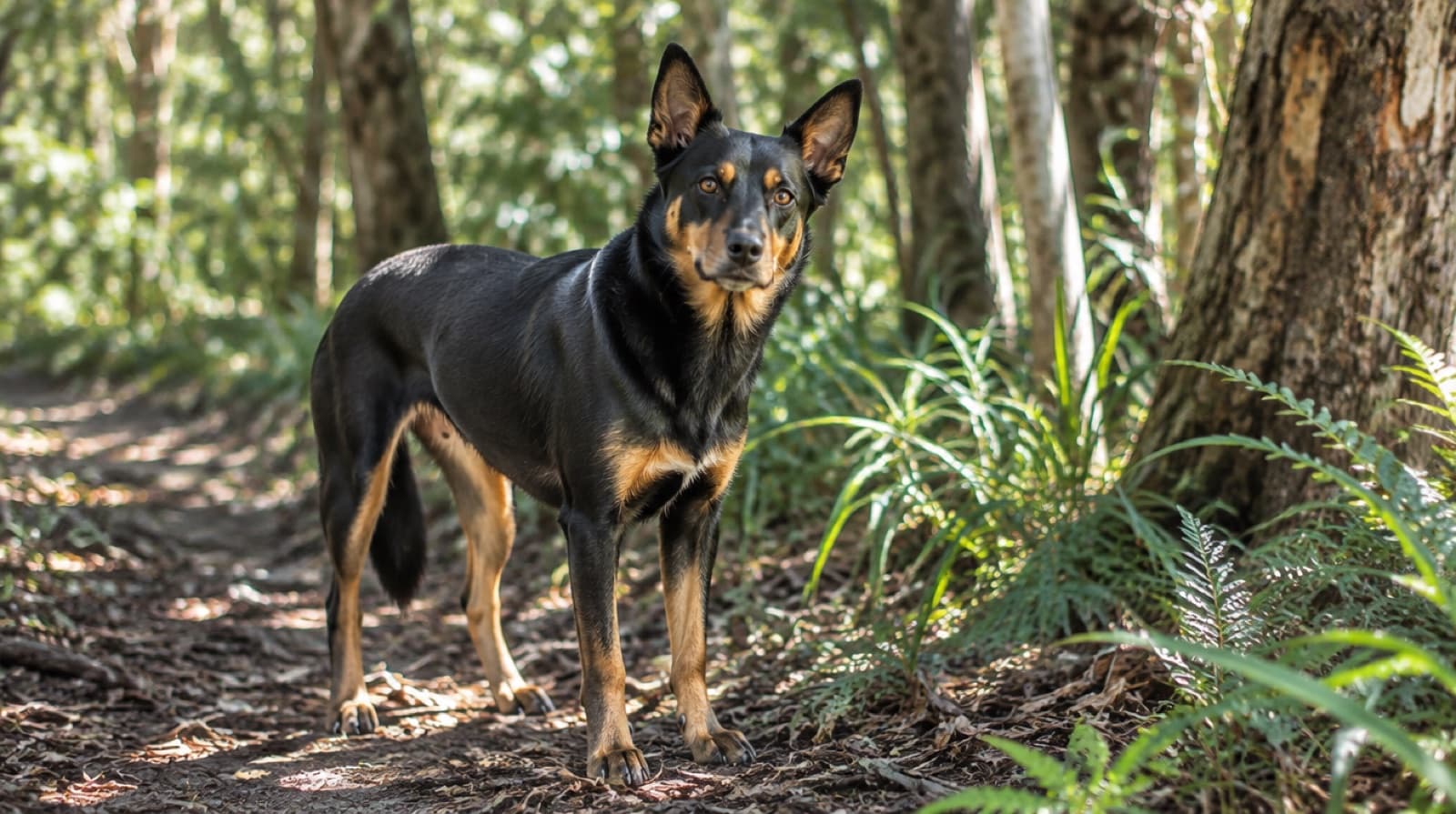
The short answer
The main health concerns for Kelpies are cerebellar abiotrophy (a progressive, DNA-testable, fatal neurological disease), hip and elbow dysplasia (lower rates than most working breeds thanks to selection, but present), progressive retinal atrophy (a heritable eye condition, uncommon but worth an eye check), cryptorchidism (undescended testicles, which raise cancer risk if untreated), and working-dog joint injuries such as cruciate tears. On top of that the Gold Coast adds the year-round paralysis tick, which is the single most important thing to manage for the breed here. Kelpies have excellent heat tolerance and one of the longer lifespans for their size (12 to 15 years). The most important early-care moves are year-round tick prevention from day one and CA DNA testing for working-line and unknown-background dogs. Pet insurance pays off the math on a hard-working dog; get it before any condition appears. This is general information, not veterinary advice.
Why Kelpies are healthier than many working breeds
Working Kelpies have been under strong selective pressure for more than a century. A Kelpie that cannot do a full day's stock work has no breeding value to a station owner, so the dog is desexed and the genes do not propagate. Over generations this has reduced heritable conditions significantly in the working population. ANKC show-line Kelpies have slightly higher rates because selection is for appearance rather than working ability, but even ANKC Kelpies are generally healthier than many show breeds.
The result: working-line Kelpies are among the healthiest medium-sized dogs in Australia. Many reach 14 to 16 years in active homes, and some reach 17 or 18. The breed's longevity is one of its less-talked-about advantages.
The most authoritative sources on Kelpie health for Australian owners are the Australian Veterinary Association, the RSPCA Knowledgebase, and, on the heritable screening schemes for hips and eyes, the Orthopedic Foundation for Animals.
1. Cerebellar abiotrophy (the defining genetic risk)
Cerebellar abiotrophy (CA) is a progressive neurological disease in which the cerebellum, the brain region controlling balance, coordination and fine motor control, degenerates over time. Affected Kelpies appear normal at birth but develop worsening incoordination as the disease progresses. The condition is genetic and recessive, so both parents must be carriers for a puppy to be affected.
Signs in affected Kelpies:
- A wide-based, unsteady (ataxic) walking pattern
- Head tremors, particularly when concentrating on a task or eating
- Loss of balance, falling sideways or backwards
- Difficulty with stairs or jumping
- An exaggerated, high-stepping gait
- Onset typically 6 weeks to 3 years of age, progressing slowly
- Cognitive function stays normal; the disease affects only motor coordination
Diagnosis is by a veterinary examination of gait, balance and reflexes, and DNA testing confirms the genetic basis. The condition is incurable and progressive, with no treatment that slows or reverses the degeneration. Management is supportive: non-slip flooring, ramps instead of stairs, and close quality-of-life monitoring. Most affected dogs are eventually euthanised when quality of life declines, usually within 1 to 3 years of clear onset. It is a genuinely hard condition, because the dog stays mentally sharp and engaged with the family throughout the physical decline.
DNA testing is available through Australian veterinary laboratories. Reputable breeders test parents and avoid breeding two carriers together. Adopted Kelpies of unknown breeding benefit most from testing, because knowing the dog is clear, a carrier or at-risk informs vet care for life.
2. Hip and elbow dysplasia (lower rates than most working breeds)
Working Kelpies have significantly lower hip dysplasia rates than many similar breeds because of the selective pressure described above. ANKC show-line Kelpies sit a little higher. Responsible breeders in both registries score parent hips (PennHIP or the BVA scheme, recorded in registries such as the OFA) before breeding. Elbow dysplasia is also lower in the breed than in many working dogs, particularly working lines.
Signs:
- Reluctance to run or jump in young dogs
- A bunny-hopping gait (both back legs together)
- Stiffness after rest, particularly in the morning
- Progressive lameness in middle age
- Reduced muscle mass in the back legs
Treatment options on the Gold Coast:
- Conservative management. Weight control, joint supplements (glucosamine, chondroitin, omega-3), controlled exercise and anti-inflammatory medication. Suitable for mild to moderate cases.
- Femoral head ostectomy (FHO). $4,000 to $7,000 per hip. Works well for a Kelpie-sized dog because the lean working build creates less joint load than heavier breeds.
- Total hip replacement. The gold standard for severe cases, $10,000 to $14,000 per hip at Gold Coast specialty hospitals.
Lean Kelpies cope with mild dysplasia notably better than overweight dogs of any breed. Weight management is the single most preventable contributor to joint problems.
3. Progressive retinal atrophy
Progressive retinal atrophy (PRA) is a heritable eye condition that turns up in the breed, uncommon but worth understanding. It is a degenerative disease of the retina that causes gradual vision loss, starting with night blindness and progressing to full blindness over months to years.
Signs of a developing eye problem:
- Reluctance to move around in low light
- Bumping into furniture in dim conditions
- Dilated pupils in normal light
- Loss of confidence in unfamiliar places
- Eventually, reduced vision in daylight too
There is no cure, but an eye examination by a veterinary ophthalmologist can confirm and grade the problem, and a routine eye check is worthwhile for a breeding dog or a rescue of unknown background. Affected dogs usually adapt remarkably well to gradual vision loss, because a Kelpie's hearing, scenting and situational awareness are so sharp. Keep furniture in consistent positions, use scent markers near hazards, and keep walk routes familiar. An adopted Kelpie showing any early sign should have an ophthalmology referral to confirm what is going on.
4. Cryptorchidism
Cryptorchidism is when one or both testicles fail to descend into the scrotum during normal development. The retained testicle stays in the abdomen, where the higher body temperature damages sperm-producing cells and dramatically raises the risk of testicular cancer in middle age. Kelpies have moderately elevated rates compared with the general dog population, and the condition has a genetic component, so affected dogs and their close relatives should not be bred.
Both testicles should be descended by 6 months of age, occasionally as late as 8 months, and a vet exam at that age identifies any retained testicle. Most rescue Kelpies are already desexed before adoption, so a retained testicle would have been removed during the desexing procedure. Treatment is surgical removal of both testicles, slightly more involved than standard desexing because the retained one is reached through a small abdominal incision, and costs a little more ($500 to $900 on the Gold Coast depending on whether one or both are retained). Left untreated, a retained testicle can develop cancer that is often advanced by the time it is found, and treating that later is far more expensive than dealing with the cryptorchidism early.
Browse Kelpies available in Gold Coast rescue
Rescue Kelpies arrive with a baseline vet check. CA DNA testing is worth considering at the first vet visit for a dog of unknown background, and year-round tick prevention should start straight away.
See Available Kelpies →5. Cruciate ligament injuries and working-dog joint stress
Active Kelpies are at elevated risk for cranial cruciate ligament (CCL) tears, because the high-impact exercise they need stresses the knee joints. The injury usually happens during a sudden direction change, a sudden stop, or a bad landing on uneven ground.
Signs:
- Sudden hind-leg lameness, often during or after vigorous play
- Reluctance to bear weight on the affected leg
- A sitting position skewed to one side to avoid pressure on the sore knee
- Stiffness after getting up
- Sometimes a clicking sensation in the knee joint
Treatment options on the Gold Coast:
- TPLO (tibial plateau levelling osteotomy). The gold-standard surgical repair, $6,000 to $9,000 per knee at Gold Coast specialty hospitals, with a 12 to 16 week recovery.
- Extracapsular repair. A less expensive alternative at $4,000 to $6,000.
- Conservative management. Strict rest, anti-inflammatories and physiotherapy. Less reliable for an athletic dog that needs to return to full activity.
Roughly half of the dogs that tear one cruciate ligament tear the other within 12 to 18 months, so the history on the first knee informs decisions on the second. Keeping the dog lean and well-conditioned is the best everyday protection.
6. The year-round paralysis tick (the Gold Coast danger that matters most)
This is the section that separates a Gold Coast Kelpie guide from a southern-states one. The Australian paralysis tick lives along the eastern seaboard, and the Gold Coast sits squarely in its endemic range. The tick injects a toxin that causes a progressive, ascending paralysis, and it can be fatal. It is most active in the warmer, wetter months, but because SEQ winters stay mild, the risk runs effectively year-round, and a Kelpie that works bushland, creeks and long grass is exactly the dog most exposed.
Signs of tick paralysis (a true emergency):
- Wobbliness or weakness in the back legs that spreads forward
- A changed or weaker bark, or a change in breathing
- Vomiting, retching or difficulty swallowing
- Excessive drooling or noisy breathing
- Collapse in the later stages
If you see these signs, treat it as an emergency and get to a vet immediately. Keep a vet-recommended tick-prevention product in place all year, and search your dog by hand after every bush, creek or long-grass outing, working through the head, ears, neck, chest and between the toes. Do not rely on prevention alone; the hands-on search is the backstop. For current guidance see the RSPCA Knowledgebase and the Australian Veterinary Association, and ask your vet which product suits a dog that spends a lot of time in tick country.
7. Heat tolerance, humidity and other conditions worth knowing
Heat tolerance (a real positive).
Kelpies handle heat genuinely well. The breed was developed for outback conditions where summer temperatures regularly top 40 degrees, and working dogs keep functioning in heat that would dangerously stress most breeds. The Gold Coast catch is humidity, which blunts the panting a dog relies on to cool, and the fact that a Kelpie will push itself. Walk and run in the cool of the day, always carry water, provide shade and a cool indoor space, and a safe swim is a brilliant heat-smart outlet. Watch for heat stress on hot, humid days even in a breed that copes well with dry heat.
Cancer.
Moderate rates in older Kelpies, generally lower than in many breeds. Any new lump in a dog over 6 warrants a vet check. Gold Coast specialty oncology is available through the region's veterinary referral hospitals.
Fleas, worms and heartworm.
The warm SEQ climate keeps fleas, intestinal worms and mosquito-borne heartworm active close to year-round, so prevention should be continuous rather than seasonal. Ask your vet about an all-in-one plan that covers ticks, fleas, worms and heartworm together.
The Gold Coast pet insurance math for Kelpies
Insurance for Kelpies is good value, though the math is closer than for some breeds because working-line dogs are unusually healthy. The injuries the breed faces are working-dog injuries (cruciate tears and ligament sprains from high-impact exercise) plus the genetic conditions.
A Kelpie that develops cruciate problems plus eventual joint arthritis plus a major emergency over a 14-year lifespan can rack up $10,000 to $25,000 in vet bills. Full insurance over the same period costs roughly $9,000 to $14,000 in premiums. The breed's long lifespan means the cover is paid for longer, but it also has more years in which a major event might occur.
- Get coverage before any condition appears. All Australian insurers exclude pre-existing conditions.
- High annual limit ($15,000 or more). Orthopaedic surgery alone can exhaust lower limits.
- Full accident and illness cover. Accident-only is not enough.
- Check orthopaedic coverage. Particularly relevant for an athletic breed prone to cruciate injuries.
Compare several major Australian providers before you commit. The Australian Veterinary Association pet insurance guide covers what to look for in a policy.
Gold Coast specialty and emergency vets
For breed-related conditions you may need a referral to a specialist, and the Gold Coast and wider South East Queensland have multi-specialty veterinary referral hospitals offering orthopaedics, ophthalmology, oncology, neurology and internal medicine. Your regular vet will refer you to the one that fits the case. For after-hours emergencies, including suspected tick paralysis, the Gold Coast is served by genuinely 24/7 emergency hospitals such as the Animal Emergency Centre at Varsity Lakes and SASH Gold Coast at Robina, plus Animal Emergency Service at Carrara. Know your nearest emergency hospital before you need it, not during a crisis.
The year-by-year health plan
- Year 1: Baseline vet visit with weight, joint assessment and, for an intact male, a check for a retained testicle. CA DNA test for unknown-background dogs. Pet insurance in place from day one. Year-round paralysis-tick prevention started immediately.
- Years 2 to 5: Annual vet check. Weight management is critical. Watch for any neurological signs (gait changes, head tremors) and any night-vision changes. Keep the dog conditioned to reduce cruciate injury risk.
- Years 6 to 9: Twice-yearly vet check from age six. Senior blood panel. Watch for new lumps and biopsy any that appear. Joint care becomes more important.
- Years 10 and up: Quarterly check-ins. Quality-of-life conversations. Pain management for joints if needed. Many Kelpies stay active well into their teens.
Frequently Asked Questions
How long do Kelpies live?
Average lifespan is 12 to 15 years, and working-bred dogs often reach their late teens if kept lean and active. The breed is genuinely long-lived for a medium-sized dog, particularly working lines from rural stock selected on hardiness rather than appearance. Weight management, steady exercise and a prompt response to any joint or neurological sign all add years.
What is cerebellar abiotrophy and how serious is it for Kelpies?
Cerebellar abiotrophy (CA) is a progressive neurological disease in which the cerebellum, the brain region controlling balance and coordination, degenerates over time. Affected dogs usually look normal at birth but develop worsening incoordination, head tremors and loss of balance, typically starting between 6 weeks and 3 years of age. It is genetic in Kelpies (recessive), so both parents must be carriers for a puppy to be affected. The condition is incurable and progressive, and most affected dogs are eventually euthanised because quality of life declines, though the dog stays mentally normal throughout. DNA testing identifies carriers, and responsible working and ANKC breeders test parents and avoid breeding two carriers together. A rescue Kelpie of unknown breeding can be tested if needed.
How common is hip dysplasia in Kelpies?
Lower than in most working breeds, because the rural working population has been under strong selective pressure: a Kelpie with dysplasia cannot do a full day of stock work, so the trait gets bred out of working lines. ANKC show-line Kelpies have slightly higher rates. Responsible breeders score parent hips before breeding. Signs include reluctance to run or jump, a bunny-hopping gait and stiffness after rest. Treatment ranges from weight management plus joint support for mild cases to surgery for severe ones, which runs into the thousands per hip at Gold Coast specialty hospitals.
What eye conditions affect Kelpies?
Progressive retinal atrophy (PRA) is the heritable eye condition worth knowing. It causes gradual vision loss, starting with night blindness and progressing over months to years. It is not common in the breed, but it is heritable, so a routine eye check is worthwhile for a breeding dog or a rescue of unknown background. Affected dogs often adapt well because a Kelpie's other senses are sharp; an adopted dog showing early signs should be seen by a vet.
What is cryptorchidism in Kelpies?
Cryptorchidism is when one or both testicles fail to descend into the scrotum. The retained testicle sits in the abdomen, where the higher body temperature significantly increases the risk of testicular cancer in the dog's middle and later years. Kelpies have moderately elevated rates compared with the general dog population. Treatment is surgical removal of both testicles. Most rescue Kelpies are already desexed before adoption, so any retained testicle would have been dealt with at the time of desexing; in an intact breeder dog it is identified by a vet exam at 6 to 12 months of age.
Does my Kelpie need year-round tick prevention on the Gold Coast?
Yes, this is the single most important health point for the breed in South East Queensland. The Australian paralysis tick lives along the eastern seaboard and the Gold Coast is squarely in its range, and because winters stay mild the risk runs effectively year-round. A Kelpie that works bushland, creeks and long grass is the dog most exposed. Keep a vet-recommended tick-prevention product going all year, search the coat by hand after every bush or long-grass outing, and treat wobbliness, a changed bark, vomiting or breathing trouble as an emergency. Tick paralysis is potentially fatal.
Is pet insurance worth it for a Kelpie?
Yes, though the math is closer than for some breeds because working-line Kelpies are unusually healthy. The breed faces working-dog injury rates (cruciate tears, ligament sprains from high-impact exercise) plus the genetic conditions. A Kelpie that develops cruciate problems plus eventual joint arthritis plus a major emergency over a 14-year lifespan can rack up $10,000 to $25,000 in vet bills, while full insurance over the same period costs roughly $9,000 to $14,000 in premiums. Get coverage before any condition appears, because pre-existing exclusions are universal.
Keep reading
Adoptable Kelpies on the Gold Coast
Live listings with a baseline vet check from rescue.
Kelpie Adoption Gold Coast
Where to find one, working vs ANKC, real cost vs breeder.
Kelpies in Gold Coast Suburban Life
Fencing, cool-hour exercise, and the Hinterland vs coastal-suburb reality.
Gold Coast Adoption Resources
Guides on adopting, costs, council rules and settling a rescue dog on the Gold Coast.