The short answer
Heelers need a job because the breed was bred for sustained mental work, not just physical activity, and the job replaces the stock work the breed was designed for. Daily routine: 90 minutes of physical exercise plus 30 to 45 minutes of mental work plus a job (dog sport, scent work, structured outing). Mental work tires faster and lasts longer than physical exercise; five minutes of training equals roughly 15 minutes of walking. Without the job element, heelers invent destructive ones such as chewing, digging, fence-fighting and herding children and bikes. On the Gold Coast, time exercise to the cool hours, use swimming and indoor enrichment through the humid summer, escape-proof the yard because heelers are escape artists, and keep year-round paralysis-tick prevention going on any bush or trail outing. Doggy daycare a day or two a week is genuinely useful for full-time-employed owners.
Why physical exercise alone is not enough
The most common heeler-owner mistake is assuming more walks will fix the destructive behaviour. Beyond a point, they will not. The breed was bred for sustained mental work, not just physical activity. Physical exercise tires the body; mental work tires the brain. Heelers need both, and the brain-capacity gap is what produces most surrender-triggering behaviours.
The biological reality: a working Cattle Dog spent its days making constant decisions about cattle position, reading the stockman's cues, adjusting to terrain and weather, and solving novel problems. The breed's brain is wired for that kind of constant engagement. Physical exercise alone leaves that capacity unfilled, so the dog comes home from a 90-minute walk physically tired but mentally restless, and still acts out indoors.
The exercise-to-mental-work ratio:
- Physical exercise: 90 minutes daily. Walks, runs, swimming, off-lead play, all timed to the cool hours in summer.
- Mental work: 30 to 45 minutes daily. Training sessions, puzzle feeders, scent games, dog sports. Splitting it across several short sessions works well.
- A job: a purposeful weekly activity. Dog sport, scent work, or a structured outing with rules. The element that makes the dog feel useful.
- Both, not either. Ninety minutes of exercise without mental work produces a fit, destructive dog. Mental work without exercise produces a calmer but under-exercised dog. The combination produces the settled companion the breed can be.
A useful shortcut: five minutes of training is roughly equivalent to 15 minutes of walking in the tiredness it produces. Adding two short training sessions to the day often calms a previously destructive heeler dramatically within a fortnight. The RSPCA Knowledgebase has good general guidance on exercise and enrichment for dogs.
What "a job" actually looks like
The word job here is broader than literal work. For a working breed in a pet home, a job is any structured activity that:
- Requires the dog to solve a problem or make decisions
- Has clear rules and a consistent structure
- Rewards focused effort with something the dog values
- Builds skill over time so the dog progresses
- Happens regularly, weekly or more
Almost any structured dog activity can serve: a formal dog sport, scent work, a training class working toward titles, a regular structured outing with consistent rules, or a household role like carrying things on a walk. What does not count is pure physical exercise (a walk is not a job), random play, or unstructured backyard time. The structure plus the cognitive element are what produce the satisfaction.
For most Gold Coast pet households the practical answer is a weekly dog-sport class or scent-work session, plus daily training built into the morning and evening routine. The class provides the formal job; the daily training builds skills toward it.
The Gold Coast job menu
Agility
Running a course over jumps, tunnels, weaves and contact obstacles. It combines high physical demand with constant decision-making and handler partnership. Heelers excel because the breed's drive, focus and quick footwork fit the sport perfectly. The Gold Coast and wider South East Queensland have dog-sport and obedience clubs that run agility from foundation through to trial level; look for a local club or a force-free trainer who offers it. In summer, favour shaded or early-morning sessions.
Scent work and nose work
The dog searches for hidden target scents. Low physical demand, very high mental demand, which makes it brilliant for heelers and especially good for senior dogs, dogs with joint issues, or households without large outdoor space. It is also the easiest sport to keep running through a humid Gold Coast summer, because most of it happens indoors or in the shade. It suits anxious or reactive dogs well because the work is done individually.
Flyball
A team relay: dogs run over hurdles, trigger a box that releases a ball, and return over the hurdles to the handler. Very high intensity and arousal, which suits a high-drive heeler that needs an outlet for explosive energy. South East Queensland has flyball teams from beginner to competition level. The team element keeps owners consistent, and the social side is part of the appeal.
Herding clinics
Rural South East Queensland properties run herding instinct clinics for urban Cattle Dogs and other working breeds, where the dog experiences sheep or duck work in a controlled setting with experienced trainers. For working-line heelers in particular this can be transformative; many dogs settle noticeably after experiencing real stock work, even just for a session. Search for a herding clinic on a property within reach of the Gold Coast.
Obedience and rally
Formal obedience builds precision and partnership through exercises such as heeling patterns, recalls, stays and retrieves. Rally is a less formal version where the handler and dog run a numbered course of cues. Heelers excel because the breed loves working closely with its person. Most Gold Coast dog clubs offer weekly classes.
Tracking and trailing
Long-distance scent work, where the dog follows a person's scent trail laid earlier across varied terrain. It genuinely uses the breed's working instinct and is more individually paced and less crowded than agility. Best run in the cool of early morning in the Gold Coast climate, and always on year-round tick prevention if the ground is bushland or long grass.
Trick training
A lower-key option that still provides serious mental work, where the dog learns named tricks of increasing complexity. It is perfect for a hot or stormy Gold Coast afternoon because it is done indoors, and it suits households that cannot commit to a weekly class but want a daily structured activity at home.
Swimming and structured trail outings
A keen swim is one of the best Gold Coast outlets for a heeler, because it burns energy without the heat load of land exercise, and the region has dog-friendly beaches and waterway spots. Bush and waterside trails give varied terrain and constant new scents. To count as a job rather than just a walk, add structure: heel sections, sit-stays at set points, some retrieve work, and a clear start-and-end ritual. Keep year-round paralysis-tick prevention in place for any bushland outing, and check the coat afterwards.
Browse Cattle Dogs available in Gold Coast rescue
Foster carer notes describe each dog's drive level and what kind of job and environment would suit it.
See Available Cattle Dogs →Before anything else: containment
A bored heeler is an escape artist, and an escaped heeler on a busy Gold Coast road is the worst outcome of an unfilled working dog. Escaping is itself a self-rewarding job, so the fix is both a secure yard and enough mental work that the dog does not want to leave. Before you bring one home, walk the fence line: a secure 1.5 metre barrier with latched gates is the minimum, dig-proof along the base, with no bin, kennel or woodpile parked beside a fence to launch from. Recheck the perimeter weekly for new gaps. A dog that gets its exercise, mental work and job rarely tests the fence; a dog that gets none will find the one weak point you missed.
The daily routine that works for Gold Coast heeler owners
Morning (before the heat):
- A 45-minute walk in the cool of early morning, with some off-lead time in a fully fenced area where possible
- 10 to 15 minutes of training on whatever skill you are working on
- A frozen food toy or puzzle feeder as you leave for work, which doubles as a cool-down in summer
Mid-day:
- If working from home, a 15-minute training session or scent-game break in the cool indoors
- If at the office, doggy daycare a couple of days a week, which is genuinely useful for the breed
- A dog walker visit if neither of those is available, timed to avoid the midday heat
Evening (after sundown):
- A 45-minute walk or an off-lead session at a fenced dog off-leash area once the footpath has cooled
- A 15-minute training session or interactive game
- Family time with structured activities (fetch with rules, tug with a release cue, gentle play)
- A bedtime puzzle feeder or long-lasting chew for the wind-down
Weekly addition:
- One dog-sport class (agility, scent work, flyball, obedience): the formal job
- One longer outing (a shaded bush trail in the cool hours, or a beach swim): varied-environment work
- One social meetup (a working-breed group, or a dog park during the quieter, cooler times)
This routine works for full-time Gold Coast households if mid-day cover is sorted. On a genuine heatwave or storm day, drop the walk and substitute indoor enrichment; the day is still salvageable. Destructive behaviour patterns mostly resolve within 4 to 8 weeks of consistent implementation.
Mental work tools for at-home enrichment
The home enrichment kit that fills the gaps when class time and outings are not available, and that carries a Gold Coast household through a hot afternoon or a wet-season storm:
- A frozen food toy. 20 to 30 minutes of focused mental work, most useful during alone time or as a settle cue, and a genuine cool-down when frozen.
- A lick mat with a smooth food (xylitol-free). 10 to 15 minutes of calming licking, particularly good for anxious dogs.
- A snuffle mat with hidden kibble. The dog uses its nose to find food in the fabric. 15 to 25 minutes of focused scenting.
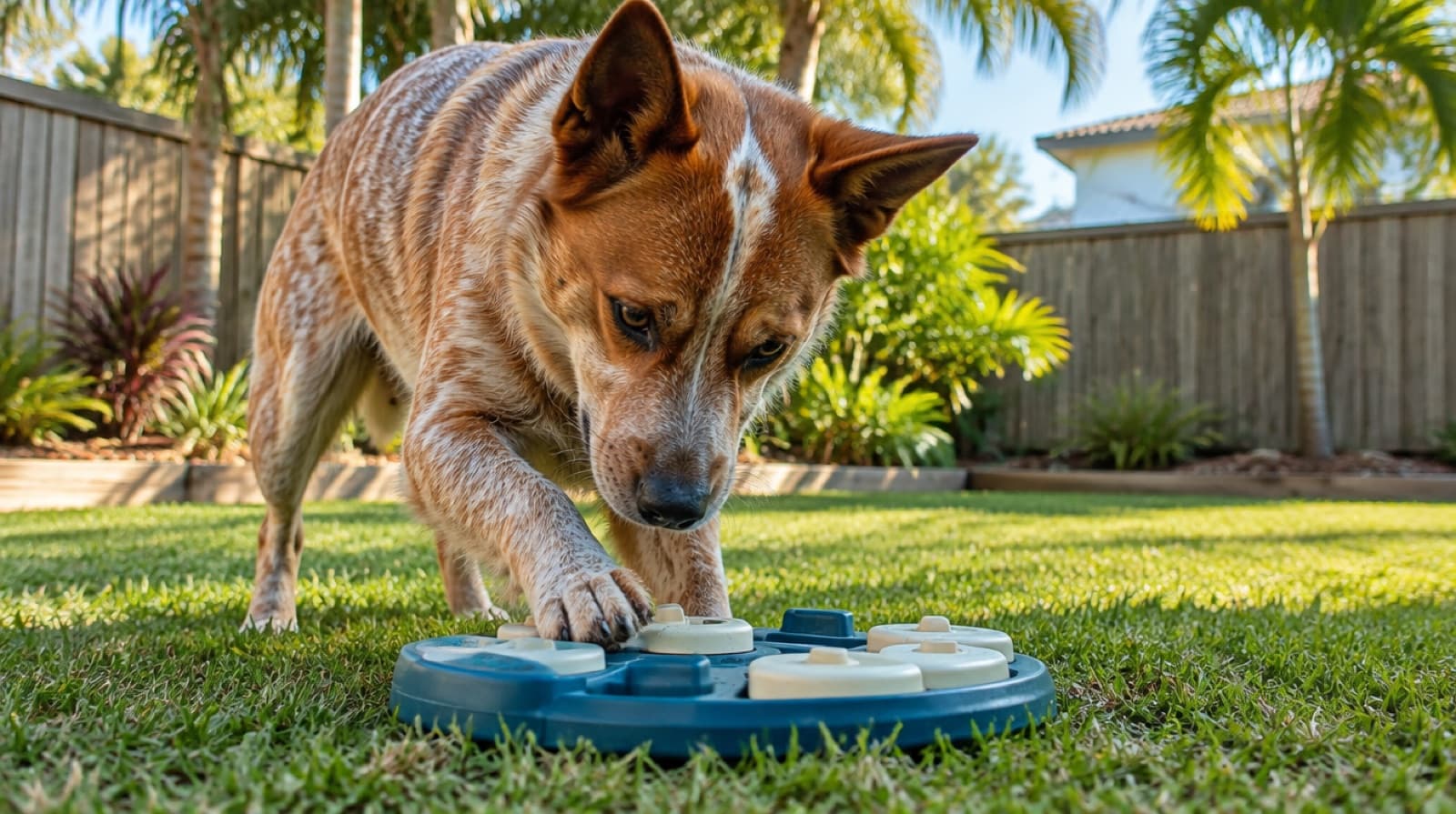
- Puzzle feeders and toys. Slow-feeder dishes, treat-dispensing balls, sliding-tile puzzles. Each gives 10 to 30 minutes of structured problem-solving.
- Long-lasting chews. A dental chew or a beef cheek roll that takes 30 to 60 minutes provides both mental and oral exercise.
- Indoor scent games. Hide treats around the house, or put treats inside cardboard boxes the dog has to open. Works in rain or summer heat.
- Brain games. Cup games, shell games, find-it with named objects, and free-shaping new behaviours.
- A trick-training rotation. Teach a new trick each week, or build existing tricks into longer sequences. The novelty maintains engagement.
What happens when the job is missing
Heelers without enough mental work plus job structure produce predictable destructive behaviours. Recognising them as job-deficit signals rather than bad behaviour is the first step.
- Destructive chewing. Furniture, doors, shoes, walls. The dog needs something to do.
- Counter-surfing for food. Seeking stimulation; reward-based off training plus more mental work fixes it.
- Fence-running and fence-fighting. The dog has invented a self-rewarding job, driving away whatever passes.
- Escaping. A heeler with no outlet goes looking for one, which on the Gold Coast means a real road-safety risk (see the containment note above).
- Herding people, bikes and pets. The heeling nip targeting movement, aimed at running children, bikes and other animals in the absence of a constructive outlet.
- Obsessive behaviour. Shadow-chasing, light fixation, tail-spinning, pacing. These compulsions emerge in under-worked working dogs and are hard to undo once established.
- Reactivity to other dogs or strangers. Pent-up energy spilling into reactive responses.
- An inability to settle indoors. Pacing, vocalising, constant demands for attention.
The first response to any of these is to increase mental work and add a job before increasing physical exercise. The fix is usually faster than expected: 2 to 4 weeks of consistent enrichment plus a weekly class can transform behaviour.
Working-line vs show-line job requirements
Drive level varies significantly within the breed. Working-line heelers typically need more intense and more frequent jobs than show-line dogs.
Working-line heelers:
- Daily mental-work needs at the higher end (45 minutes or more)
- Multiple weekly sport sessions ideal (agility plus scent work, or a similar combination)
- Herding clinics satisfy in a way other sports cannot
- Most likely to develop destructive behaviour without a sufficient outlet
Show-line heelers:
- Daily mental-work needs around 30 minutes usually sufficient
- A weekly sport session plus daily training usually enough
- More tolerant of routine variation
- Still high-energy by general dog standards
The foster or shelter notes describe an individual dog's drive level. Match the job intensity to the dog in front of you, not to the breed average.
Gold Coast resources for heeler owners
- Reward-based trainers. Look for a force-free, reward-based trainer experienced with working breeds who offers ongoing classes from puppy through to advanced. Use force-free methods only, because heelers respond badly to aversive tools. The Australian Veterinary Association supports reward-based training as the welfare-appropriate approach.
- Dog-sport clubs. Search for a Gold Coast or South East Queensland agility, flyball, obedience or scent-work club; most welcome heelers and run classes across skill levels.
- Off-leash areas. The City of Gold Coast maintains dog off-leash areas across the city; use a fully fenced one for a heeler until recall is solid, and confirm the current zone on the City of Gold Coast dog off-leash areas information.
- Doggy daycares. Some Gold Coast daycares are particularly experienced with working breeds; ask specifically about their heeler experience, because some suit the breed better than others.
- Herding clinics. Rural South East Queensland properties run urban-dog herding instinct sessions, which are worth seeking out for a working-line dog.
- Online resources. Many Australian dog-sport trainers run online programs (trick training, scent-work and agility foundations) for households that cannot commit to a weekly in-person class.
Frequently Asked Questions
What does "needs a job" actually mean for a Cattle Dog?
Heelers were bred to make decisions all day about cattle movement, then sleep deeply when the work was done, so the breed's brain craves purposeful problem-solving, not just physical exercise. A job can be a dog sport such as agility or scent work, a structured outing with rules and rewards, or a household role like carrying things on a walk. The dog needs to feel useful, not just tired. A long walk satisfies the body but leaves the brain unfilled, and without the job element a heeler invents its own, usually a destructive one.
How much mental work does a Cattle Dog actually need?
About 30 to 45 minutes of mental work a day, on top of 90 minutes of physical exercise. It can be broken into small sessions: ten minutes of training, ten minutes of a puzzle feeder, ten minutes of a scent game. Five minutes of training produces roughly the same tiredness as 15 minutes of walking. A heeler that has had its exercise plus mental work plus a job should settle contentedly in the evening; if it is still bouncing off the walls, add mental load before adding more physical exercise.
What dog sports work best for Cattle Dogs on the Gold Coast?
Agility, scent work, flyball, obedience and rally, tracking, and herding clinics all suit the breed, and heelers excel at every one of them. The Gold Coast and wider South East Queensland have active dog-sport clubs for most of these; search for a local club or a force-free trainer who runs classes, and pick one or two activities that fit your schedule. In the SEQ heat, indoor or shaded, cool-hour options such as scent work and trick training are easier to sustain through summer than high-intensity outdoor sport. Consistency matters more than the specific sport.
My Cattle Dog is destroying things when I leave. Will more exercise fix it?
Sometimes, but more often the missing piece is mental work plus structure, not more physical exercise. A dog that has walked 90 minutes and still chews the couch needs mental stimulation, an alone-time enrichment plan (a frozen food toy, a lick mat, a puzzle feeder while you are out), and sometimes confinement to a smaller safe space while you are gone. Try adding 15 minutes of training before you leave plus a frozen food toy as you walk out the door. Destruction usually drops sharply within one to two weeks.
Can I work full-time and own a Cattle Dog on the Gold Coast?
Yes, with planning. The breed needs 90 minutes of physical exercise plus about 30 minutes of mental work plus a job, on top of the hours you are at work. Workable patterns include doggy daycare a couple of days a week, a mid-day dog walker, a work-from-home arrangement so the dog is not alone all day, or a partner whose hours differ from yours. Without one of those, full-time office work plus an adolescent heeler is a setup for destruction and surrender. Timing the daily walks to the cool hours of a Gold Coast day is part of making it sustainable.
How do I stop my heeler nipping at the kids and bikes?
Start by understanding it is herding, not aggression: the breed is hardwired to nip at moving heels to drive stock, and running children, bikes, joggers and other pets trigger the same instinct. Manage it with three things together. Give the dog a real daily outlet so the drive has somewhere to go, teach an incompatible behaviour such as running to a mat or fetching a toy when things get fast and exciting, and supervise closely around running games until the training is solid. A force-free, reward-based trainer experienced with working breeds can help build the redirection. The instinct never fully disappears, but it becomes manageable.
Are puzzle feeders enough mental work for a Cattle Dog?
They are a useful part of the daily routine but not the whole answer. A frozen food toy gives 15 to 30 minutes of focused mental work and is particularly good during alone time, and adding a snuffle mat, a lick mat and rotating puzzle toys varies the challenge. The bigger wins come from training sessions, scent games and dog sports, where you and the dog work together on a problem. Solo puzzle work is the floor; partnered work is the ceiling.
Keep reading
Adoptable Cattle Dogs on the Gold Coast
Live listings with foster carer notes on drive and energy level.
Cattle Dog Adoption Gold Coast
Where to find one, working vs show line, real cost vs breeder.
Cattle Dog Health Issues
BAER deafness testing, hip dysplasia, PRA, the year-round tick, insurance ROI.
Gold Coast Adoption Resources
Guides on adopting, costs, council rules and settling a rescue dog on the Gold Coast.