The short answer
A Devon Rex's coat needs the opposite of ordinary cat grooming: do not brush the fragile curly coat much, because vigorous brushing breaks the hairs; smooth it with a hand or soft damp cloth instead. Because the coat is so sparse, the skin's oils build up rather than spreading through a full coat, so a Devon Rex can get greasy skin, greasy nail beds and waxy ears, which means occasional gentle baths with a mild cat shampoo (rare among cats) and regular gentle ear cleaning. The thin coat also means the breed feels the cold and seeks warmth, so give it cosy spots away from air-conditioner draughts, and it has little sun protection, another reason indoor life suits it. See a vet for red or sore skin, or a smelly, sore ear.
Why the coat needs a different approach
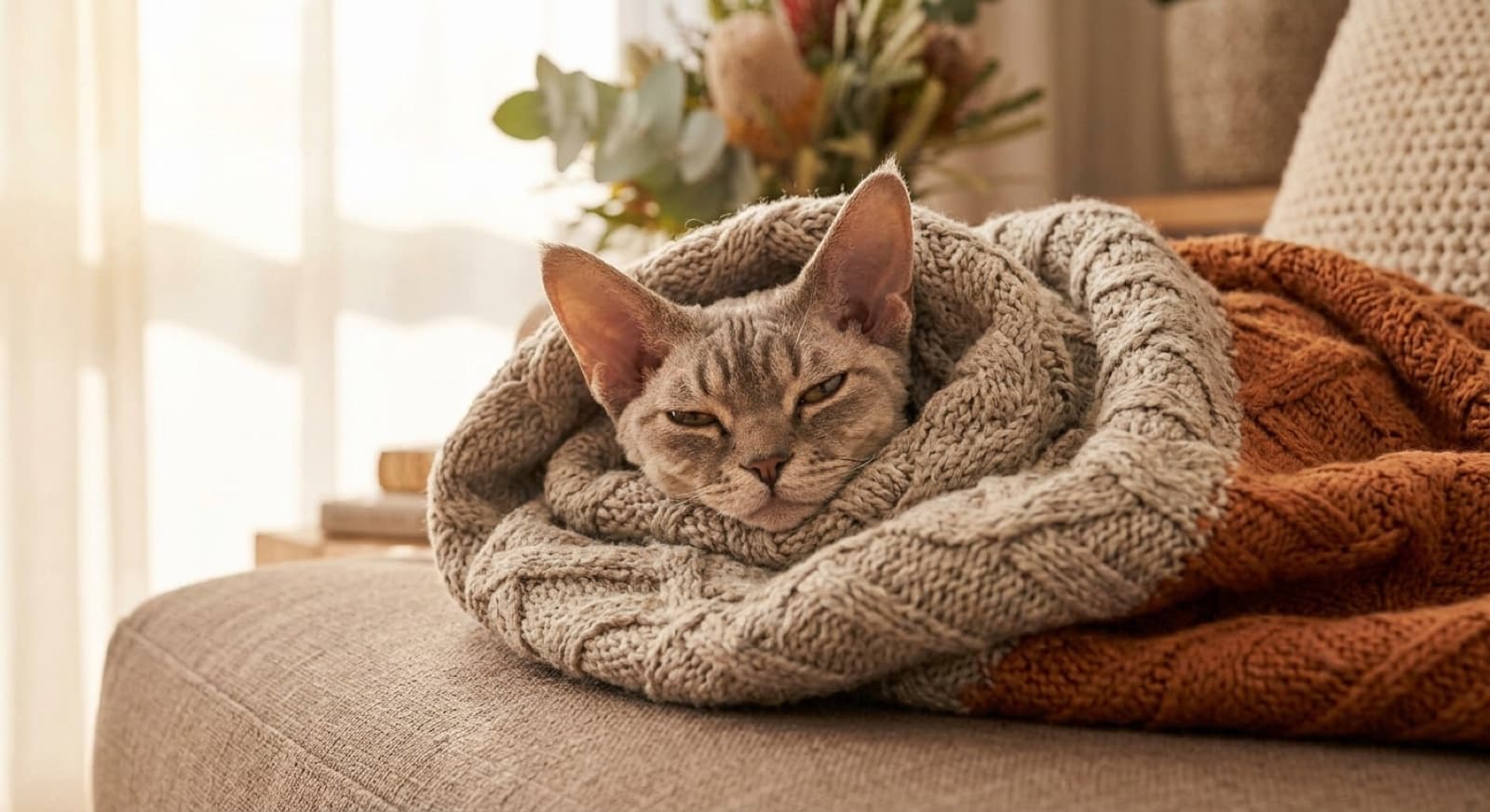
Most cat grooming is about managing loose hair from a full coat. A Devon Rex is different, because its coat is soft, fine, wavy and unusually sparse, made mostly of down with delicate, fragile curly guard hairs, sometimes with bare patches. That changes two things. First, the coat is easily damaged: brushing it the way you would a normal cat can snap the fine hairs and cause bald spots, so you brush a Devon Rex far less, if at all. Second, and more importantly, a sparse coat changes how the skin's natural oils behave, which is the key to the whole care routine below. The coat also sheds very little, so grooming is not about hair removal at all.
Grooming: gentle, and less than you think
- Do not over-brush. The fragile coat breaks under vigorous brushing. Most owners simply smooth the coat with a hand or a soft, slightly damp cloth, or use a very soft brush lightly and only occasionally.
- Keep it clean, not brushed. A gentle wipe-over that keeps the coat and skin clean does more good than any real brushing.
- Be gentle with a new rescue cat. Build up handling slowly so the cat is relaxed about being touched, wiped and, later, bathed.
Oily skin, and the occasional bath
Here is the part that surprises new owners. In a normal cat, the skin's oils are absorbed and spread through a full coat. In a Devon Rex, with so little coat, those oils build up on the skin instead, so the cat can become noticeably greasy, particularly on the belly, feet, nail beds and ears. That is why the Devon Rex is one of the few cats that genuinely benefits from an occasional gentle bath, using a mild, cat-specific shampoo, to keep the skin clean and comfortable, something most cats never need.
How often depends on the individual cat, so ask your vet for a sensible schedule rather than over-bathing, which can dry the skin. Never use a human or dog shampoo, dry the cat thoroughly and keep it warm afterwards, since the thin coat gives little insulation. The RSPCA Knowledgebase has good general guidance on grooming and skin care. If the skin looks red, sore, flaky or greasy beyond what a bath resolves, see a vet, because it may be a skin condition such as a yeast (malassezia) problem that needs treatment.
Ears, nails and skin checks
The same oil build-up that affects the skin also collects in the Devon Rex's large ears as brown, waxy debris, which if left can lead to irritation and infection, so check the ears often and clean them gently when waxy, using a vet-recommended ear cleaner and never poking into the ear canal. See a vet if an ear smells, looks red or sore, or the cat is scratching or head-shaking. Trim the nails regularly and wipe the greasy nail beds while you do, and use grooming time to run your hands over the skin, checking for redness, sores, or paralysis ticks, which are a year-round risk across South East Queensland and easy to feel on a sparse-coated cat.
Warmth and sun in the Brisbane climate
A thin coat cuts both ways. It means a Devon Rex feels the cold and actively seeks warmth, which is part of why the breed is such a devoted lap cat. Brisbane's warm subtropical climate is genuinely kinder to a sparse-coated breed than a cold one, a real plus, but cool winter nights and strong air conditioning can still leave a Devon Rex chilly, so provide cosy, warm beds and resting spots away from draughts and the direct blast of the air conditioner. The other side of a sparse coat is less protection from sun and heat: exposed skin can burn, so keeping the cat indoors and out of prolonged direct sun through a hot window is the simple protection, and it happens to suit the breed, which is safest and happiest as an indoor cat anyway.
Meet a Devon Rex in Brisbane rescue
If you can offer gentle coat and skin care, warm spots and plenty of company, a Devon Rex is one of the most charming cats there is. Browse Devon Rex and rex-coated cats available across Brisbane and Queensland rescues.
See Available Devon Rex →Frequently Asked Questions
How do I groom a Devon Rex’s coat?
Very gently, and less is more. A Devon Rex's coat is soft, fine and fragile, made mostly of down with delicate curly guard hairs, so vigorous brushing can break the hairs and cause bald patches, which is the opposite of what a normal cat coat needs. Instead of brushing regularly, most owners simply smooth the coat with a hand or a soft, damp cloth, or use a very soft brush only occasionally and lightly. The coat sheds little, so it is not about removing loose hair the way it is with other breeds. If in doubt, do less: a gentle wipe-over that keeps the coat clean is better for a Devon Rex than any real brushing.
Why does a Devon Rex have oily skin and need baths?
Because the coat is so sparse, the natural oils the skin produces are not absorbed and spread through a full coat the way they are in other cats, so they build up on the skin instead, and a Devon Rex can become noticeably greasy, particularly on the belly, feet, nail beds and ears. This means Devon Rex are one of the few cats that genuinely benefit from an occasional gentle bath, using a mild cat-specific shampoo, to keep the skin clean and comfortable, something most cats never need. How often depends on the individual cat, so ask your vet, and never use a human or dog product. Dry the cat well and keep it warm afterwards, since the thin coat offers little insulation.
How do I care for a Devon Rex’s ears?
Regularly, because they need it more than most cats. The same oils that build up on the skin also accumulate in a Devon Rex's large ears as brown, waxy debris, which if left can lead to irritation and infection. Check the ears often and clean them gently when they look waxy, using a vet-recommended ear cleaner and never poking anything into the ear canal. If an ear smells, looks red or sore, or the cat is scratching it or shaking its head, that is a sign to see a vet rather than just clean it, because it may be an infection or a yeast (malassezia) problem that needs treatment. Routine gentle ear care prevents most trouble.
Does a Devon Rex get cold, and how does that work in Brisbane?
Yes, the sparse coat gives little insulation, so Devon Rex feel the cold and actively seek out warmth, laps, sunny spots and warm beds, which is part of why they are such affectionate lap cats. Brisbane's warm subtropical climate is actually kinder to a thin-coated breed than a cold one, which is a genuine plus, but it is not the whole story: cool winter nights and strong air conditioning can still leave a Devon Rex cold, so provide cosy, warm resting places and a soft bed away from draughts and the direct blast of the air conditioner. The flip side is that a sparse coat also means less protection from sun and heat, another reason the breed suits indoor life.
Do I need to protect a Devon Rex from the sun?
It is worth being mindful of, because a sparse coat leaves more skin exposed, and any thinly-coated or bare areas can be prone to sunburn and, over years, sun damage, particularly on pale-skinned cats. The simplest protection is the one the breed suits anyway: keeping the cat indoors, out of prolonged direct sun through a hot window, which removes the risk while also keeping the cat safe from Brisbane's outdoor hazards. If you notice reddened, sore or scaly skin on exposed areas, see a vet. For a Devon Rex, indoor life with warm spots to bask in gentle, indirect light gives it the warmth it loves without the sun exposure a sparse coat cannot shrug off.
Keep reading
Adoptable Devon Rex in Brisbane
The Devon Rex breed profile and any Devon Rex or rex-coated cats currently listed across Brisbane rescues.
Devon Rex Adoption in Brisbane
Where to look, why purebreds are rare in rescue, adopt-versus-buy cost, and avoiding scams.
Devon Rex Health Issues
Devon Rex myopathy, HCM, a clotting disorder, skin and dental issues, the DNA tests, and the signs to watch.
All Cat Adoption Resources
Guides on adopting, kitten care, indoor living and costs for cats in Brisbane and Queensland.