The short answer
Poodles and Poodle crosses appear in Auckland rescue through SPCA New Zealand (Auckland centres at Māngere and Hobsonville) and foster-based rescues such as Saving Hope Foundation and PAWS Restart, with miniatures, toys and small doodles more common than standards. An adult Poodle costs $149 to adopt at the SPCA with desexing, microchipping and vaccination done, against several thousand dollars for a breeder Poodle and often as much or more for a doodle. The breed comes in three sizes (toy, miniature, standard), is highly intelligent and low-shedding, and is a wonderful family dog, but the curly coat must be professionally clipped every six to eight weeks or it mats to the skin, which is the real ongoing cost and the single most underestimated part of owning one. A single-coated breed, the Poodle takes a summer clip well and dries quickly after a wet Auckland walk, which is a genuine advantage here.
Three sizes, one clever breed
The Poodle is a single breed in three sizes, all sharing the same intelligence, the same curly non-shedding coat and much of the same temperament. Understanding the sizes is the first step to choosing the right rescue dog.
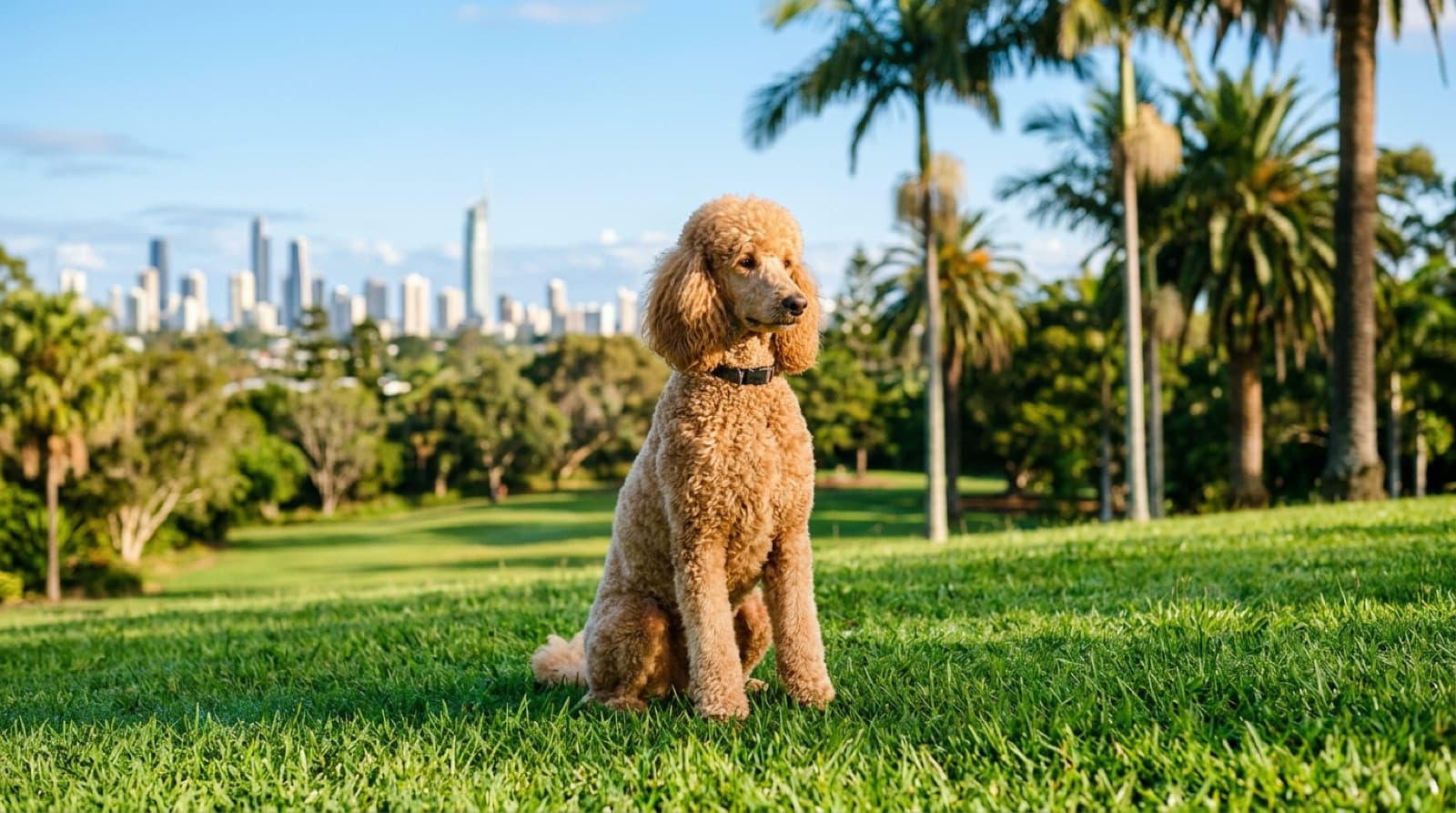
Standard Poodle.
A genuinely large, athletic dog, over 38 cm at the shoulder and often 20 to 30 kg, originally bred as a water retriever. Standards are active, need real daily exercise, and are one of the most trainable large dogs there is. They suit an active household with room, not a tiny apartment, and are less common in New Zealand rescue than the smaller sizes.
Miniature Poodle.
The popular middle size, about 28 to 38 cm and 7 to 8 kg. Smart, lively and adaptable, a Miniature Poodle manages well in an Auckland unit or a family home so long as it gets exercise and mental work. It is the size most likely to turn up in New Zealand rescue.
Toy Poodle.
A small companion dog under 28 cm and 3 to 4 kg, devoted and clever, well suited to apartment life and to owners who want a little dog to keep close. Toys are prone to some size-specific health issues (see the breed guide below) and, like all Poodles, need the same regular clipping.
And the doodles.
Poodle crosses, the Cavoodle, Spoodle, Groodle and Labradoodle, are bred in enormous numbers for the low-shedding appeal, and they are now one of the most common types in New Zealand rescue precisely because of that volume. A doodle inherits an unpredictable mix of its parent breeds, so a foster carer's notes on the individual dog tell you far more than the cross label does, and most doodles still need the same regular grooming a Poodle does. If a Cavoodle is what you are really after, see our Cavoodle breed guide.
Why Poodles and doodles reach rescue
The grooming is underestimated.
This is the big one. A Poodle's coat does not shed out; it keeps growing like human hair and mats to the skin without a professional clip every six to eight weeks, which is an ongoing cost and effort many owners did not plan for. Owners who did not plan for it sometimes surrender the dog, or let the coat mat so badly it has to be clipped off. The coat is the reason the breed is so wanted and the reason many end up in rescue, which is why it comes up again and again in this guide.
Size and energy surprises.
Standard Poodles are surrendered when their size and exercise needs surprise a household expecting a calm dog, and toys and minis when a cute puppy grows into a real dog with real needs. Poodles are intelligent and can be prone to separation anxiety, so an under-stimulated or frequently-alone Poodle can develop problem behaviours.
Housing, over-breeding and ex-breeding dogs.
Plenty of Auckland homes are rented or sit under a body corporate, and a move into a place that will not take a dog is a common surrender trigger, so check your lease or body corporate rules before you adopt. On top of that the doodle boom means huge numbers are bred, and volume alone feeds rescue. Poodles and doodles are also bred commercially, so when an operation is reduced or shut down, rescues take in ex-breeding dogs that often need patience and decompression but blossom into devoted pets.
Where to actually look in Auckland
- SPCA New Zealand. The country's oldest and largest animal welfare charity runs the Auckland Centre at Māngere (50 Westney Road, open daily, adoptions by appointment through its online application) alongside its other Auckland centre at Hobsonville, and Poodles, Poodle crosses and doodles come through across the year. Every SPCA dog is desexed, microchipped and vaccinated before adoption, the fee is the same at every centre, and the Dog Control Act requires the SPCA to register the dog before it goes home with you. Browse at spca.nz/adopt.
- Saving Hope Foundation. An Auckland no-kill dog rescue whose dogs live in foster homes across the city, with each listing naming the suburb. A foster carer who has lived with a Poodle or doodle for weeks can tell you exactly how it is with children, other pets and being left alone, which matters for a breed prone to separation anxiety. Listings at savinghope.co.nz.
- PAWS Restart. A smaller registered Auckland charity (CC61702) that rehomes dogs through foster care. Smaller rescues see fewer purebred Poodles at any one time, but small curly crosses come through, the matching is careful and the carer notes are detailed. Find them at pawsrestart.org.nz.
- Auckland Council animal shelters. Impounded dogs that are not claimed can be rehomed through the council, so it is worth checking the council's dogs and animals pages as well as the charities above.
The honest cost comparison
Real first-year costs in Auckland (for a Miniature Poodle; a Standard costs a little more to feed, a Toy a little less):
| First-year cost | Rescue Poodle | Breeder Poodle |
|---|---|---|
| Adoption fee or purchase price | $149 adult or $399 puppy at the SPCA (plus a $2.50 service charge) | Several thousand dollars |
| Desexing | Included | $300 to $600 |
| Microchipping | Included | Paid separately |
| First-year vaccinations | Included | $250 to $400 |
| Initial vet check | Included | $100 to $200 |
| Council registration (reduced fee if desexed and microchipped) | Set by Auckland Council (cheaper for a desexed dog) | Set by Auckland Council (cheaper for a desexed dog) |
| Professional grooming (6 to 8 clips a year) | $500 to $1,000 | $500 to $1,000 |
| Year 1 food | $500 to $1,000 or more | $500 to $1,000 or more |
| Parasite prevention (flea, worm, heartworm) | $300 to $550 | $300 to $550 |
| Initial gear (bed, lead, bowls, harness, brush) | $250 to $450 | $250 to $450 |
| Reward-based training class | $200 to $400 | $200 to $400 |
| Pet insurance (recommended) | $600 to $1,000 or more | $600 to $1,000 or more |
| Year 1 total (excluding council fee) | The adoption fee plus the everyday costs above | Several thousand dollars more, with the vet work still to pay |
The line to notice is grooming. Unlike most breeds, a Poodle carries a real, recurring grooming cost for its whole life, not just the first year, and it is the number most new owners forget to budget for. Get a quote from an Auckland groomer before you apply, not after, and read the coat section of our Poodle breed guide.
Browse Poodles available in Auckland rescue
Live listings from Auckland shelters and New Zealand rescues, including Poodles and doodle crosses. Foster carer notes describe individual size, temperament and coat before you apply.
See Available Poodles →What to expect from a rescue Poodle
- Very intelligent and trainable. Poodles are among the smartest breeds and thrive on reward-based training and mental work; a bored Poodle finds its own entertainment.
- People-focused, and prone to separation anxiety. The breed bonds hard and does best in a household that is around; build alone-time gradually with a new rescue dog.
- Active, especially the Standard. Standards need real daily exercise; miniatures and toys need less but still want a walk and a game every day.
- Low-shedding but high-maintenance coat. The trade-off of the breed: almost no hair on your clothes, but a coat that must be clipped and brushed regularly.
- Often good with families, though toys are delicate around very young children, so introductions should be careful.
- Mostly house-trained, sometimes needing a refresh for the new routine.
The first month home is a decompression period. The 3-3-3 rule applies: three days to decompress, three weeks to start showing personality, three months to fully settle.
Auckland weather, the summer clip and the kauri rule
Auckland changes the climate picture for a Poodle, mostly in good ways. New Zealand has none of the dangerous ticks that shape dog ownership across the Tasman, so there is no year-round tick emergency to plan around. What Auckland has instead is a mild, humid, often wet climate, and that changes the routine in smaller ways.
Humidity, rain and the coat. Auckland summers are warm and sticky rather than extreme, and the Poodle's single curly coat is easier to manage in that than a double coat: a shorter summer clip keeps the dog cool and mat-free, and plenty of Auckland owners use it. Still walk in the cooler hours, carry water and watch for heat stress on a humid afternoon. Winters are mild and wet, and a wet curly coat mats faster and hides skin trouble, so towel the dog off after a rainy walk, dry the ears, and keep the clipping schedule going through winter rather than letting the coat grow out. Fleas and intestinal worms stay active most of the year in a mild climate, so keep prevention continuous rather than seasonal, and ask your vet about heartworm risk for your area.
Where you can walk, and the kauri rule. Dogs in Auckland's council-controlled parks and beaches are on-leash by default, you must carry a lead, and off-leash access applies only where a place is listed for it, often with time-of-day or seasonal limits at beaches. The regional rules changed on 1 August 2025, so check the council's find where and when you can walk your dog page before you try a new beach. Large sections of the Waitākere Ranges are closed to stop the spread of kauri dieback, and some regional-park beaches prohibit dogs in part, so a west-coast bush walk with a Poodle needs planning rather than assuming. If something goes wrong after hours, Animal Emergency at VSA runs two 24-hour hospitals, at Sylvia Park in Mt Wellington and in Henderson, so know the route before you need it.
Registering your Poodle in Auckland, and avoiding scams
The Poodle is a companion and gundog breed and is not on the restricted list, so it is legal to own and rehome normally. New Zealand's dog law is the Dog Control Act 1996. Every dog older than three months must be registered with the council for the current registration year, a dog registered for the first time must be microchipped within two months of that registration, and when a dog changes hands both the old owner and the new owner must tell the council in writing within 14 days. Auckland Council sets its own fees: a desexed dog is markedly cheaper than an entire one, a Responsible Dog Owner Licence cuts the fee again, and paying before 1 August avoids the late rate, so a rescue Poodle, already desexed and microchipped, registers at the low end. Check the current figures on the Auckland Council registration page, and remember the SPCA must register a dog before it rehomes it, so an SPCA Poodle arrives already on the books.
On scams, New Zealand has no national breeder register, so there is no breeder registration number to check against a listing. That makes the old rules matter more: see the puppy with its mother at the seller's property, get the microchip number and vaccination record in writing, and never pay a deposit or a transport fee for a dog you have not met. Poodles and especially doodles are favourite bait breeds because they are so wanted, and a cheap or free doodle on Trade Me or Facebook with a story about being out of town is the classic setup. Adopting through the SPCA or a verified Auckland rescue avoids the problem entirely.
Frequently Asked Questions
Can you actually find a Poodle in Auckland rescue?
Yes, and Poodle crosses even more so. Purebred Poodles do reach New Zealand rescue, particularly miniatures and toys surrendered when the grooming commitment was underestimated, and older dogs from reduced breeding operations. Poodle crosses, the doodles (Cavoodle, Spoodle, Groodle, Labradoodle), are one of the most common types in New Zealand rescue now because they are bred in such numbers. SPCA New Zealand's Auckland centres at Māngere and Hobsonville see Poodles and Poodle crosses, and foster-based rescues such as Saving Hope Foundation and PAWS Restart place plenty of small curly-coated dogs. Set an alert and be ready to apply.
How much does it cost to adopt a Poodle in Auckland?
At SPCA New Zealand the fee is the same at every centre: $149 for a dog aged five months to eight years, $399 for a puppy under five months and $75 for a senior of nine or more, plus a $2.50 service charge, with desexing, microchipping and vaccination already done. Foster-based rescues set their own fee and show it on each listing. A breeder Poodle in New Zealand costs several thousand dollars, and a fashionable doodle cross often as much or more, before any of that vet work. On top of the adoption fee, budget for Auckland Council registration (cheaper for a desexed dog and cheaper again with a Responsible Dog Owner Licence) and, crucially for this breed, ongoing grooming, which is the real recurring cost of owning a Poodle and runs to several hundred dollars a year.
What is the difference between a toy, miniature and standard Poodle?
They are one breed in three sizes. The Standard Poodle is a genuinely large, athletic dog (over 38 cm at the shoulder, often 20 to 30 kg) originally bred as a water retriever, and it needs real daily exercise. The Miniature Poodle (about 28 to 38 cm, 7 to 8 kg) is the popular middle size, smart and active but apartment-manageable. The Toy Poodle (under 28 cm, 3 to 4 kg) is a small companion dog. All three share the same intelligence, the same curly non-shedding coat that must be clipped, and much of the same health picture, though some conditions skew by size. In New Zealand rescue, miniatures, toys and small doodle crosses are more common than standards.
Are Poodles hypoallergenic?
Low-shedding, but not truly allergen-free, which is a distinction worth making before you adopt. The Poodle's curly, single-layer coat sheds very little and traps loose hair rather than dropping it, which is why the breed and its crosses are marketed as hypoallergenic and why doodles are so popular. But dogs produce allergens in their dander and saliva as well as their hair, so a Poodle still carries them, just with far less loose hair spreading them around. If an allergy is your reason for the breed, spend real time with an individual dog before committing, because reactions vary from dog to dog.
Why do so many Poodles and doodles end up in rescue?
Mostly because the grooming commitment is underestimated. A Poodle's coat does not shed out; it grows continuously and mats to the skin without regular clipping every six to eight weeks, which is an ongoing cost and effort many owners did not plan for. Standards are also surrendered when their size and energy surprise a household, toys and minis when a cute puppy becomes a real dog, and doodles in large numbers simply because they are bred in such volume for a booming market. A smaller group come from reduced or shut-down breeding operations. None of it reflects the dog, which is why rescue Poodles are so often lovely, already-grown companions.
How can I tell if a Poodle or doodle advertised online is a scam?
New Zealand has no national breeder register, so there is no breeder registration number to check against a listing. Rely on the basics instead: see the puppy with its mother at the seller's property, get the microchip number and vaccination record in writing, and never pay a deposit or a transport fee for a dog you have not met. Poodles and especially doodles are favourite bait breeds for scammers because they are so wanted, and a cheap or free doodle on Trade Me or Facebook with a story about being out of town is the classic setup. Adopting through the SPCA or a verified Auckland rescue avoids the problem entirely.
Keep reading
Adoptable Poodles in Auckland
Live listings with foster carer notes on size, temperament and coat.
Poodle Breed Guide
The three sizes, the coat that must be clipped, Addison disease, sebaceous adenitis, hips and patellas, and bloat in Standards.
The Best Dog Rescues in Auckland
SPCA New Zealand, Saving Hope Foundation and PAWS Restart compared: how each works and what the fee covers.
Auckland Adoption Resources
Guides on adopting, costs, council rules and settling a rescue dog in Auckland.