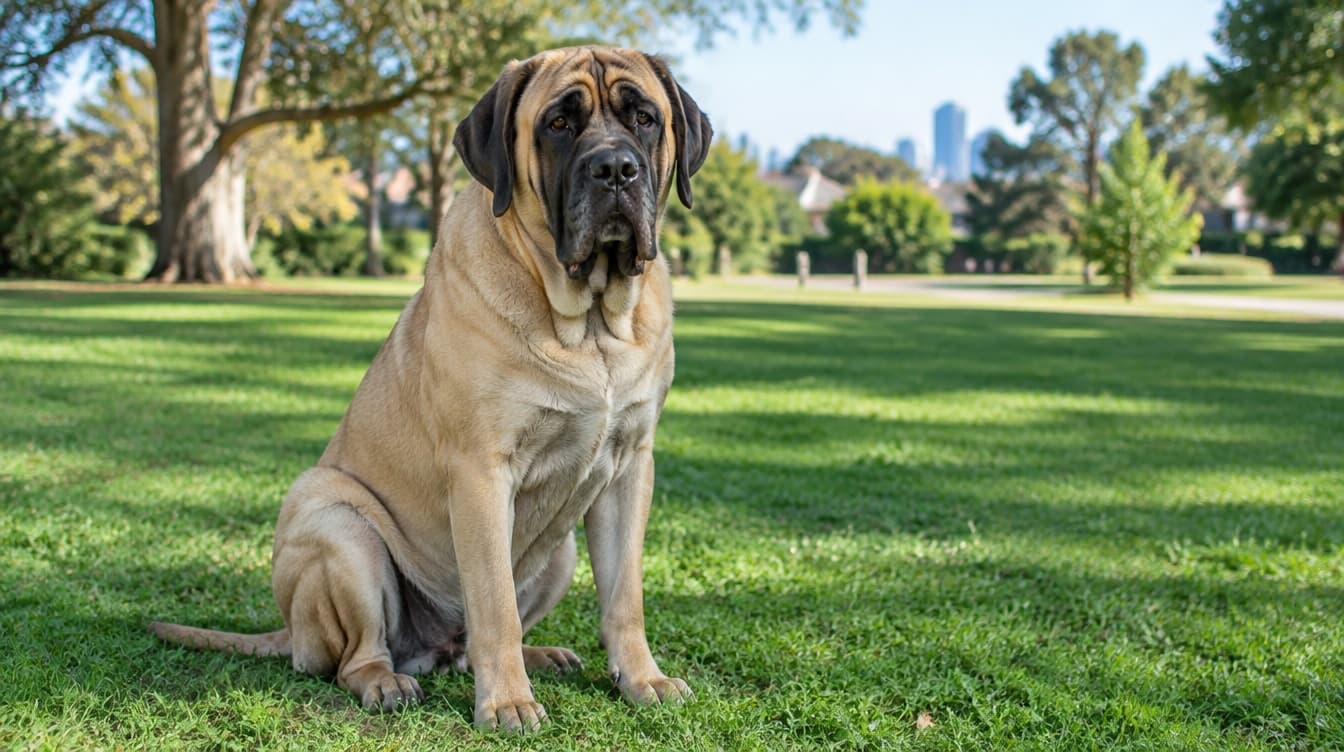
The short answer
You can adopt a Mastiff in Auckland, but be honest about the size. This is a giant, calm guardian breed for experienced owners, not a first dog, and most reach rescue because the size, cost, space or guarding needs outran the home. Purebreds are uncommon in rescue, so set alerts across SPCA New Zealand (Auckland centres at Māngere and Hobsonville) and foster-based rescues such as Saving Hope Foundation and PAWS Restart, be application-ready, and stay open to a cross or an older dog. An adult Mastiff costs $149 to adopt at the SPCA with desexing, microchipping and vaccination done, against several thousand dollars from a breeder, and the breed is not restricted in New Zealand. The Mastiff needs early socialisation, steady reward-based training while it is still small enough to guide, space, a giant-dog budget, and cool management on Auckland's humid summer days. Meet those needs and you have one of the calmest, most devoted guardians there is.
Why Mastiffs end up in New Zealand rescue
With a giant guardian breed, the honest first lesson is why they land in rescue, because it tells you whether the breed is right for you.
The puppy is manageable, the adult is enormous. A Mastiff is one of the heaviest breeds there is. People take on a big-pawed puppy and underestimate the giant it becomes: eating and vetted at giant-dog scale, drooling, needing space, and needing its training done while it is still small enough to guide. When that reality lands, some owners cannot keep up.
Housing and cost. A move to a rental or body corporate that will not take a giant guardian breed can cost an owner the dog, and plenty of Auckland homes are rented or sit under a body corporate. The ongoing cost of feeding and vetting a giant breed catches people out too.
Socialisation and the guarding instinct. A Mastiff is a guardian, naturally watchful and wary of strangers. One that was never taught that visitors and other dogs are normal becomes hard to manage at that size, and the behaviour, almost always a socialisation gap rather than a bad dog, is why rescues assess these dogs carefully and look for experienced homes.
What this means for you. A Mastiff in rescue is rarely a broken dog. It is usually a calm guardian whose size, cost or need for training outran its last home. If you have experience with large or guardian breeds, the space and budget, and a cool spot for the humid days, you are looking at a wonderful adoption.
Where to adopt a Mastiff or cross in Auckland
Because Mastiffs are uncommon in general rescue, a wide alert net is the right approach. Set listing alerts on every rescue you would consider, and check the council shelters, which see plenty of big dogs. Expect a careful application process, which is the mark of a responsible rescue placing a giant guardian. For a fuller directory, see our Auckland adoption resources hub.
1. SPCA New Zealand
The country's oldest and largest animal welfare charity runs the Auckland Centre at Māngere (50 Westney Road, open daily, adoptions by appointment through its online application) alongside its other Auckland centre at Hobsonville. Giant and guardian breeds are uncommon on the roster but do appear, more often as crosses. Every SPCA dog is desexed, microchipped and vaccinated before adoption, the fee is the same at every centre, and the Dog Control Act requires the SPCA to register the dog before it goes home with you. Staff can give you an honest read on how the dog is with people and other animals before you commit, which matters a great deal with a giant guardian. Browse at spca.nz/adopt.
2. Saving Hope Foundation and PAWS Restart
Saving Hope Foundation is an Auckland no-kill dog rescue whose dogs live in foster homes across the city, with each listing naming the suburb, at savinghope.co.nz. PAWS Restart is a smaller registered Auckland charity (CC61702) that rehomes dogs through foster care, at pawsrestart.org.nz. Because the dogs live in foster homes, the notes on a Mastiff's temperament, guarding drive, health and behaviour with people and other animals tend to be detailed and honest, which is exactly what you need to match a giant guardian to the right household.
3. Auckland Council animal shelters
Impounded dogs that are not claimed can be rehomed through the council, and big guardian breeds and their crosses turn up there more often than in the charities, so check the council's dogs and animals pages alongside the rescues above. A council dog comes with less history, so ask what assessment has been done and plan a careful introduction.
Be wary of any group calling itself a Mastiff rescue that asks for money before you have confirmed a real address, a current adoptable-dog list and charitable status. Browse the current Mastiffs and crosses on the Auckland Mastiff listings.
What a Mastiff costs: adopt versus buy
Adoption is far cheaper at the outset. At SPCA New Zealand the fee is the same at every centre: $149 for a dog aged five months to eight years, $399 for a puppy under five months and $75 for a senior of nine or more, plus a $2.50 service charge, with desexing, microchipping and vaccination already done. Foster-based rescues set their own fee and show it on each listing.
A Mastiff from a breeder in New Zealand, by contrast, typically costs several thousand dollars, with none of that vet work done yet. So adopting is many times cheaper up front, the dog arrives already vetted, and an assessed adult lets you see the real size and temperament rather than gamble on a puppy of a breed where socialisation is everything.
The ongoing cost is a giant-dog one, and it is the honest part. Budget for large food quantities, year-round flea and worm prevention with a vet-recommended product, because both stay active in Auckland's mild climate, giant-dog vet care, good reward-based training with someone who knows guardian breeds, a cool spot for the humid summer days, and pet insurance taken out while the dog is young. Council registration under the Dog Control Act 1996 is an annual fee set by Auckland Council, markedly cheaper for a desexed dog, cheaper again with a Responsible Dog Owner Licence, and cheaper if you pay before 1 August.
Not restricted in New Zealand, and the weather to manage
It is worth stating plainly, because people assume any giant guardian breed is restricted. The Mastiff is not a restricted breed in New Zealand. Schedule 4 of the Dog Control Act 1996 lists the Brazilian Fila, Dogo Argentino, Japanese Tosa, Perro de Presa Canario and the American Pit Bull Terrier type, which must be classified as menacing, and the Mastiff is not among them. It is legal to own and to rehome normally. Every dog older than three months must be registered with the council for the current registration year, a dog registered for the first time must be microchipped within two months of that registration, and when a dog changes hands both the old owner and the new owner must tell the council in writing within 14 days. A rescue Mastiff arrives already desexed and microchipped, so it registers at the low rate; check the current figures on the Auckland Council registration page before you rely on a figure, and remember the SPCA must register a dog before it rehomes it.
Three practical points matter more than the law. First, housing: some Auckland landlords and body corporate schemes are cautious about giant guardian breeds, so if you rent or live under a body corporate, confirm dogs are allowed and be ready to reassure. Second, the weather: there is no tick in New Zealand that paralyses dogs, and Auckland's mild, wet climate suits a heavy dog for most of the year, but a Mastiff carries a lot of mass and often a shortened muzzle, so on humid summer days give it a cool space, exercise in the cool of the morning and evening, shade and water, and watch for heat stress, which escalates fast in a giant dog; in the wet winter, dry the coat and the skin folds after a rainy walk. Third, where you can walk: dogs in Auckland's council-controlled parks and beaches are on-leash by default, you must carry a lead, and off-leash access applies only where a place is listed for it on the council's find where and when you can walk your dog page, with the rules changed on 1 August 2025, and large sections of the Waitākere Ranges are closed for kauri dieback. If something goes wrong after hours, and bloat in a deep-chested giant is the emergency to know about, Animal Emergency at VSA runs two 24-hour hospitals, at Sylvia Park in Mt Wellington and in Henderson.
Browse adoptable Mastiffs in Auckland
Mastiffs are uncommon in rescue, so crosses and older dogs appear more often than purebred puppies. Browse live New Zealand listings and set an alert.
See Available Mastiffs →If you have been searching “Mastiff for sale Auckland”
Plenty of people arrive here after searching for a Mastiff to buy, because the for-sale listings outnumber the rescue ones. Reputable breeders exist, but before you spend anything, know that the online market for giant purebred puppies is a target for scams and backyard breeding, and a breed where early socialisation matters this much is the worst one to get from a careless source. A cheap puppy or a deposit request for a dog you have not met in person is a warning sign rather than a bargain, and a cheap or free Mastiff on Trade Me or Facebook with a story about being out of town is the classic setup.
New Zealand has no national breeder register, so there is no breeder number to check, and that makes the old rules matter more: see the puppy with its mother at the seller's property, get the microchip number and vaccination record in writing, and never pay a deposit or a transport fee for a dog you have not met. A seller who will not show you both healthy parents at their property is a red flag rather than a mark of quality. Adoption sidesteps much of that: it costs a fraction of a breeder price, gives a vet-checked dog a home, and an assessed adult asks far less guesswork about temperament and size. The Mastiff breed guide covers what to look for in a well-raised dog.
Adult or puppy, and is a Mastiff right for you?
For almost every adopter an assessed adult is the more responsible choice, and Mastiff puppies are rare in rescue anyway. An adult shows you the real size, temperament and how it copes with humid days and with people, where a puppy grows alarmingly fast and needs careful joint-friendly exercise and feeding plus early socialisation through its first months. An adult often has some training in place and a lower adoption fee, and the rescue can tell you how the dog is with people, children and other animals.
Be honest about the fit. A Mastiff is a calm, devoted giant guardian for an experienced owner with space, a giant-dog budget and a cool spot for summer, who will socialise and train it gently while it is young and accept the drool and the scale. It is not a first dog, not a match for a small flat, and rescues will usually look for experience with large or guardian breeds. Meet its needs and it is one of the steadiest, most affectionate companions there is. If you cannot, a smaller breed will suit you both far better than adopting and surrendering later.
Frequently Asked Questions
Where can I adopt a Mastiff near me in Auckland?
Start with SPCA New Zealand, whose Auckland centres are at Māngere and Hobsonville, and the foster-based Auckland rescues Saving Hope Foundation and PAWS Restart, then check the Auckland Council animal shelters, which rehome unclaimed impounded dogs and see plenty of big dogs. Be realistic about supply. Purebred Mastiffs are uncommon in rescue, so Mastiff crosses, often blended with other large or bully breeds, show up more often than full purebreds. The best approach is to set listing alerts across every rescue you would consider, have your application and references ready, and stay open to a cross or an older dog. Rescues assess big guardian dogs carefully, so expect a thorough application. Never send money before you have confirmed a real, registered rescue.
Why do Mastiffs end up in rescue?
Almost always because the scale of the dog outran the home, not because of the temperament. A Mastiff is one of the heaviest breeds there is, and a manageable puppy becomes a giant that eats and is vetted at giant-dog scale, drools, needs space and needs its training done while it is still small enough to guide. Many owners underestimate all of that. A move to a rental or body corporate that will not take a giant guardian breed, which bites hard in Auckland where plenty of homes are rented or sit under a body corporate, costs some owners the dog. The guarding instinct matters too: a Mastiff that was not socialised becomes wary and hard to manage at that size, and ends up surrendered. The nature is usually intact; most just needed an experienced owner who understood they took on a giant guardian, not an easy first dog.
How much does it cost to adopt a Mastiff versus buy one?
Adoption is far cheaper up front. At SPCA New Zealand the fee is the same at every centre: $149 for a dog aged five months to eight years, $399 for a puppy under five months and $75 for a senior of nine or more, plus a $2.50 service charge, with desexing, microchipping and vaccination already done. Foster-based rescues set their own fee and show it on each listing. A Mastiff from a breeder in New Zealand, by contrast, typically costs several thousand dollars, with none of that vet work done yet. So adopting is many times cheaper at the outset and the dog arrives already vetted. Where a Mastiff gets expensive is the ongoing care. It is a giant breed, so budget for large food quantities, year-round flea and worm prevention, giant-dog vet care, quality reward-based training, and pet insurance you take out while the dog is young.
Are Mastiffs restricted in New Zealand?
No. The Mastiff is not a restricted breed in New Zealand. Schedule 4 of the Dog Control Act 1996 lists the Brazilian Fila, Dogo Argentino, Japanese Tosa, Perro de Presa Canario and the American Pit Bull Terrier type, which must be classified as menacing, and the Mastiff is not among them. It is legal to own and to rehome normally, and like any dog it simply needs to be registered with the council once it is older than three months and microchipped within two months of its first registration. Auckland Council charges markedly less for a desexed dog, which a rescue Mastiff already is. People sometimes assume any large guardian breed is restricted, which is not the case here. The real issue is housing rather than law: some Auckland landlords and body corporate schemes are cautious about giant guardian breeds, so the work is being an organised, reassuring applicant. Check the current registration fees on the Auckland Council page before you rely on a figure.
Can a Mastiff cope with the Auckland climate?
Better than in a hot climate, with a little care. There is no tick in New Zealand that paralyses dogs, and Auckland's mild, wet climate suits a heavy dog for most of the year. The humid summer days are the thing to manage: a Mastiff carries a lot of body mass and many have a degree of shortened muzzle, so it does not shed heat well. Give it a reliably cool space on sticky days, exercise limited to the cool of the morning and evening, constant shade and water, and a close eye for heat stress, which escalates fast in a giant dog. In the wet winter, dry the coat and the skin folds after a rainy walk, because damp folds get sore. Gentle, moderate exercise suits the breed anyway, so the main job is simply avoiding the heat of the day.
Are Mastiffs good family dogs?
They can be wonderful family dogs with an experienced owner and proper training. A well-raised Mastiff is calm, gentle, devoted and naturally protective of its household, and many are patient and tolerant with the children they live with. The catches are size and the guarding instinct: a dog this large can knock over a small child without meaning to, so supervision is basic sense, and early socialisation and steady, reward-based training are not optional with a giant guardian. It needs to learn that visitors and other dogs are normal while it is still small enough to guide. The foster carer's notes on a specific dog with children predict the fit far better than the breed average, so ask.
Is a Mastiff a good first dog?
For most first-time owners, no. A Mastiff is a giant, powerful guardian with a protective streak, and it needs confident, consistent handling, early socialisation and reward-based training while it is still manageable in size. A poorly-socialised, under-trained giant is a serious liability simply because of its scale, and that is a lot to take on cold. It is also a big commitment of money and space. Most rescues will look for a home with experience of large or guardian breeds. If this would be your first dog, be honest with the rescue about your experience and let them steer you toward a breed that fits your life.
Is it safe to buy a Mastiff online?
Be careful. Giant purebred puppies are high-value and a target for scams and backyard breeding, and a breed where early socialisation matters this much is the worst one to get from a careless source. New Zealand has no national breeder register, so there is no breeder number to check. Rely on the basics instead: see the puppy with its mother at the seller's property, get the microchip number and vaccination record in writing, and never pay a deposit or a transport fee for a dog you have not met. A cheap or free Mastiff on Trade Me or Facebook with a story about being out of town is the classic setup. Adoption sidesteps most of that risk, costs a fraction of a breeder price, and an assessed adult tells you what you are taking on.
Keep reading
Adoptable Mastiffs in Auckland
Live listings of Mastiffs and crosses across Auckland and New Zealand rescues.
Mastiff Breed Guide
The guardian temperament, socialisation, joint and heat care, bloat, and what a giant breed needs day to day.
The Best Dog Rescues in Auckland
SPCA New Zealand, Saving Hope Foundation and PAWS Restart compared: how each works and what the fee covers.
Auckland Adoption Resources
Guides on adopting, costs, council rules and settling a rescue dog in Auckland.