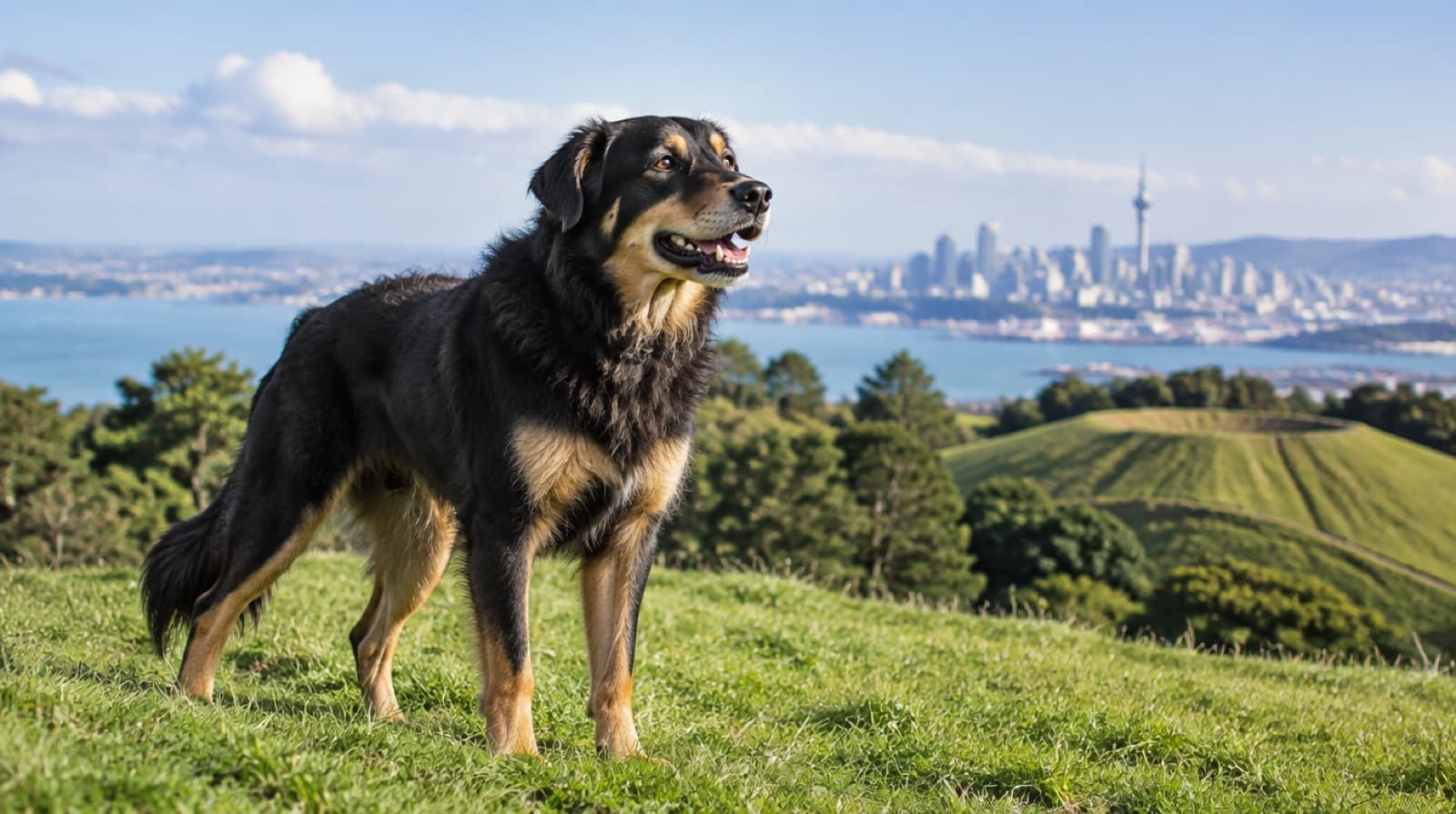
The short answer
Huntaways and Huntaway crosses appear in Auckland rescue through SPCA New Zealand (Auckland centres at Māngere and Hobsonville), foster-based rescues such as Saving Hope Foundation and PAWS Restart, and the Auckland Council shelters, mostly as dogs leaving farm life or as crosses with Collie, Kelpie or Labrador. An adult costs $149 to adopt at the SPCA with desexing, microchipping and vaccination done, against several thousand dollars for a breeder puppy. Size and shape vary widely, the coat can be long and shaggy or smooth, and every Huntaway is bred to bark, so the breed needs a fenced section with some distance from the neighbours, a lot of daily exercise and a job for the mind. An adult rescue dog with a known temperament is the easier fit; a young farm dog that has never lived in a house is the harder one.
Why Huntaways end up in New Zealand rescue
The Huntaway was bred on New Zealand farms for heading sheep, forcing them into pens, backing (jumping onto the backs of sheep packed in a yard) and working them in yards and woolsheds, and Dogs NZ lists the NZ Huntaway in its Working group. What sets it apart is the voice: every Huntaway is selected for a loud, deep bark on command, because it moves stock with sound. That working background explains almost every reason the breed reaches rescue, and none of them reflect on the dog.
Dogs leaving farm life.
Working dogs that did not make the grade, dogs retired from the job, and litters from working parents that never had a farm to go to all find their way to rescue. These dogs often have never lived in a house, so ask the rescue what the dog knows about indoor life before you assume it is house-trained.
The bark.
A dog bred to bark does not stop because it has moved to the suburbs. Households that took on a Huntaway without planning for the noise, especially on a small section with close neighbours, surrender dogs that were simply doing what they were bred for.
Energy without a job.
A Huntaway needs a lot of exercise and something to do. A bored farm dog in a backyard digs, barks and escapes, and plenty of surrenders happen in the adolescent stage when that energy peaks and the household is not set up for it.
Crosses from town.
Many rescue Huntaways are crosses, often with Collie, Kelpie or Labrador, from unplanned litters rather than farms. A cross can carry the bark and the drive, or very little of either, so the foster carer's notes on the individual dog matter more than the label.
Where to actually look in Auckland
- SPCA New Zealand. The country's oldest and largest animal welfare charity runs the Auckland Centre at Māngere (50 Westney Road, open daily, adoptions by appointment through its online application) alongside its other Auckland centre at Hobsonville, and Huntaways and Huntaway crosses come through regularly. Every SPCA dog is desexed, microchipped and vaccinated before adoption, the fee is the same at every centre, and the Dog Control Act requires the SPCA to register the dog before it goes home with you. Browse at spca.nz/adopt.
- Saving Hope Foundation. An Auckland no-kill dog rescue whose dogs live in foster homes across the city, with each listing naming the suburb. A foster carer who has lived with a Huntaway for weeks can tell you exactly how much it barks, how it is with children and other pets, and whether it settles indoors, which is the single most useful thing to know before you commit. Listings at savinghope.co.nz.
- PAWS Restart. A smaller registered Auckland charity (CC61702) that rehomes dogs through foster care. Smaller rescues see fewer Huntaways at any one time, but the matching is careful and the carer notes are detailed. Find them at pawsrestart.org.nz.
- The Retired Working Dogs NZ Charitable Trust. Not an Auckland shelter but a registered charity (CC55572) based in the Wairarapa, at West Taratahi near Masterton, whose purpose is to find homes for retired working dogs leaving farms, including Huntaways and heading dogs, or to foster those that cannot be rehomed for medical reasons. It operates as a national listing network, so dogs can be anywhere in the country, and its adoption process and fee are not something we have been able to verify from its own site, so treat both as directional and ask. The charity entry is at register.charities.govt.nz.
- Auckland Council animal shelters. Impounded dogs that are not claimed can be rehomed through the council, and farm-type dogs are a regular sight in the pound, so it is worth checking the council's dogs and animals pages as well as the charities above.
Farm dog or cross, and what the difference means
Two kinds of Huntaway reach Auckland rescue, and which one you take on shapes the first months.
The working dog leaving a farm.
Bred and raised to work stock, usually black and tan, with the full voice and the full drive. Te Ara describes the breed as generally good-natured and anxious to please, and that eagerness is what makes a farm dog trainable in a home. The gap is experience: stairs, floors, traffic, being left alone in a house and living without a job are all new. An adult farm dog with a steady temperament can make the move well, but it needs space, time and an owner who will give it work.
The cross from town.
A Huntaway crossed with a Collie, Kelpie or Labrador is more common in rescue than a pure farm dog and usually has lived in a home already. The bark and the energy vary from dog to dog, so the foster notes are the guide. A Labrador cross often brings a softer, more food-driven temperament; a Collie or Kelpie cross usually brings more drive, not less.
Type matters, but individual temperament matters more, and the foster or shelter notes give the best read on any specific dog.
The honest cost comparison
Real first-year costs in Auckland:
| First-year cost | Rescue Huntaway | Breeder Huntaway |
|---|---|---|
| Adoption fee or purchase price | $149 adult or $399 puppy at the SPCA (plus a $2.50 service charge) | Several thousand dollars |
| Desexing | Included | $400 to $700 |
| Microchipping | Included | Paid separately |
| First-year vaccinations | Included | $150 to $250 |
| Initial vet check | Included | $100 to $200 |
| Council registration (reduced fee if desexed and microchipped) | Set by Auckland Council (cheaper for a desexed dog) | Set by Auckland Council (cheaper for a desexed dog) |
| Year 1 food (active medium to large breed) | $900 to $1,500 | $900 to $1,500 |
| Parasite prevention (flea, worm, heartworm) | $350 to $600 | $350 to $600 |
| Initial gear (large bed, lead, crate, bowls, harness, long line) | $300 to $500 | $300 to $500 |
| Reward-based training class | $200 to $400 | $200 to $400 |
| Pet insurance (recommended) | $900 to $1,500 | $900 to $1,500 |
| Year 1 total (excluding council fee) | The adoption fee plus the everyday costs above | Several thousand dollars more, with the vet work still to pay |
Rescue saves several thousand dollars in year one, and the ongoing costs are identical. Two lines deserve attention for a Huntaway in Auckland: training, because a dog bred to bark needs an outlet and an off switch taught early, and pet insurance, which is worth it given the inherited defects Te Ara lists in New Zealand working dogs: hip dysplasia, which excess weight makes worse, jaw faults, cleft palate and retina problems that can cause early blindness. The breed detail is in our Huntaway breed guide.
Browse Huntaways available in Auckland rescue
Live listings from Auckland shelters and New Zealand rescues. Foster carer notes describe each dog's energy level, how much it barks and its household fit before you apply.
See Available Huntaways →What to expect from a rescue Huntaway
A typical Auckland rescue Huntaway is:
- An adolescent or adult. Pure Huntaway puppies are the exception in rescue; dogs leaving farm life and crosses from town make up most listings, and a settled adult is usually the easier dog.
- Big and strongly built, with size and shape that vary widely. Dogs NZ calls the breed medium to large and the coat can be long and shaggy or smooth, usually black and tan. We do not publish a weight, height or lifespan because no source we rely on gives one; the listing gives that dog's own size.
- Bred to bark. The defining breed trait: a loud, deep bark selected for moving stock, which needs an outlet, an off switch and neighbours at a sensible distance.
- Good-natured and anxious to please. Te Ara's description of the breed, and it is what makes a farm dog trainable in a home. The exceptions are noted in the listings.
- High energy with a need for a job. A lot of daily exercise plus training, a dog sport or scent work; a Huntaway with nothing to do makes its own entertainment.
- Possibly new to living indoors, if it has come straight from a farm, so house-training and alone-time may need building from scratch.
- Worth a joint and eye check. Te Ara lists hip dysplasia and retina problems among the inherited defects in New Zealand working dogs, and keeping the dog lean protects the hips.
The first weeks ask more of you than they would with a companion breed, because a farm dog is learning a whole new life. The 3-3-3 rule still applies: three days to decompress, three weeks to start showing personality, three months to fully settle.
The first week home: a realistic plan
Day 1:
- Bring the dog home during daylight hours, and walk the fence line first: a farm dog that wants out will find the weak point
- Show them their bed, food and water area, somewhere quiet and indoors, even if the dog has only ever slept outside
- Keep it calm: skip introductions to extended family and other dogs for now
- A short, gentle walk on lead in the cool of the late afternoon, not the heat of the day
Days 2 to 3:
- Two walks daily, 30 to 45 minutes each, timed to avoid the midday heat, always with water
- Establish a measured meal routine and weigh the food, because a lean Huntaway is a Huntaway with better hips
- Begin reward-based training (name response, sit, recall on a long line), and start teaching a quiet cue the first time the dog barks and stops
Days 4 to 7:
- Longer walks and some off-lead time in a fully fenced dog off-leash area, in the cool hours, once recall is reliable on the long line
- First vet visit for a baseline weight and body-condition score, a hip, jaw and eye check, and a year-round flea and worm prevention plan
- Begin building short alone-time periods so the dog learns the new home is safe when empty, and listen from the street for barking while you are out
Huntaways and Auckland living
- House and section. A Huntaway is happiest with a securely fenced section, easy outdoor access and some distance from the neighbours, and the breed does best living inside with the family rather than banished to the yard, where a bored dog barks. Apartments are a poor fit for a dog bred to bark. Plenty of Auckland homes are rented or sit under a body corporate, so check the pet rules and the noise rules in writing before you apply.
- Exercise and a job. A lot of daily activity keeps a Huntaway balanced, and the mind matters as much as the legs: training, scent work, agility or a long off-leash run in a fenced area all count. A dog that was bred to work all day will not be satisfied by a walk around the block.
- Off-leash areas. Auckland Council lists every off-leash park and beach section, with the times that apply, on its find where and when you can walk your dog page, and a fully fenced park is the safe place to let a strong, keen Huntaway run loose. The default everywhere else is on-leash with a lead in hand, and the rules changed in August 2025, so check before you go. A dog bred to move sheep should stay on lead anywhere stock could be nearby.
- Weight and joints. Keeping a Huntaway lean is the single most protective everyday thing you can do for its hips, because Te Ara notes that hip dysplasia in New Zealand working dogs is made worse by excess weight.
Auckland weather, a shaggy coat and the kauri rule
Auckland is kind to a farm dog. New Zealand has no tick that paralyses dogs, so there is no year-round tick emergency to plan for. What Auckland has instead is a mild, humid, often wet climate, and that changes the routine in smaller ways.
Humidity, rain and the coat. Auckland summers are warm and sticky rather than extreme, but a keen Huntaway will still push itself on a humid afternoon, so walk and run in the cooler hours, carry water and watch for heat stress. Winters are mild and wet, which a farm dog shrugs off, but a long shaggy coat holds the wet, so dry the dog properly after a rainy walk and check the skin under the coat now and then. Fleas and intestinal worms stay active most of the year in a mild climate, so keep prevention continuous rather than seasonal, and ask your vet about heartworm risk for your area.
Where you can walk, and the kauri rule. Dogs in Auckland's council-controlled parks and beaches are on-leash by default, you must carry a lead, and off-leash access applies only where a place is listed for it, often with time-of-day or seasonal limits at beaches. The regional rules changed on 1 August 2025, so check the council's find where and when you can walk your dog page before you try a new beach. Large sections of the Waitākere Ranges are closed to stop the spread of kauri dieback, and some regional-park beaches prohibit dogs in part, so a west-coast bush walk with a Huntaway needs planning rather than assuming. If something goes wrong after hours, Animal Emergency at VSA runs two 24-hour hospitals, at Sylvia Park in Mt Wellington and in Henderson, so know the route before you need it.
Registering your Huntaway in Auckland, and avoiding scams
New Zealand's dog law is the Dog Control Act 1996. Every dog older than three months must be registered with the council for the current registration year, a dog registered for the first time must be microchipped within two months of that registration, and when a dog changes hands both the old owner and the new owner must tell the council in writing within 14 days. The Act exempts registered working dogs from microchipping, but that applies to a dog registered as a working dog on a farm, not to a pet Huntaway in Auckland, which is microchipped like any other dog. Auckland Council sets its own fees: a desexed dog is markedly cheaper than an entire one, a Responsible Dog Owner Licence cuts the fee again, and paying before 1 August avoids the late rate, so a rescue Huntaway, already desexed and microchipped, registers at the low end. Check the current figures on the Auckland Council registration page, and remember the SPCA must register a dog before it rehomes it, so an SPCA Huntaway arrives already on the books.
On scams, New Zealand has no national breeder register, so there is no breeder number to check. That makes the old rules matter more: see the puppy with its mother at the seller's property, get the microchip number and vaccination record in writing, and never pay a deposit or a transport fee for a dog you have not met. A cheap or free Huntaway on Trade Me or Facebook with a story about being out of town is the classic setup. Adopting through the SPCA or a verified Auckland rescue avoids the problem entirely.
Frequently Asked Questions
Can you actually find a Huntaway in Auckland rescue?
Yes. The Huntaway is New Zealand's own farm dog, and dogs leaving farm life, along with Huntaway crosses bred in town, come through SPCA New Zealand's Auckland centres at Māngere and Hobsonville, through foster-based rescues such as Saving Hope Foundation and PAWS Restart, and through the Auckland Council shelters. Many rescue Huntaways are crosses, often with Collie, Kelpie or Labrador. Most are adolescents or adults, pure Huntaway puppies are the exception, and an adult whose temperament and energy are already known is usually the easier dog.
How much does it cost to adopt a Huntaway in Auckland?
At SPCA New Zealand the fee is the same at every centre: $149 for a dog aged five months to eight years, $399 for a puppy under five months and $75 for a senior of nine or more, plus a $2.50 service charge, with desexing, microchipping and vaccination already done. Foster-based rescues set their own fee and show it on each listing. A breeder puppy in New Zealand typically costs several thousand dollars before any of that vet work. On top of the adoption fee you pay Auckland Council registration, which is cheaper for a desexed dog and cheaper again with a Responsible Dog Owner Licence, so a rescue Huntaway registers at the low rate.
Do Huntaways bark a lot, and is that a problem in Auckland?
Yes, it is what they are bred for. Every Huntaway is selected for a loud, deep bark rather than yapping, and on farms they bark on command to move sheep. In a suburban home that instinct does not switch off, so a Huntaway on a small section with close neighbours is a real risk of complaints. Plan for plenty of exercise, training that gives the bark an outlet and an off switch, and company during the day, and think hard about how close your neighbours are before you adopt.
Are Huntaways good family pets?
They can be. Te Ara describes them as generally good-natured and anxious to please, and Dogs NZ lists the NZ Huntaway in its Working group. The bigger questions are space, exercise and noise: a Huntaway is a working dog with a lot of energy and a strong bark, and it needs something to do. An adult rescue Huntaway whose temperament and energy are already known is often an easier fit than a young dog, and the foster or shelter notes tell you how a specific dog is with children and other pets.
How big does a Huntaway get?
Size and shape vary widely. Te Ara describes the Huntaway as a big, strongly built all-rounder whose size and shape vary a lot, and Dogs NZ calls the breed medium to large, with coats that can be long and shaggy or smooth, usually black and tan. No source we rely on gives a weight, height or lifespan, so we do not publish one. Each rescue listing gives that dog's own size, which tells you far more than a breed average.
What health problems do Huntaways have?
Te Ara lists inherited defects seen in New Zealand working dogs, including hip dysplasia, which excess weight makes worse, jaw faults (undershot or overshot), cleft palate, and retina problems that can cause early blindness. Keeping a Huntaway lean is the single most protective everyday thing you can do for its hips, and it is worth asking your vet to check joints and eyes at the first visit.
Do Huntaways cope with the Auckland climate?
Yes, Auckland suits a farm dog well. New Zealand has no tick that paralyses dogs, summers are warm and humid rather than extreme, and winters are mild and wet. Exercise in the cool of the morning or evening on humid days and carry water, and in winter dry a long shaggy coat properly after a wet walk, because a damp coat left to sit is how skin trouble starts. Keep flea and worm prevention continuous in a mild climate, and ask your vet about heartworm risk for your area.
How can I tell if a Huntaway advertised online is a scam?
New Zealand has no national breeder register, so there is no breeder number to check. Rely on the basics instead: see the puppy with its mother at the seller's property, get the microchip number and vaccination record in writing, and never pay a deposit or a transport fee for a dog you have not met. A cheap or free Huntaway on Trade Me or Facebook with a story about being out of town is the classic setup. Adopting through the SPCA or a verified Auckland rescue avoids the problem entirely.
Keep reading
Adoptable Huntaways in Auckland
Live listings with foster carer notes on temperament, barking and family fit.
Huntaway Breed Guide
The breed guide: the bark, the working background, inherited hip and eye problems, and what a Huntaway needs day to day.
The Best Dog Rescues in Auckland
SPCA New Zealand, Saving Hope Foundation and PAWS Restart compared: how each works and what the fee covers.
Auckland Adoption Resources
Guides on adopting, costs, council rules and settling a rescue dog in Auckland.