The short answer
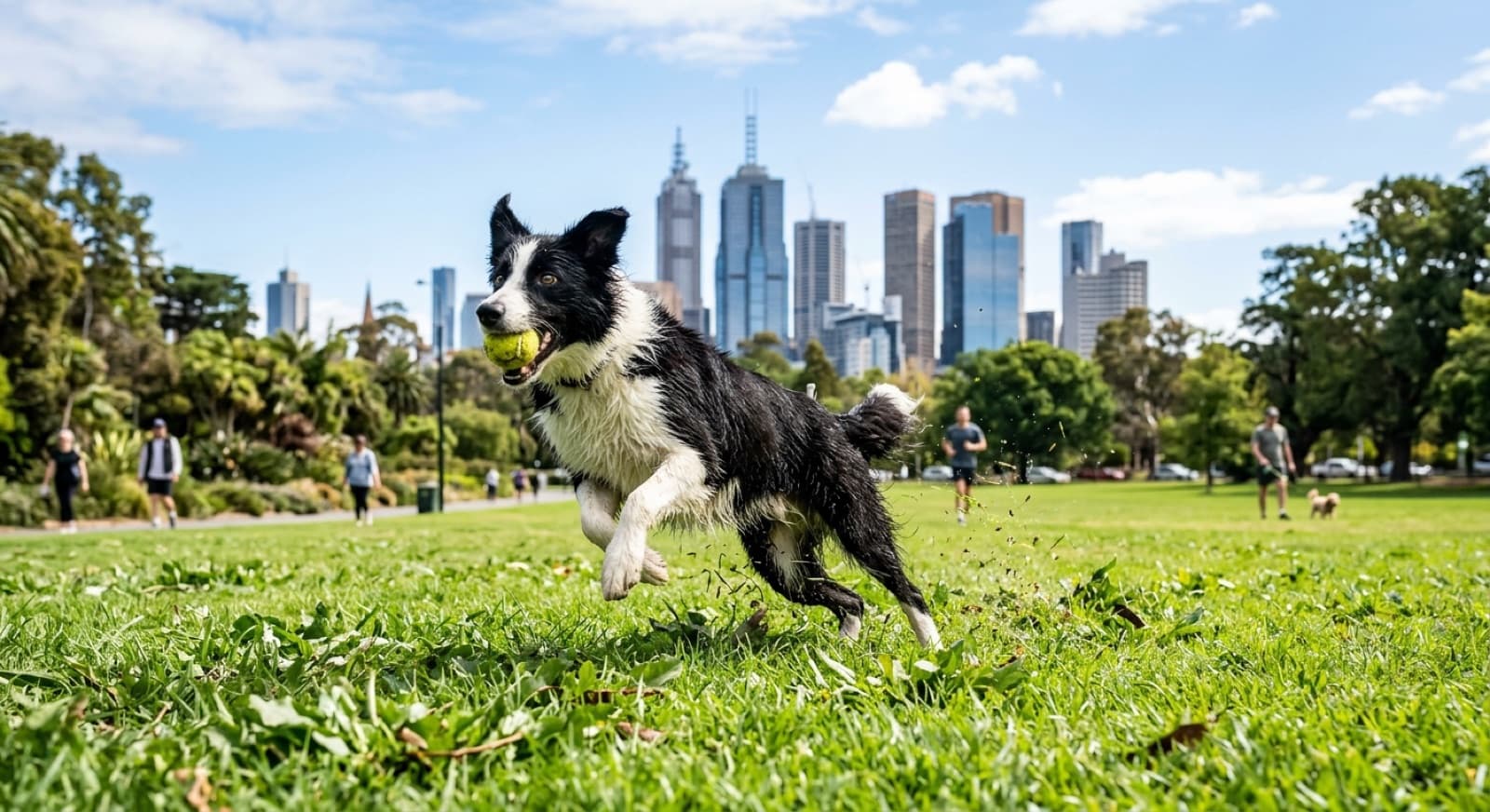
BC adolescence runs 6 to 24 months and ends most adoptions of the breed. The dog has full physical capability and adolescent self-control; without exercise plus mental work, destructive behaviour emerges. The right routine: 90 minutes of daily physical exercise plus 30 minutes of mental work, split across the day, plus a job for the brain (training, dog sports, scent work). Mental work tires a BC faster than physical exercise. Reward-based training only, because BCs shut down under aversive methods. Verify off-lead spots on the Parks Victoria index and run the dog early and late on Melbourne's hot days. Common adolescent issues (counter-surfing, herding kids, fence-fighting, separation destruction) are all manageable with training and management combined. By 3 to 4 years most BCs settle into wonderful adult companions for the families that got through adolescence.
Why BC adolescence is uniquely hard
Many breeds have a difficult adolescent phase. Border Collies have a uniquely demanding one because of three things stacked together: high working-bred energy that must go somewhere, intense intelligence that needs constant problem-solving, and a sensitive temperament that responds dramatically to handling (well to good handling, badly to poor handling).
What makes the 6 to 24 month phase specifically hard:
- Physical capability without impulse control. The dog is now adult-sized with adult strength but the brain's self-regulation is still developing. Same gap as a 14-year-old human.
- Boredom-driven destruction. A BC with energy and no outlet finds its own activities. Chewing furniture, digging up the garden, fence-fighting with neighbours, counter-surfing for food, escaping the yard.
- Herding behaviour intensifying. The chase-and-nip instinct fully matures. Kids running, bikes passing, joggers, cats, traffic; all become herding targets.
- Testing learned boundaries. Like adolescents of any species, BCs test what they were taught as puppies. Rules need consistent reinforcement.
- Reactivity windows. Some BCs develop reactive behaviour around other dogs, strangers or specific triggers during adolescence. Most cases resolve with patient training; some need professional help.
- Sleep disruption from over-arousal. Under-exercised BCs cannot settle to sleep, which compounds the next day's problems.
The good news: the phase ends. By 3 to 4 years most BCs have settled into recognisable adult patterns. Owners who get through it almost universally describe their adult BC as the best dog they have had. The breed's reputation as a wonderful companion comes from adult dogs in homes that survived adolescence.
Why mental work matters more than exercise alone
A common BC owner mistake: assuming more physical exercise solves all problems. It does not. Border Collies have substantial mental work needs that exercise alone cannot meet.
The biological reality: Border Collies were bred for sustained mental work (deciding stock movements, reading a handler's cues, adjusting tactics on the fly). The brain is wired for constant problem-solving. Physical exercise alone tires the body but leaves the brain unsatisfied; the dog comes home from a 90-minute walk physically tired but mentally restless, and still acts out indoors.
The exercise-to-mental-work ratio:
- Physical exercise: 90 minutes daily. Walks, runs, swimming, off-leash play.
- Mental work: 30 minutes daily. Training sessions, puzzle feeders, scent games, dog sports. Can be split across many short sessions.
- Both, not either. 90 minutes of exercise without mental work produces a fit, destructive dog. 30 minutes of mental work without exercise produces a calmer but physically unsatisfied dog.
A useful mental shortcut: five minutes of training is roughly equivalent to 15 minutes of walking in the tiredness it produces. Adding two short training sessions to the daily routine often calms a previously destructive BC dramatically. The RSPCA takes the same line on canine behaviour generally, that exercise and mental enrichment both have to be met before you can fairly expect calm behaviour; its guidance is in the RSPCA Knowledgebase.
The daily routine that works for Melbourne BC owners
Morning (before work):
- 45-minute walk, including some off-lead time at a verified off-lead area where the dog can genuinely run
- 10 to 15 minutes of training (sit, stay, recall, tricks; whatever you are working on)
- Frozen Kong or puzzle feeder as you leave for work (mental work during the alone period)
Midday:
- If working from home: a 15-minute training session or scent game break
- If at the office: doggy daycare two or three days a week is genuinely useful for BCs; the social-and-physical day prevents the alone-time destruction pattern
- A dog walker visit if neither working from home nor daycare is available
Evening:
- 45-minute walk or an off-lead session at a designated off-leash area
- Family time with structured activities (fetch, training, gentle play)
- Bedtime puzzle feeder or long-lasting chew for the wind-down
Weekly addition:
- One dog-sport session (agility, scent work, flyball) or a BC-specific group meetup
- One longer bushwalk or riverside walk of 60 to 90 minutes
- One swimming session if your dog enjoys water
This routine genuinely works for full-time Melbourne households if the midday coverage is sorted. The destructive behaviour patterns mostly resolve within 4 to 8 weeks of consistent routine. In summer, do the hard exercise early and late: a Border Collie will keep running past the point that is safe on a 40C day, so you have to manage the heat for it, feel the footpath before you set out because hot bitumen burns pads, and swap the midday run for indoor brain work on extreme-heat days. Melbourne's cool, changeable winters are no barrier; a wet day is a good day for indoor mental work plus a shorter walk, not a day off.
Browse adoptable Border Collies in Melbourne
Across the Victorian rescues we aggregate, listing notes describe how each specific dog handles adolescent triggers and what its current training level is.
See Available Border Collies →Common adolescent BC behaviours and how to handle them
1. Destructive chewing
Furniture, doors, shoes, leads, walls. Almost always caused by under-exercise plus boredom. Two parallel fixes: increase the exercise plus mental work routine, AND confine the dog to a smaller safe space with appropriate enrichment when unsupervised. A frozen Kong, a lick mat and a long-lasting chew all provide alternative outlets. Crate training works for some BCs; for others a baby-gated room is better. Avoid punishment after the fact, because BCs do not connect a post-destruction reprimand with the original act.
2. Counter-surfing
BCs are tall enough to reach kitchen counters and intelligent enough to learn that food appears there. Management plus training: do not leave food on accessible surfaces (the dog is rewarded every time it finds food and learns the behaviour pays off), and actively train “off” or “leave it” with high-value rewards. Once the dog learns counters never have food, the behaviour fades.
3. Fence-running and fence-fighting
BCs in yards adjacent to other dogs or pedestrians often develop fence patrols and fence-fighting behaviour. The behaviour is self-rewarding (the dog perceives that barking made the trigger go away) and gets worse with practice. Management: limit yard time without supervision, especially during high-trigger periods such as school drop-off and evening foot traffic. Training: teach the dog to come away from the fence on cue with high-value rewards. Sometimes a visual barrier (privacy slats in the fence) reduces the triggers enough that the behaviour fades.
4. Herding children
The chase-and-nip response to running kids is normal BC instinct, not aggression. Management while training: separate the dog from running children unless supervised, teach kids to stop moving when the dog gets too excited, and teach the dog “leave it” and “settle” with reward-based methods. A reward-based trainer experienced with herding breeds can fast-track resolution. Most BCs become entirely safe around children with training, but it takes consistent work.
5. Reactivity to other dogs
Some BCs develop reactive behaviour during adolescence around specific triggers (other dogs, certain breeds, on-lead encounters). The behaviour can look fearful, frustrated or aggressive. It almost always responds to professional reward-based training; the worst thing to do is force exposure or use aversive corrections, both of which worsen reactivity. A qualified Melbourne force-free trainer handles BC reactivity routinely.
6. Separation-related destruction
BCs are prone to separation anxiety, particularly if the dog has not been gradually conditioned to alone time. Signs include destructive behaviour focused around doors and windows, excessive vocalisation when alone (neighbours will tell you), inappropriate toileting, and intense greeting on return. Mild cases respond to gradual desensitisation plus enrichment during alone time. Severe cases need professional behavioural intervention; sometimes anti-anxiety medication is part of the treatment plan in coordination with your vet.
7. Obsessive behaviour (shadow chasing, light chasing, tail spinning)
BCs can develop compulsive behaviours around moving lights, shadows, reflections or their own tail. The behaviour is repetitive and the dog cannot easily disengage. It often emerges in dogs without a sufficient mental work outlet. Management: interrupt the behaviour by redirecting to an alternative activity, address the root cause (more mental work, more structured exercise), and avoid creating triggers (do not encourage shadow chasing as a “game”; remove laser pointers, which are particularly damaging for the breed). Established obsessive behaviour can need professional help to resolve.
Reward-based training for sensitive dogs
Border Collies respond dramatically to reward-based training methods. They are intelligent enough to learn quickly and sensitive enough that harsh handling produces worse behaviour, not better.
The core principles:
- Reward what you want; ignore or redirect what you don't. It sounds simple; it works powerfully with BCs because they are paying attention.
- High-value rewards. For BCs, the reward needs to compete with whatever triggered the wrong behaviour. Boring kibble does not compete with chasing a cat; a high-value treat or favourite toy does.
- Short, frequent sessions. 5 to 10 minutes several times a day beats one long session. BCs learn fast but get bored.
- Build success. Set the dog up to succeed. Train new behaviours in low-distraction environments first, then add distraction gradually.
- Never aversive tools. Prong collars, e-collars, choke chains, alpha-rolls. All counterproductive for the breed. BCs respond to relationship and motivation, not coercion.
Reward-based methods are the standard among qualified force-free trainers, and the position is backed by the Australian Veterinary Association. A Melbourne force-free trainer is the right starting point for a young BC.
Melbourne training and activity options that suit BCs
Several types of training and activity work particularly well for Melbourne Border Collies:
- Reward-based group training classes. Many Melbourne trainers run weekly group classes covering basics through advanced. The structure plus the social aspect both benefit BCs. Look for a force-free trainer who uses reward-based methods.
- Agility and obedience clubs. Dogs Victoria runs member obedience and agility clubs across the state, and its site is where to find a club near you. BCs excel at agility, and the combined mental and physical workload is uniquely suited to the breed.
- Scent work and nose work. A growing dog sport in Melbourne. Scent games suit BCs because the mental engagement is intense and the physical demand is moderate. Good for older BCs and those with joint issues.
- Flyball. A team relay sport involving fetch over hurdles. High intensity but fun; it suits high-drive BCs well.
- Herding clinics. Several rural Victorian properties offer herding instinct clinics for urban BCs; the dog experiences stock work in a controlled setting. Some BCs find their happiest selves at these sessions.
- Trick training. A lower-key option that still provides serious mental work. Many trainers and online courses specialise in trick training.
- Reward-based dog walkers for ongoing support. A dog walker who also reinforces training cues during walks doubles the practical training time.
For everyday running, verify off-lead spots on the Parks Victoria dog-friendly parks index, because off-lead status differs park to park and changes over time. Two reliable inner options are Royal Park in Parkville, with designated off-leash areas, and Yarra Bend Park in Kew, largely off-lead with on-lead sections near Dights Falls. Councils also set their own off-lead areas and time-of-day orders under a Domestic Animal Management Plan, so “check your local council” is the right habit for anything close to home.
When professional help is needed
Some adolescent BC issues exceed what an owner can fix alone. Get professional reward-based training help if:
- Reactivity to other dogs is escalating despite management
- Resource guarding (food, toys, beds, people) is intensifying
- Separation distress is severe (destruction, vocalisation, toileting) and not improving with enrichment
- Obsessive behaviours have established (shadow chasing, tail spinning, light fixation)
- Herding behaviour with children has involved any bite or skin break
- You are considering surrender because you cannot manage the behaviour
Melbourne has good options for professional reward-based behavioural support. A force-free trainer handles most issues; severe cases warrant a veterinary behaviourist consultation, and your regular vet or the Australian Veterinary Association can point you to one. The cost of a few professional sessions (around $150 to $300 each) is significantly less than the cost of surrendering and starting over with a different dog.
What the adult BC looks like once you get there
By 3 to 4 years, most BCs settle into recognisable adult patterns. The destructive intensity is mostly gone, the bond with the owner is established, and the dog reads household routines and adjusts. The same dog that destroyed a couch at 14 months becomes a calm, settled companion at 4 years.
The wonderful adult BC traits owners describe:
- Deeply loyal and bonded to family
- Intuitive about family moods and routines
- A willing partner in any activity (hiking, swimming, training, dog sports)
- Calm indoors when exercise needs are met
- Highly responsive to verbal and visual cues from the owner
- A long lifespan (12 to 15 years) means many years of the great adult dog
- Reliable with family children once trained
- Easy to travel with around Melbourne's pet-friendly venues
Owners who survived adolescence almost universally describe their adult BC as one of the best dogs they have known. The breed's reputation as a wonderful companion is real; it just requires getting through the hard first few years to access it.
Frequently Asked Questions
When does Border Collie adolescence start and end?
BC adolescence runs roughly 6 to 24 months. The hardest phase for most Melbourne owners is 8 to 18 months, when the dog has full physical capability and adult-sized energy but adolescent self-control and impulse management. Working-line BCs sometimes extend the difficult phase past 30 months. Show-line BCs and crosses often settle earlier. By 3 to 4 years most dogs are recognisably calmer adults with the energy outlet routine established.
Why does my Border Collie need so much mental work, not just exercise?
Physical exercise tires the body; mental work tires the brain. A BC with all-physical and no-mental exercise is the dog you see at the park: 90 minutes of running, then home, then still bouncing off the walls because the brain is unfilled. Border Collies were bred to make decisions all day about stock movement, so their brains require problem-solving. Five minutes of trick training or scent work fills brain space that 30 minutes of fetch cannot. The calmest, most balanced BCs get both every day.
My adolescent BC is destroying the house when I leave. What should I do?
Two parallel actions. First, address the energy outlet: the dog needs more exercise plus mental work BEFORE you leave, not after. A 45-minute walk plus 15 minutes of training in the morning before work changes destructive behaviour significantly. Second, address what the dog has access to: confine it to a smaller safe space with appropriate enrichment (frozen Kongs, lick mats, long-lasting chews) during your absence. Crate training works for some BCs; for others a baby-gated room is better. Talk to a reward-based trainer if the behaviour persists, because sometimes underlying anxiety needs addressing separately from energy.
My BC is herding my kids. Is this dangerous?
Herding behaviour (chasing, nipping at heels, circling) is normal BC instinct, not aggression. With young children it can become a problem because the kids run and the dog chases; the nip at heels is not biting in the harmful sense but it can break skin and frighten kids. Management is essential while training takes effect. Separate the dog from running children unless supervised. Teach the dog a reliable "leave it" and reward calm behaviour around moving children. Teach the children to stop moving when the dog gets too excited. A reward-based trainer experienced with herding breeds can fast-track resolution.
How much exercise should an adolescent BC actually get?
Aim for 90 minutes of physical exercise daily plus 30 minutes of mental work, split across the day. Two walks (45 minutes each) plus a training session, OR one walk plus a swim plus dog sports, OR similar combinations. Working-line BCs and high-drive individuals sometimes need more. The under-exercised end produces destructive behaviour; the over-exercised end produces an athlete who needs more, not less. Find your specific dog's level by experimenting; the right amount produces a calm, settled dog in the evening. On Melbourne 40C and heatwave days, shift the hard exercise to early morning and late evening and replace the midday session with indoor mental work.
Should I use a corrective collar or e-collar on my BC?
No. Border Collies are sensitive dogs, and aversive training tools (prong collars, e-collars, choke chains) produce worse behaviour, not better. The breed responds dramatically to reward-based training and shuts down or becomes reactive under harsh handling. Reward-based methods are the standard among qualified force-free trainers, and the RSPCA and Australian Veterinary Association both back reward-based training over aversive tools. A Melbourne force-free trainer is the right starting point.
What does success look like at the end of BC adolescence?
By 3 to 4 years most BCs settle into recognisable adult patterns. The dog still needs daily exercise and mental work, but the destructive intensity is mostly gone. The bond between dog and owner is established; the dog reads your routines and adjusts accordingly. Many adult BCs become wonderful companions for active families: loyal, intelligent, responsive, willing partners in whatever the family does. The hard adolescent phase ends and the breed's actual character emerges. Owners who get through adolescence almost universally describe their adult BC as the best dog they have had.
Keep reading
Adoptable Border Collies in Melbourne
Live listings with notes on each dog's drive and training level.
Border Collie Adoption in Melbourne
Working vs show line, where to find one, and the real cost versus a breeder.
Border Collie Health Issues
Hip dysplasia, CEA, MDR1, epilepsy, TNS and insurance ROI for Melbourne owners.
How to Adopt a Dog in Melbourne
The full Melbourne adoption process, paperwork, vet questions and home-check tips.