The short answer
With a Rottweiler, socialisation and training are not optional extras; they are what turn a powerful guardian breed into a steady, safe, wonderful family dog. Socialise the dog early and throughout its life to people, dogs, places and situations, train with consistent reward-based methods and a calm, confident approach, and manage the natural guarding instinct by channelling it rather than encouraging or suppressing it. Many owners benefit from a good force-free trainer or obedience class. A Rottweiler is not a restricted breed in Victoria, but responsible ownership still matters: council registration, secure fencing, good lead manners, and running the dog early and late on Melbourne's 40C days. Put the work in, and a Rottweiler is a magnificent, dependable companion; skip it, and a large powerful dog becomes a real problem.
Why training and socialisation define Rottweiler ownership
More than almost any breed, the Rottweiler you end up with depends on the work you put in. This is a large, powerful, intelligent guardian breed, and the same traits that make a well-raised Rottweiler a steady, dependable family companion make an under-socialised, poorly-trained one a serious problem. The breed does not raise itself, and the stakes are higher than with a small dog because of the size and strength.
The good news is that these dogs are highly trainable and want to work with their people, so the effort pays off richly. A Rottweiler given proper socialisation and consistent, kind training grows into exactly the calm, confident, protective-in-the-right-way dog the breed is famous for at its best. Understanding that this is the core commitment of ownership, and being ready to meet it, is the single most important thing a prospective Rottweiler adopter can do.
Socialisation: the foundation
Socialisation is the process of giving a dog plenty of positive experiences with the world, people of all kinds, other dogs, places, sounds, surfaces and situations, so it grows up confident and takes life in its stride. For a guardian breed like the Rottweiler it is the foundation everything else rests on, because a well-socialised Rottweiler is discerning and steady, while an under-socialised one can be fearful or reactive, which in a dog this powerful is a real concern.
With an adopted Rottweiler, socialisation is an ongoing, lifelong process rather than a puppy-only task. Continue building good associations at the dog's own pace: calm, positive exposure to new people and dogs, rewarding relaxed behaviour, and never forcing the dog into situations that overwhelm it. If your rescue Rottweiler is nervous or reactive in some situations, a Melbourne force-free trainer can help you work through it methodically. The goal is a dog that meets the world with confidence rather than suspicion.
Training: reward-based and consistent
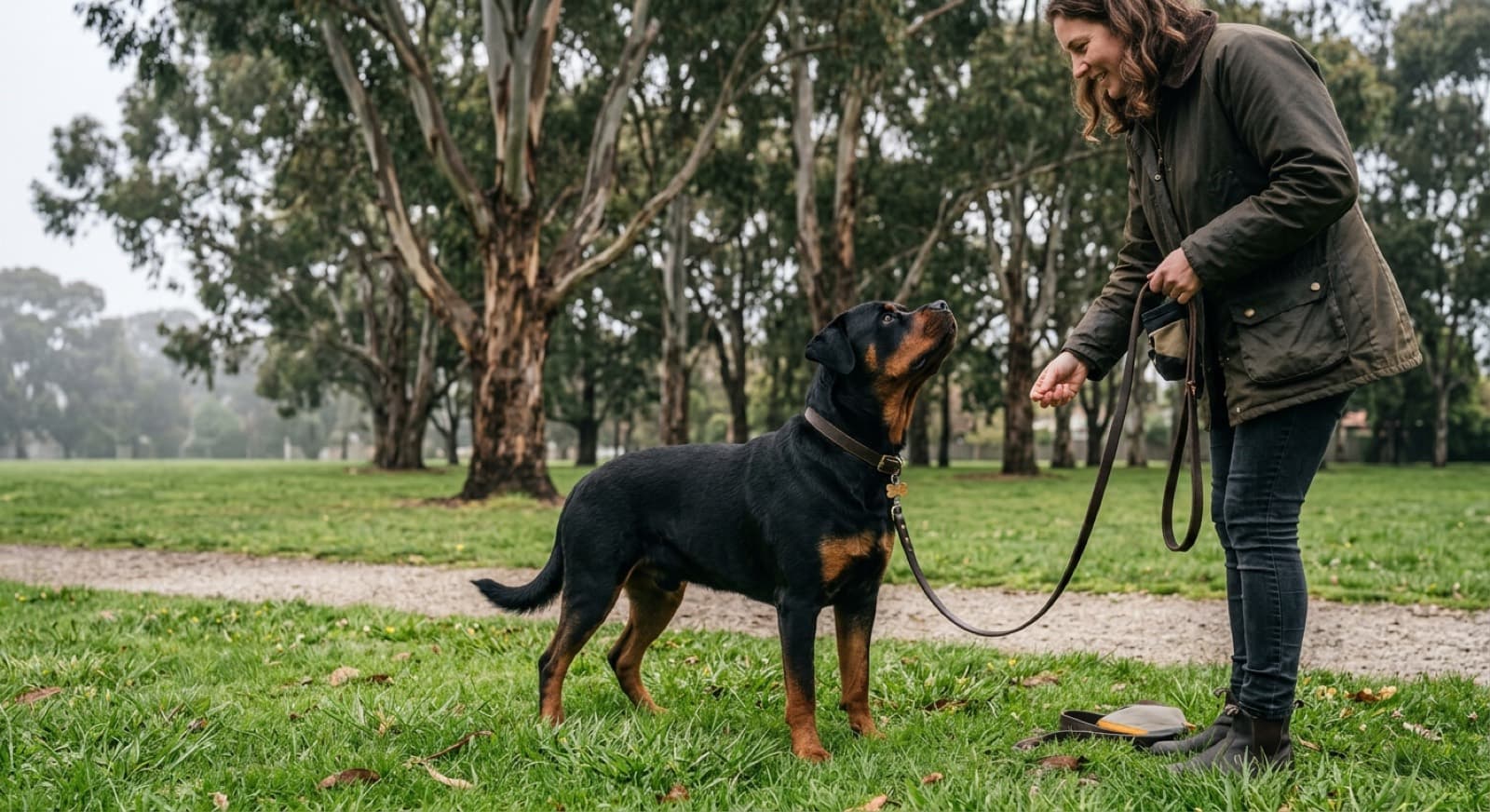
Rottweilers are intelligent and eager to work, which makes them very trainable, but they need a handler who is consistent, clear and calm rather than harsh. Reward-based, positive training builds a strong bond and a responsive dog, while punishment-based or dominance methods damage trust and can make a powerful dog worse rather than better. Reward the behaviour you want, keep sessions short, positive and engaging, and be consistent across the whole household.
Focus early on the foundations that matter most for a large, strong dog: a reliable recall, a solid settle, calm behaviour around people and other dogs, and good lead manners so the dog does not pull a handler off their feet. Many Rottweiler owners find a good force-free trainer or a structured obedience class genuinely worthwhile, both for the training and the socialisation, and it is especially valuable for less experienced owners. The RSPCA Knowledgebase has sound, reward-based training guidance to build from, and the Australian Veterinary Association takes the same line: reward-based methods over aversive tools such as prong or electronic collars, which are counterproductive and can be dangerous with a powerful breed.
Managing the guarding instinct
The Rottweiler is a natural guardian, watchful and protective of its family and territory and aloof with strangers, and that instinct is part of the breed rather than a fault. The aim is not to eliminate it but to channel it, so the dog is protective in the right way: steady, discerning, and reliably under your control.
That comes from good socialisation and training. A Rottweiler that is well-socialised and looks to you for guidance can be called off and settled, and takes its cues from you about who is welcome. Manage introductions to visitors calmly and positively, teach and reward a solid settle, and never, ever encourage or reward guarding, protection work or aggression in a pet Rottweiler, which is both dangerous and irresponsible with a dog this powerful. A well-raised Rottweiler does not need to be taught to protect its family; the instinct is there, and your job is to shape a stable, controlled dog around it.
Thinking about adopting a Rottweiler?
Across the Victorian rescues we aggregate, listing notes describe how each specific Rottweiler handles strangers, other dogs and children, and what its current training level is. Browse the adoptable dogs, and read the full adoption guide first.
Read the Rottweiler Adoption Guide →Where the Rottweiler sits under Victorian law
It is worth being clear on this, because the breed carries an unfair reputation and adopters often ask. A Rottweiler is not a restricted breed in Victoria. The Domestic Animals Act 1994 restricts five specific breeds: the American Pit Bull Terrier, the Japanese Tosa, the Dogo Argentino, the Fila Brasileiro and the Perro de Presa Canario. The Rottweiler is not on that list, so it is an ordinary registered dog that can be owned and rehomed normally. Agriculture Victoria sets out the restricted-breed rules and the wider dangerous-dog framework.
The part that does apply to a Rottweiler is behaviour-based, not breed-based. A council can declare any individual dog, of any breed, dangerous or menacing on the strength of what it has done: a dog that attacks or bites a person or animal, or rushes at or chases someone, can be declared and made subject to strict controls on containment, muzzling and signage. That is the real reason socialisation and training carry weight with a powerful breed. The law does not judge your Rottweiler for being a Rottweiler; it judges the dog by how it behaves, and a well-raised one never gives a council reason to look twice. Register the dog with your council, keep it well-managed, and the legal picture is straightforward.
Responsible ownership in Melbourne
Owning a Rottweiler well goes beyond the dog itself to being a responsible owner in the community. That means secure, high fencing suited to a large, strong dog, reliable lead manners and control in public, council registration under the Domestic Animals Act 1994, and being a considerate neighbour and a good ambassador for a breed that carries an unfair reputation. Every well-behaved Rottweiler in public helps counter the misconceptions, and every poorly-managed one reinforces them.
Melbourne's climate shapes the routine. On 40C and heatwave days a big, heavily muscled dog overheats quickly, so do the real exercise in the early morning and late evening, feel the footpath before you set out because hot bitumen burns pads, and swap the midday walk for indoor training and enrichment. The cool, changeable winters are no barrier at all; a wet day is a day for a shorter walk plus more mental work, not a day off, and a bored Rottweiler stuck inside with nothing to do will find its own trouble. Paralysis tick is not a metro Melbourne worry, so it is a travel consideration for the east-coast bushland rather than a daily one at home.
For off-lead running, off-lead status is set park by park and council by council, so verify each spot on the Parks Victoria dog-friendly parks index before you unclip. Two inner options with designated off-lead areas are Royal Park in Parkville and Yarra Bend Park in Kew. Councils also set their own off-lead areas and time-of-day orders under a Domestic Animal Management Plan, so checking your local council is the right habit for anything close to home. With a powerful, still-settling dog, earn a rock-solid recall on a long line before you trust any open off-lead park; a Rottweiler that will not come back is a management problem in a shared space.
Practically, check your housing situation before you commit, because many rentals and owners corporations are cautious about large guarding breeds even where the law allows them; the Rottweiler is not restricted in Victoria, but housing rules are a separate matter. Keep the dog well-exercised and mentally engaged, because a satisfied Rottweiler is a settled one, and stay committed to the training and socialisation for the life of the dog. Responsible ownership is the whole package, and it is what makes the difference between a Rottweiler that is a joy and one that is a liability. For everyday care and the breed's health, see our Rottweiler health guide.
Frequently Asked Questions
Why is socialisation so important for a Rottweiler?
Because a Rottweiler is a large, powerful guardian breed, and socialisation is what shapes it into a steady, confident, safe adult rather than a fearful or reactive one. A well-socialised Rottweiler that has had plenty of positive experiences with people, other dogs, places and situations from early on grows up taking the world in its stride, while an under-socialised guarding dog of this size and strength is a genuine responsibility. Socialisation is not a one-off task but an ongoing process, and with an adopted dog it continues throughout life, building good associations at the dog's own pace. It is the single most important thing you can do for a Rottweiler and for everyone the dog meets, and it is a real, lifelong commitment.
How do I train a Rottweiler?
With reward-based, positive methods, consistency, and a calm, confident approach, ideally starting early and continuing throughout the dog's life. Rottweilers are highly intelligent and eager to work, which makes them very trainable, but they also need a handler who is consistent and clear rather than harsh, because punishment-based methods damage trust and can make a powerful dog worse, not better. Reward good behaviour, keep sessions positive and engaging, and build a strong bond through training. Many Rottweiler owners benefit from working with a good force-free trainer or attending structured obedience classes, both for the training itself and for the socialisation. The RSPCA and the Australian Veterinary Association both back reward-based training over aversive tools, and the work you put in shapes the steady adult you live with for the next decade.
How do I manage a Rottweiler's guarding instinct?
You manage and channel it rather than trying to eliminate it, because guarding is part of what the breed is. A Rottweiler is naturally watchful and protective of its family and territory, and aloof with strangers, and that is normal, not a fault. The key is a well-socialised, well-trained dog that looks to you for guidance and can be reliably called off and settled. Teach a solid recall and a settle, manage introductions to visitors calmly, and never encourage or reward guarding or aggression, which is both dangerous and irresponsible with a dog this powerful. A confident, consistent owner and good socialisation produce a Rottweiler that is protective in the right way: steady, discerning and under control.
Do Rottweilers need a professional trainer?
Not always, but many owners benefit from one, and for a first-time large-breed owner it is genuinely worth it. A good force-free trainer or a structured obedience class provides expert guidance, socialisation with other dogs, and support in raising a powerful breed well, and it can head off problems before they start. It is especially valuable if you are less experienced, if the dog shows any reactivity or guarding you are unsure how to handle, or if you simply want to do right by a large guardian dog. Look for a trainer who uses reward-based, force-free methods, because harsh or dominance-based approaches are counterproductive and can be dangerous with this breed. Think of it as an investment in a safe, steady dog.
Is a Rottweiler a restricted or dangerous breed in Victoria?
No. The Rottweiler is not one of Victoria's restricted breeds. The Domestic Animals Act 1994 restricts five specific breeds: the American Pit Bull Terrier, the Japanese Tosa, the Dogo Argentino, the Fila Brasileiro and the Perro de Presa Canario. A Rottweiler is an ordinary registered dog and can be owned and rehomed normally. What matters is that a council can declare any individual dog, of any breed, dangerous or menacing based on its behaviour, so a Rottweiler that bites or rushes people can be declared and made subject to strict controls. That is precisely why responsible socialisation, training and containment carry real weight with a powerful breed. Register the dog with your council and keep it well-managed, and the law is not an obstacle.
How should I introduce a rescue Rottweiler to my home and family?
Slowly and calmly, giving the dog time to decompress and settle. A newly adopted Rottweiler needs a few weeks to relax into a new home before its true personality fully emerges, so keep the first days quiet, establish a routine, and introduce family members, visitors and other pets gradually and positively. Follow the rescue's advice, because they know the individual dog, and lean on the foster carer's notes if it came from a foster home. Supervise interactions with children and other animals early on, keep introductions to visitors low-key, and build trust before adding complexity. A calm, patient settling-in period sets the foundation for a steady, well-adjusted dog.
Can a Rottweiler be a good dog in a suburban Melbourne home?
Yes, with the right owner and setup. A Rottweiler suits a suburban home with a secure yard and space, an active, experienced owner, and a commitment to daily exercise, training and socialisation. It is less suited to apartment living, both for the space and because many owners corporations and landlords are wary of large guarding breeds, so check your building's rules and your lease if you rent. Being a responsible owner in a suburban setting also means secure fencing, council registration under the Domestic Animals Act 1994, good lead manners in public, and being a considerate neighbour and a good ambassador for a misunderstood breed. Given all that, a Rottweiler is a steady, devoted suburban family companion.
How much exercise and mental work does a Rottweiler need?
A good hour or so of exercise a day, with mental work as important as the physical. This is an intelligent working breed that thrives on having a job and a purpose, so obedience training, structured activities, scent games and problem-solving matter as much as the walk, and a bored, under-stimulated Rottweiler can become difficult to manage given its size. Combine daily walks and secure play with regular training and enrichment, and you get a settled, satisfied dog. On Melbourne's 40C and heatwave days, shift the hard exercise to early morning and late evening and swap the midday session for indoor brain work, because a big dog carrying that much muscle overheats fast. A Rottweiler is not a dog to leave idle in a yard; it wants to work with and for its family, and meeting that need for both body and mind is central to a happy, well-behaved dog.
Keep reading
Rottweiler Adoption in Melbourne
Where to adopt, what it costs, and why these powerful guardians end up in rescue.
Rottweiler Health Issues in Melbourne
The large-breed risks to plan for: hips, bloat, bone cancer and the heart, plus heat management.
Adoptable Rottweilers in Melbourne
Live listings of Rottweilers and Rottweiler crosses, with filters for age, size and compatibility.
How to Adopt a Dog in Melbourne
The full Melbourne adoption process, paperwork, vet questions and home-check tips.