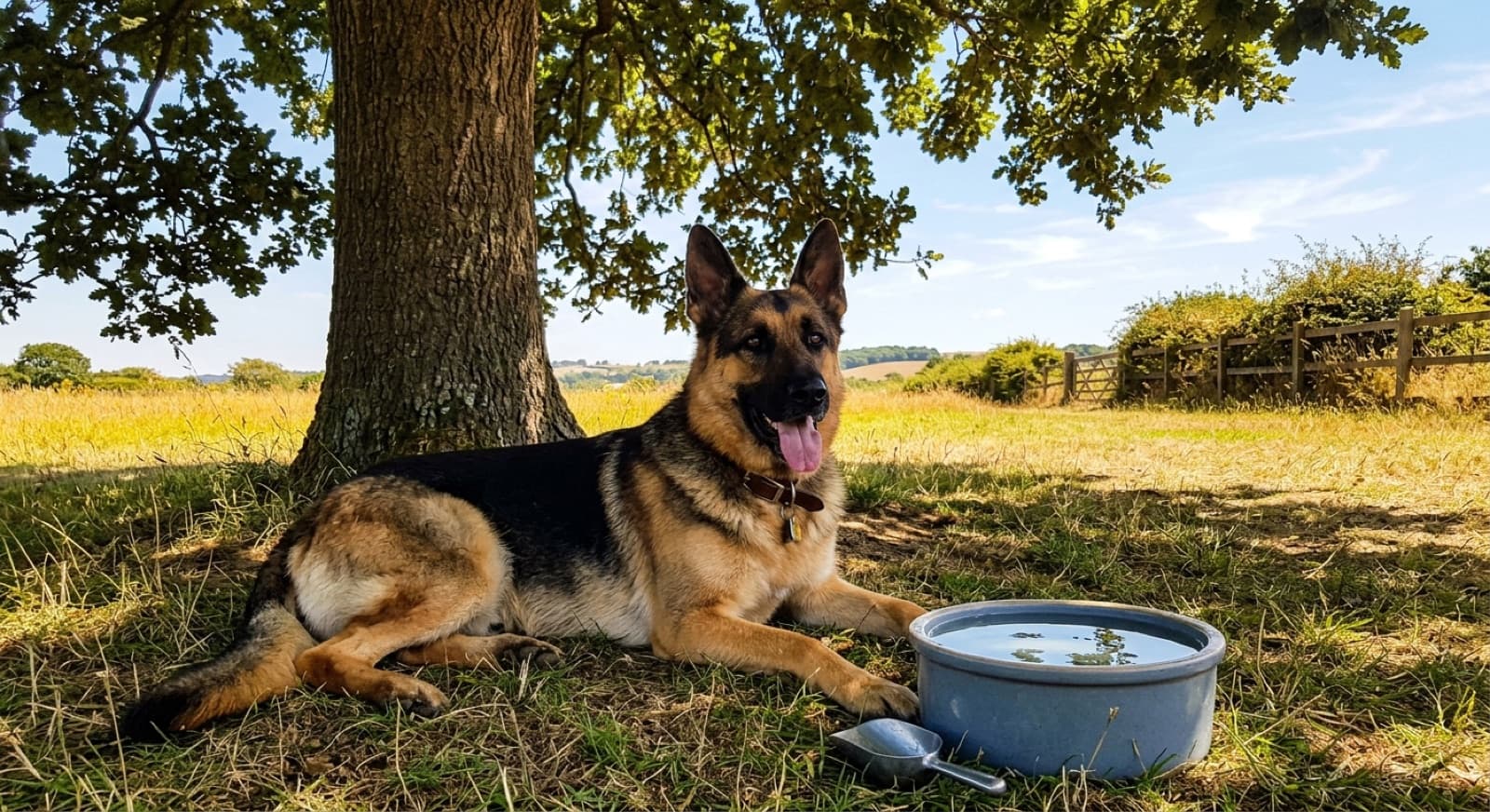
The short answer
Do not shave your Shepherd. The double coat insulates against heat as well as cold, and shaving exposes the skin to sunburn, removes the guard hairs that block direct sun, and leaves the dog without insulation in Melbourne's cool winters. Brush the undercoat out every two weeks during summer shed, not the topcoat off. Walk in the cool hours (before 8 AM, after 8 PM in peak summer), use the seven-second footpath test for any midday walk, and skip the walk entirely on a heatwave day. Check the Bureau of Meteorology forecast each morning, because Melbourne can swing from a mild week to a 42 degree northerly in a day. Know the early heat-stroke signs by heart: panting that does not settle, thick rope-like saliva, bright red gums, stumbling, collapse. Get to a vet immediately if you see any of those.
The do-not-shave truth: how the double coat actually works
The single most common mistake first-time Shepherd owners make in their first Melbourne summer is shaving the dog. The intuition seems sound: a thick coat must be hot, so cutting it off must help. The biology disagrees, and the dog ends up worse off, not better.
A German Shepherd has two coat layers doing different jobs. The outer coat (the guard hairs, the longer harsher layer you see and pat) blocks UV from reaching the skin, deflects rain and water, and creates an air gap between the sun-warmed surface and the dog's body. The undercoat (the soft dense layer underneath) traps a thin layer of air close to the skin that acts as insulation in both directions: it slows heat moving in from the outside on a hot day, and it slows heat moving out on a cold day. That second job matters more in Melbourne than in warmer cities, because the same dog that faces a 42 degree January also faces a 6 degree July night.
What shaving does:
- Removes the UV barrier. The skin underneath is pale and never normally sees direct sun. Sunburn happens on the back, ears, nose bridge and belly within hours of outdoor exposure.
- Removes the air-gap insulation. The dog is now in direct radiative heat from any sun-warmed surface (footpath, brick wall, car bonnet), with nothing buffering it.
- Does not change how the dog cools itself. Dogs cool by panting (evaporation through the tongue and respiratory tract) and through the paw pads. Coat thickness barely affects either system.
- Permanent coat damage. A shaved double coat does not grow back the same. The undercoat often returns patchy and the guard hairs grow back finer, less protective. Many shaved Shepherds never get their proper coat back, and then feel Melbourne's cold winters more.
What to do instead:
- Brush out the undercoat every two weeks through summer shed. A slicker brush and an undercoat rake work together. The dog will shed handfuls. That shed undercoat is what was getting hot and matted next to the skin. Removing it (without removing the guard hairs) makes the coat work better.
- Bath occasionally with a proper dog-coat shampoo. Once every 6 to 8 weeks in summer, no more. Over-bathing strips natural oils and damages the coat.
- If the coat is genuinely matted close to the skin (rare in a brushed Shepherd), see a professional groomer. They can de-mat without shaving.
The one legitimate exception: if a vet directs a shave for medical reasons (a hot spot, a skin infection, surgery prep), follow the vet's instructions. Otherwise the answer is no, every summer.
A Melbourne summer is not your dog's biology
German Shepherds were developed in Germany at the end of the 1800s for cool, wet climate herding and protection work. Their thermal comfort range is roughly 5 to 22 degrees Celsius. Above 22 they start to feel it. Above 28 they need active management. Above 32 they are in genuine heat-stress territory. Melbourne's temperate oceanic climate sits comfortably inside that band for much of the year, which is part of why the breed does well here. The danger is not the average day. It is the spike.
A Melbourne summer looks like this for a Shepherd:
- Air temperature. Melbourne's summer average maximum is around 25 to 26 degrees, cooler on the bayside where the sea breeze off Port Phillip helps. But heatwave days, driven by hot northerly winds, run to 38, 42 and occasionally higher, and they can arrive after a mild week the dog has acclimatised to.
- The four-seasons swing. Melbourne is famous for changing fast. A cool morning can become a 40 degree afternoon, then a cool change with a wind gust and a drop of 10 degrees in an hour. The cool change does not erase the heat the dog already absorbed.
- Where it is hottest. The outer west and north (Werribee, Melton, Sunbury, Craigieburn) run hotter than the bayside suburbs (St Kilda, Brighton, Frankston), which get sea-breeze relief. Plan the hot-day routine around your own suburb.
- Surface temperatures. A bitumen footpath in direct midday sun reaches 50 to 60 degrees Celsius even when the air is 30. Concrete sits 5 to 10 degrees cooler than bitumen but still well above body-comfortable. Sand can reach 65 to 70 degrees in summer.
- Indoor temperatures. A Melbourne apartment without air conditioning on a 42 degree day can hold 32 to 38 degrees indoor temperature for hours. A car parked in the sun reaches 50 degrees inside in 15 minutes.
Everything in the next sections works backwards from those numbers. Managing your Shepherd through Melbourne's heat is really about managing the handful of extreme days each summer, and knowing which day is which before you head out the door. The Bureau of Meteorology forecast is the tool that tells you.
One point of relief compared with the New South Wales coast: paralysis ticks are a low risk in metro Melbourne, so heat, not ticks, is the seasonal danger to plan around here. The exception is travel. If you take your Shepherd to the New South Wales coast or into East Gippsland, talk to your vet about tick prevention before you go, because those regions do carry the risk.
The seven-second footpath test
The single most useful checking habit you can build: before any midday or afternoon walk in Melbourne summer, press the back of your hand flat onto the footpath where you would walk for seven seconds. If you cannot keep your hand there for the full seven seconds without it being uncomfortable, the surface is too hot for your dog's paws.
A dog's paw pads look tough, but the skin underneath the keratin is no different from yours. Bitumen at 55 degrees burns paw pads in under a minute. Burnt paws are a common heatwave-day presentation at Melbourne emergency vets and they take 7 to 14 days to heal.
The test is calibrated to be conservative. By the time the footpath is hot enough to burn paws, you cannot reliably hold your hand on it for seven seconds. If you fail the test, the options are:
- Walk on grass instead (parks, ovals, river reserves)
- Walk in shaded streets only
- Walk later, after sundown when the bitumen has cooled
- Skip the walk and do indoor enrichment instead
Dog boots exist and some Shepherds tolerate them, but most do not. The simpler and more reliable answer is to walk earlier or later in the day. The RSPCA Knowledgebase has a clear summary at RSPCA on keeping pets cool.
The Melbourne summer walk schedule
The single biggest shift from cool-season to hot-season is when you walk. Across the Victorian rescues we aggregate, the advice adopters hear is the same: move to a dawn-and-dusk routine from December through February, and stay flexible because Melbourne's heat arrives in bursts rather than a steady season.
A workable summer schedule:
- Morning walk: 5:30 to 8:00 AM. Cooler air, cool bitumen. On a forecast hot day this is your main and possibly only exercise window, so use it.
- Mid-day: indoor cool-down. The dog is in the coolest part of the house with water available, fan or aircon on, ideally on a tiled or cooling-mat surface.
- Evening walk: after 8:00 PM in peak summer, after sundown. Even if the air is still warm, the footpath will have cooled. Bring water.
- Skip the walk on heatwave days. If the forecast is 38-plus, the dog is not getting a walk. Do indoor scent games, puzzle feeders and short training sessions instead. Mental tiredness is real tiredness.
Off-lead beach and reserve sessions work well in summer because:
- The dog can swim, which cools rapidly
- Surfaces are sand or grass, not bitumen
- A bay breeze drops the effective temperature
- The dog self-regulates pace
Melbourne has several off-lead dog beaches on Port Phillip Bay that suit a Shepherd swim, including Altona Beach, Brighton Dog Beach and the Williamstown foreshore, plus grassy off-lead reserves inland such as Royal Park in Parkville and Yarra Bend Park in Kew. The Parks Victoria dog-friendly parks index lists where dogs are welcome and where they must stay on lead. Always rinse with fresh water afterwards, because saltwater left in a Shepherd's undercoat is a recipe for hot spots and skin irritation.
Browse adoptable German Shepherds in Melbourne
Adult Shepherds from Victorian rescue arrive already lead-trained, often with a foster carer's notes on how the dog handles heat. The right dog plus the right routine is the whole game.
See Available Shepherds →Heat stroke: the signs every Shepherd owner needs to know
Heat stroke kills dogs in Melbourne every summer, and Shepherds are over-represented in the emergency vet stats because they are big, double-coated and people forget the seriousness. Once a dog tips into clinical heat stroke, body-systems failure starts inside 15 to 30 minutes. Survival depends on how fast you cool the dog and how fast you get to a vet.
The early signs (you can still turn it around with cooling and shade):
- Heavy, fast panting that does not slow down when the dog rests
- The dog seeking shade aggressively or stopping repeatedly on a walk
- Pulling for water or trying to drink from puddles
- Lying down on cool surfaces (concrete in shade, tiles) without prompting
- Body feels noticeably hotter than usual when you touch the ears or belly
The progressing signs (this is now a veterinary emergency):
- Thick, rope-like, stringy saliva
- Bright red or purple gums (lift the lip and check)
- Glazed or unfocused eyes
- Vomiting or diarrhoea
- Stumbling, weakness, dragging back legs
- Collapse or unconsciousness
What to do if you see any of these signs:
- Stop the activity immediately. Get the dog out of direct sun. Move to shade, indoors, or into an air-conditioned car if you can.
- Offer cool water. Do not force-pour it down the throat (aspiration risk). Let the dog drink at its own pace. Stop if the dog vomits.
- Wet the dog with cool, not iced, water. Focus on the paw pads, inner thighs, belly and armpits where the blood vessels are close to the skin. Ice or icy water actually slows cooling because it constricts surface blood vessels.
- Use airflow. A fan, a car aircon, or moving air over the wet dog speeds evaporation, which speeds cooling.
- Call a vet immediately, even if the dog seems to recover. Heat stroke can damage internal organs hours after the apparent recovery. Bloodwork the same day picks up kidney and liver involvement that you would otherwise miss.
Melbourne emergency vet options worth knowing before you need them: the University of Melbourne's Werribee animal hospital, the Animal Referral Hospital (ARH) at Essendon Fields, the Animal Emergency Centre (AEC) at Mount Waverley, Advanced Vetcare in Kensington, and Lort Smith in North Melbourne (open daily, but only 8am to 10pm). Save two 24-hour emergency vet phone numbers in your phone before summer hits, not during the emergency.
Cooling tools that actually help
The Melbourne pet retail aisle has dozens of summer dog products. Most are gimmicks. The few that genuinely help:
- Gel cooling mats. The kind that stays a few degrees below ambient through a pressure-activated gel layer. Useful for old or arthritic Shepherds who cannot move easily between cool spots. Sits on the floor, dog lies on it, no power needed.
- A standing fan or pedestal fan. Cheaper than aircon and surprisingly effective for an indoor dog. Move it to wherever the dog settles. Dogs cool primarily through evaporation, and moving air accelerates evaporation from the panting tongue and damp paw pads.
- Frozen Kong, lickimat or treat-stuffed feeders. A frozen banana-and-yoghurt Kong gives a Shepherd 30 minutes of cool licking work. Mental enrichment plus physical cooling, and ideal for a heatwave day indoors.
- A paddling pool or shell pool in the yard. The cheap shallow plastic ones. Fill 10 cm deep, leave in shade, refresh water daily. Many Shepherds lie down in them on their own when hot.
- A garden hose with a mist setting. Most Shepherds learn to like a gentle mist on a hot afternoon, particularly on the belly and paws.
- Aircon, where you have it. The single most effective tool. If you keep one room aircon-cooled, that becomes the dog's daytime room on a hot day.
Things that do not help or actively hurt:
- Ice cubes in the water bowl. Tap water is fine. The temperature difference between fridge water and tap water makes essentially no difference to internal cooling.
- Cold drink water on a very hot dog. Cold water against a panting throat is fine in small amounts. Pouring ice water on an overheated dog constricts skin blood vessels and slows cooling. Use cool water, not iced.
- Wet towels draped over the dog. A wet towel left on the dog actually traps heat once it warms up, especially with a thick coat. Wet the paws and belly, not the back.
- Booties for daily walks. Most dogs hate them, most are not breathable, and the simpler answer is to walk on cool surfaces.
The higher-risk Shepherds
Within the breed, certain dogs need extra management on a Melbourne heatwave day:
- Senior Shepherds (8 years and older). Older dogs regulate temperature less well, often have early kidney issues that make dehydration risky, and may have arthritis that limits how easily they move to cool spots.
- Overweight Shepherds. Body fat is insulation and reduces fitness for cooling work. An overweight Shepherd struggles dramatically more in heat than a fit one.
- Dogs on certain medications. Some prescriptions (some heart medications, some anti-inflammatories, some sedatives) affect temperature regulation. Ask your vet at the start of summer.
- Black-coated Shepherds. A black coat absorbs significantly more solar radiation than a tan or sable coat. They heat up faster in direct sun.
- Long-coated Shepherds. The longer-coat variant (sometimes called long-haired GSDs) has a thicker overall coat and needs more grooming attention in summer. Still do not shave.
- Working-line Shepherds without a sufficient outlet. A high-drive working dog that has been pent up indoors through a run of hot days will push past its own heat tolerance to burn off energy when finally let out. Watch them more carefully on the first outdoor session after a heatwave.
The summer routine, summarised
A short version you can pin to the fridge:
- Check the Bureau of Meteorology forecast every morning in summer
- Walk before 8 AM and after sundown
- Seven-second footpath test before any midday outing
- Do not shave the coat, brush the undercoat out every two weeks
- Fresh water always available, refreshed twice daily
- Cool indoor space (aircon, fan, cooling mat, tile floor)
- Never leave the dog in a parked car, even for two minutes
- Skip the walk on 38-plus heatwave days, do indoor enrichment instead
- Know the early heat-stroke signs and your nearest 24-hour vet
- If in doubt, cool the dog first, drive to the vet second
A well-managed Melbourne summer for a German Shepherd is not difficult. It is one habit (checking the forecast), two small daily decisions (when to walk, where to walk) and one large background decision (the cool indoor space). The dog handles the rest. The risk is not the average day, it is the heatwave spike, so the whole job is spotting the extreme day early and staying home when it arrives.
Frequently Asked Questions
Should I shave my German Shepherd in summer to keep it cool?
No. The double coat actually insulates the dog against heat as well as cold. Shaving removes the outer guard hairs that block direct sun, and it exposes the skin to sunburn and irritation. The undercoat (the soft, dense fluff) does most of the temperature regulation, and brushing it out properly every two weeks during the summer shed is the right approach instead of clipping. It also matters in reverse in Melbourne, where a genuinely cool, damp winter means a shaved dog is left without insulation when the temperature drops. The only exception is medical: if a vet directs a shave for skin treatment, follow that advice.
What temperature is too hot to walk a German Shepherd in Melbourne?
Above 28 degrees Celsius in direct sun, the risk goes up sharply for a double-coated working breed. On a Melbourne heatwave day, when the northerly wind pushes maximums to 38 or well past 40 degrees, the safer move is to skip the walk entirely and do mental enrichment indoors. Melbourne summers are famously variable, so check the Bureau of Meteorology forecast each morning rather than assuming the day will match yesterday. The bitumen footpath sits 15 to 20 degrees hotter than the air, so use the seven-second footpath test (press the back of your hand to the pavement for seven seconds) before any midday walk.
What are the early signs of heat stroke in a German Shepherd?
Excessive panting that does not settle when the dog stops moving, thick or rope-like saliva, bright red gums, glazed eyes, stumbling, vomiting, and collapse. By the time a dog is staggering, you are in a veterinary emergency. The earlier signs to watch for are the panting that does not slow down and the dog seeking shade or stopping repeatedly on a walk. If you see any of these, stop, get the dog into shade, offer water (do not force-pour it), wet the paws, belly and inner thighs with cool (not iced) water, and head straight to a vet.
Does Melbourne's variable weather make heat safety harder for a GSD?
Yes, in a specific way. Melbourne summers are relatively dry on most days, and lower humidity does help a panting dog cool. The catch is the swing: a run of mild weeks can be broken by a single 40-plus degree northerly day, and a dog that has not acclimatised feels that spike hard. A sudden cool change late in the day does not undo the morning heat load, either. Plan around the extremes, not the average. Check the forecast daily, treat any day forecast for 38 degrees or more as a no-walk day, and never assume the four-seasons-in-one-day reputation will hand you a cool afternoon.
Should I use a cooling vest or cooling mat for my GSD?
A cooling mat in the home is genuinely useful, especially for older Shepherds. They are gel-filled, lie on the floor where the dog wants to be, and stay 5 to 10 degrees cooler than ambient for several hours. Cooling vests are more situational. They work briefly (about 20 to 40 minutes) on a hot walk that you cannot avoid, but they do not replace skipping the walk on a heatwave day. The most reliable cooling tools are shade, water and a fan, in that order.
Can a German Shepherd swim at Melbourne beaches?
Most Shepherds enjoy water but are not natural swimmers like Labradors. Their build (large chest, heavy bone, double coat) means they tire faster. They can absolutely swim, just keep sessions shorter and stay in shallow water until you know the individual dog. Port Phillip Bay has several off-lead dog beaches that suit a Shepherd swim, including Altona Beach, Brighton Dog Beach and the Williamstown foreshore. Always rinse with fresh water after saltwater to protect the coat and skin.
Are German Shepherds at higher risk of heat stroke than other breeds?
They are at higher risk than thin-coated single-layer breeds (Greyhounds, Whippets, short-coated mixes) but lower risk than brachycephalic breeds (Pugs, French Bulldogs, Boxers). Shepherds tolerate heat reasonably well for a double-coated breed, but they are working dogs bred for cooler climates. A Melbourne heatwave asks more of them than the breed needed in its European homeland. Older Shepherds, overweight Shepherds, dogs with thick coats and dogs on medication that affects temperature regulation are the highest-risk subgroup.
Keep reading
Adoptable German Shepherds in Melbourne
Read foster notes about each dog's heat tolerance and summer routine.
GSD Health Issues to Plan For
Hip and elbow dysplasia, DM, bloat, EPI, and Melbourne emergency vets.
German Shepherd Adoption in Melbourne
The Victorian rescues, real costs, and the older-Shepherd movement.
How to Adopt a Dog in Melbourne
The full Melbourne adoption process, paperwork, vet questions and home-check tips.