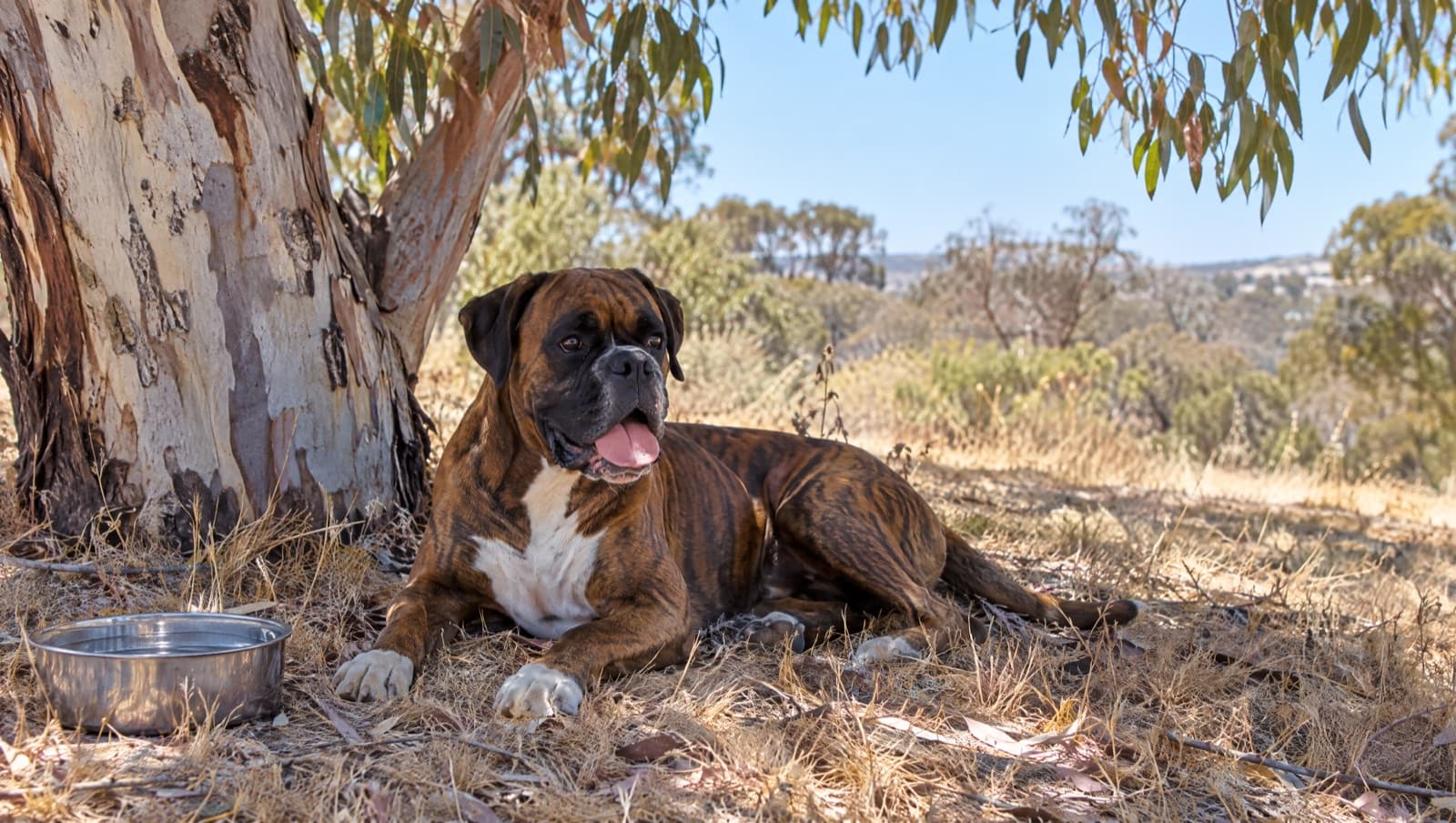
The short answer
Give a young adult Boxer about 90 minutes of exercise a day, split into two walks plus play or training. Through the Illawarra summer, walk early and late, and on the hottest, most humid days skip the walk and use indoor games instead. Test the footpath with the back of your hand for seven seconds before any warm-weather walk. Learn the early signs of heat stress (panting that will not settle, very red gums, stumbling) and act at once. Keep a vet-recommended tick product going all year and check the dog after bush walks near the escarpment.
Why Boxer exercise needs planning
Most energetic breeds cope with heat, and most heat-sensitive breeds are low-energy. Boxers are both energetic and heat-sensitive. They were bred as working dogs with plenty of stamina, and the modern breed kept that energy while carrying a shorter muzzle that cools less efficiently.
- Energy. A young adult Boxer needs around 90 minutes of activity a day. Without it, it chews, jumps and cannot settle.
- Cooling. The short muzzle means each pant shifts less heat, so the dog warms up faster and cools down slower.
- Illawarra weather. Humid coastal summers with hot days and warm nights, and mild winters that suit a Boxer well.
The good news is that autumn, winter and spring on the coast are ideal Boxer weather. The work is in the summer months, and in spotting the risky days early enough to change the plan.
How the short muzzle affects exercise
Dogs cool mainly by panting. Air moves over the moist surfaces inside the nose and airways, water evaporates and heat leaves the body. A longer muzzle gives more surface to cool across, and dry air lets the water evaporate faster. On a humid day, that evaporation slows down.
A brachycephalic (short-faced) dog has a shorter nasal passage, often a longer soft palate and narrower airways. Each breath moves less air, so it has to pant harder, and the effort of panting adds heat of its own. Boxers sit at the mild end of this group. Most breathe and exercise well, but they still cool less efficiently than a Labrador or a Greyhound.
- Boxers tire sooner on hot days than long-nosed dogs of the same size
- Humid days are harder on them than dry days of the same temperature
- A Boxer with Brachycephalic Obstructive Airway Syndrome (BOAS) is far more limited and needs a vet assessment
- Older Boxers often breathe less efficiently than they did when young
If your Boxer snores loudly, breathes noisily on easy walks or overheats on mild days, ask your vet about BOAS. The RSPCA Knowledgebase has general guidance on short-faced breeds, and our Boxer health guide covers the airway and heart conditions that affect how much exercise a dog can safely do.
What 90 minutes a day looks like
The 90 minutes does not need to be one session. Split sessions suit Boxers better. A typical Illawarra day through autumn, winter and spring:
- Morning walk: 30 to 45 minutes. Mixed pace with time to sniff. The main physical session.
- Midday mental work: 15 minutes. A puzzle feeder, a short training session or a scent game. Mental effort tires a Boxer too.
- Evening walk: 30 to 45 minutes. Often the social one, with off-lead play once recall is solid.
Across the week:
- Off-lead time in a council-declared area. Wollongong City Council lists its areas on its off-leash dog parks page, while Shellharbour and Kiama keep their own lists. Our Wollongong dog parks guide explains how they work.
- One longer walk of 60 to 90 minutes on a cool day
- Several short training sessions or games of tug and fetch
- A swim on a warm day, with close supervision (more below)
Senior Boxers (eight and up) still benefit from two walks a day. Shorten them and slow the pace rather than dropping them, since too little movement stiffens ageing joints.
Browse adoptable Boxers around Wollongong
Shelter and rescue listings often describe a dog's energy and exercise needs. Matching the right dog to your routine is most of the job.
See Available Boxers →The Illawarra summer
Summer on the Illawarra coast is warm and humid, with hot days that can arrive back to back and nights that stay sticky. That combination is what catches Boxer owners out: the dog never fully cools down between walks. Check the Bureau of Meteorology forecast the night before, including the humidity, and plan around it.
On warm days:
- Walk early. Shortly after sunrise, while the air and footpaths are coolest, is the best window.
- Rest through the middle of the day. Keep the dog in the coolest room with water, a fan or air-conditioning, and a tiled floor or cooling mat.
- Walk again late. After the evening cools, and only after testing the footpath.
On the hottest days:
- Skip the walk. A missed walk costs nothing; heat stroke can cost the dog's life. Use a quick toilet break in the shade instead.
- Keep the dog inside. A backyard in full sun is not safe for a Boxer on a hot day.
- Watch the evening. Humid nights can stay warm well after dark, so do not assume the evening walk is safe.
The seven-second footpath test.
Press the back of your hand flat on the footpath or road for seven seconds. If that is uncomfortable, it is too hot for your dog's paws. Bitumen, concrete and beach sand can be far hotter than the air on a sunny day.
Swimming.
Water exercise sidesteps much of the heat problem, and many Boxers enjoy a paddle. They are not strong natural swimmers, though, because of their heavy chest and short muzzle. Keep swims short and shallow, stay close, and consider a dog life jacket for deeper water. Dogs are only allowed on some beaches and in some waterways, so check the council's list before you go.
Bush walks and paralysis ticks
The escarpment gives Wollongong owners plenty of bushland on the doorstep, and a Boxer on a cool morning walk enjoys it as much as you do. It is also paralysis tick habitat. The Australian paralysis tick lives along the whole NSW coast, the risk runs all year, and it peaks from about August to February. The tick's toxin causes paralysis that can be fatal without veterinary treatment.
- Keep tick prevention current all year, using a product your vet recommends.
- Check by hand after every bush walk, including the head, neck, ears, lips and between the toes. A short Boxer coat makes this quicker than for most breeds.
- Treat the signs as an emergency. Wobbly back legs, a changed bark, gagging or laboured breathing mean a vet visit straight away.
- Watch for snakes in long grass on warm days, and keep the dog close.
Emergency: heat stroke
Heat stroke is life-threatening, and the Boxer's short muzzle puts it among the more at-risk breeds. Early signs, when you can still turn it around, include heavy panting that does not ease when the dog rests, seeking shade or stopping repeatedly, and ears or belly that feel hotter than usual. Later signs, which are a veterinary emergency, include thick or stringy saliva, very red or purple gums, glazed eyes, vomiting or diarrhoea, stumbling and collapse.
Start cooling and call a vet at the same time. Move the dog into shade or an air-conditioned room. Wet it with cool, not icy, water, especially the belly, groin, armpits and paws, and get air moving over the wet coat. Offer small sips of water if the dog can drink, but never force it. Then go straight to a vet, even if the dog seems to recover, because heat stroke can damage organs hours later. During business hours, call your regular vet on the way. After hours, the Animal Referral Hospital Wollongong at Fairy Meadow runs an after-hours emergency service. The RSPCA heatstroke guide has more detail.
Save your regular vet and the after-hours hospital in your phone before summer starts.
The cooler months
Autumn, winter and spring are the Boxer's best seasons on the coast. Keep the full 90 minutes going and use the cooler days for longer walks. Winters are mild, but a Boxer has a short single coat and little body fat, so older or lean dogs feel a cold, windy morning more than you might expect.
- Warm up stiff joints. Start walks slowly, particularly with older Boxers or any dog with hip problems.
- Dry off after rain. Towel the dog dry and give it a padded bed off the floor, away from draughts.
- Boxers are indoor dogs. A short-coated dog does best sleeping inside with the family.
- Remember the ticks. Cooler weather lowers the tick risk but does not remove it.
Why under-exercised Boxers struggle
Heat is a reason to change the timing, not to stop exercising. An under-exercised Boxer is hard to live with, because the energy comes out somewhere.
- Chewing furniture, doors and leads
- Counter-surfing for food
- Barking and jumping on people
- Being unable to settle indoors
- Weight gain, which makes heat and joint problems worse
A Boxer that gets enough exercise is usually calm and affectionate at home. The same dog without it is the one that ends up surrendered for “behaviour problems.” If you are thinking about adopting, our Boxer adoption guide covers how to match a dog to your household.
Indoor enrichment for hot and wet days
- Puzzle feeders. A frozen stuffed toy, a lick mat or a snuffle mat. On hot days a frozen treat also helps the dog cool down.
- Training sessions. Five to ten minutes of reward-based training, several times a day.
- Scent games. Hide treats around the house, or in cardboard boxes the dog can pull apart.
- Gentle indoor fetch. Down a hallway with a non-slip floor, in short bursts.
- Long-lasting chews. Something that takes 30 minutes or more keeps the dog busy and settled.
Boxers that need extra care
- Dogs with BOAS. Much less tolerance for heat and exercise. Follow your vet's advice.
- Senior Boxers. Shorter, slower walks, and watch closely for early signs of heat stress.
- Overweight Boxers. Extra fat holds heat and strains joints. Bringing the weight down is a priority.
- Boxers with heart conditions. Heart disease lowers exercise tolerance on its own. Your vet sets the safe level.
- White Boxers. Thin-coated skin burns in strong summer sun, so keep them out of the harsh middle of the day.
The year-round routine, summarised
- Around 90 minutes of exercise a day, split into two or more sessions
- On warm days, walk early and late; on the hottest, most humid days, skip the walk
- Seven-second footpath test before any warm-weather walk
- Indoor enrichment whenever outdoor exercise is not safe
- Water always available, and a cool room on hot days
- Never leave the dog in a parked car, even for a minute
- Paralysis tick prevention all year, plus flea, worm and heartworm prevention planned with your vet
- A hand check for ticks after every bush walk
- Know the early signs of heat stroke, your regular vet and the after-hours hospital
Frequently Asked Questions
How much exercise does a Boxer need each day?
A young adult Boxer needs around 90 minutes of physical exercise a day plus some mental work. Split it into two or three sessions, such as a 30 to 45 minute morning walk, a similar evening walk, and play or training in between. Senior Boxers need less and do better with shorter, more frequent walks. An under-exercised Boxer tends to become destructive, restless and overweight.
Are Boxers brachycephalic, and what does that mean for exercise?
Yes, mildly. A Boxer's muzzle is shorter than a typical dog's, so panting moves less air and the dog cools more slowly. Most Boxers breathe well, but they overheat faster than long-nosed dogs of the same size. A Boxer that flags early on a warm walk is usually heat-stressed, not unfit.
When is it too hot to walk a Boxer in Wollongong?
There is no single cut-off, and on the humid Illawarra coast the temperature alone can mislead you. Once a summer day is warm and sticky, walk only in the early morning or after the evening has cooled. On the hottest days, skip the walk and do indoor enrichment instead. Check the footpath too: press the back of your hand on it for seven seconds, and if that is uncomfortable it is too hot for paws.
Why does humidity matter for a Boxer?
Dogs cool mainly by panting, which works by evaporating moisture from the nose, mouth and airways. In humid air that evaporation is less effective, so every pant shifts less heat. A short-muzzled Boxer already cools less efficiently than a long-nosed dog, so a humid coastal day can push it into heat stress faster than the temperature suggests.
What are the signs of heat stroke in a Boxer?
Heavy panting that does not settle when the dog rests, thick or stringy saliva, very red gums, glazed eyes, stumbling, vomiting and collapse. Boxers reach heat stroke faster than long-nosed breeds because the short muzzle limits cooling. If you see these signs, move the dog into shade, wet it with cool (not icy) water, get air moving over it, and call a vet on the way there. After hours, the Animal Referral Hospital Wollongong at Fairy Meadow runs an emergency service.
Can I take my Boxer on bush walks around the escarpment?
Yes, with planning. Choose cooler mornings, carry water, and keep the dog on lead where the rules require it. The bushland of the Illawarra escarpment is paralysis tick habitat all year, with a peak from about August to February, so keep your Boxer on a vet-recommended tick product and check it by hand after every bush walk. Snakes are more active in warm weather, which is another reason to keep the dog close.
My Boxer snores and pants loudly. Is that normal?
Some snoring is normal for the breed because of the shorter muzzle. Loud snoring you can hear across the house, open-mouth breathing at rest, noisy breathing on easy walks or overheating on mild days can point to Brachycephalic Obstructive Airway Syndrome (BOAS). Ask your vet for an airway assessment, because BOAS can be managed and sometimes improved with surgery.
Keep reading
Adoptable Boxers in Wollongong
Current listings with notes on each dog's energy and needs.
Boxer Adoption in Wollongong
Where to find one, why Boxers reach rescue, and what adoption costs.
Boxer Health Issues
Heart conditions, cancers, hips, bloat, ticks and the insurance question.
Dog Parks and Off-Lead Areas in Wollongong
How Illawarra councils set off-lead areas, plus tick and snake safety.
Wollongong Dog Guides
Registration, desexing, off-lead areas and more for Illawarra dog owners.
Dog Adoption in Wollongong
Every adoptable dog we track from Illawarra and NSW shelters and rescues.