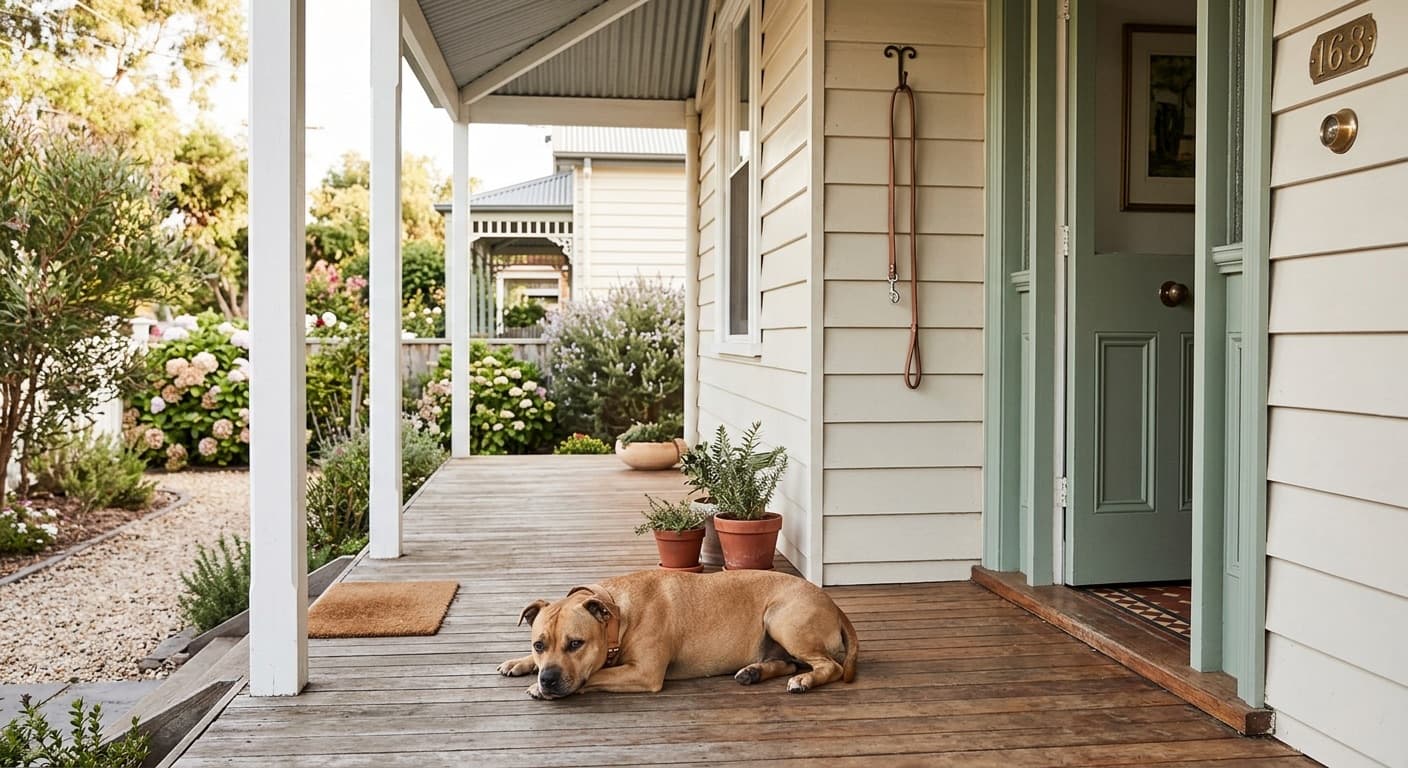
The short answer
Staffies are legal in NSW. Only five breeds are restricted, and the Staffordshire Bull Terrier is not one of them. On the Coast, the real hurdles are housing and the lead. NSW rules limit a landlord's ability to unreasonably refuse a pet and a strata committee's ability to impose blanket bans, and NCAT can review an unreasonable refusal. Outside your home, Central Coast Council requires a lead everywhere, footpaths included, except in designated off-leash areas. If anyone mistakes your Staffy for a restricted breed, shelter paperwork and vet records are your best defence.
The NSW restricted-breed list: who is actually on it
The legal foundation for restricted breeds in NSW is the Companion Animals Act 1998, administered by the NSW Office of Local Government. Section 55 of the Act names five breeds as restricted in NSW:
- American Pit Bull Terrier (also called Pit Bull Terrier)
- Dogo Argentino
- Japanese Tosa
- Fila Brasileiro
- Perro de Presa Canario (also called Presa Canario)
That is the full list. A dog declared to be one of those breeds cannot legally be sold or given away in NSW. Existing owners face strict containment rules: a child-proof enclosure, signage on the property, the dog muzzled in public, an annual permit fee, and microchipping and desexing requirements above the standard.
The Staffordshire Bull Terrier and the American Staffordshire Terrier are separate breeds from the American Pit Bull Terrier. They are not on the section 55 list. They follow ordinary NSW dog law: microchipping by 12 weeks and lifetime registration by six months on the NSW Pet Registry. The state law is the same on the Central Coast as in the rest of NSW.
The name confusion that causes the problem
Much of the pushback Staffy owners meet comes down to the casual phrase “pit bull”. In everyday Australian conversation it is often used loosely for any muscular, short-coated, blocky-headed dog. That is not how the law works.
The American Pit Bull Terrier is a specific breed with its own history and breed standard. Most dogs people call “pit bulls” in Australia are actually Staffordshire Bull Terriers, American Staffordshire Terriers, or crosses of those.
The practical effect: a landlord, strata committee or neighbour says “no pit bulls”, meaning the dog they imagine, while pointing at a Staffy. You need to know the difference, and you need to be able to show it.
Renting with a Staffy on the Central Coast
The Coast has a mix of owners and renters, and compared with inner Sydney there are more freestanding houses with yards, from older weatherboards in Woy Woy to family homes around Wyong and Tuggerah. A house with a fenced yard is often an easier sell to a landlord than a unit, but consent still matters.
NSW residential tenancy law gives renters real protection on pets. The headline point: a landlord cannot unreasonably refuse a tenant's request to keep a pet. The grounds for refusal have to be specific and reasonable.
What can count as a reasonable refusal:
- The property does not suit the type or number of pets, such as a tiny unit with no outdoor space.
- Keeping the pet would breach a separate law, for example containment rules for declared dangerous dogs, which do not apply to an ordinary Staffy.
- The landlord lives at the property and would share facilities, with grounds connected to that.
What does not count on its own:
- The landlord personally dislikes the breed.
- The breed is muscular or short-coated and the landlord assumes it is dangerous.
- Other tenants have been told they cannot have pets.
If a landlord refuses, ask for the refusal in writing with the reasons stated. If the reasons do not meet the “reasonable” test, you can apply to NCAT, which can review the refusal. The most current summary of tenancy and pet rules is on NSW Fair Trading. Read the current page before you sign a new lease, and get the landlord's consent in writing before you apply to adopt.
Strata bylaws: can your unit block ban your Staffy?
If you own or rent a unit or townhouse, for example in the blocks near the water at Gosford, Terrigal or The Entrance, the strata scheme's pet bylaws matter as well as the lease.
Under the Strata Schemes Management Act 2015 (NSW) and reforms in the years since, a strata committee cannot enforce a blanket ban on pets in most cases. A refusal has to be on reasonable grounds. “The dog will be a nuisance” or “the breed is dangerous” on their own are unlikely to pass that test, particularly for a breed that is not on the restricted list.
In practice, for a Staffy owner:
- The committee can ask for information about the dog, such as size, age and behavioural history.
- The committee can attach reasonable conditions, such as the dog on a lead in common areas and the owner liable for damage.
- The committee should not refuse based purely on a breed that is legal under state law.
- If you think a refusal is unreasonable, you can apply to NCAT, the NSW Civil and Administrative Tribunal, to have it reviewed.
Check the NSW Government's current guidance at nsw.gov.au strata living before you commit, because the position has shifted across recent reforms and the latest official summary is the safest reference.
Browse adoptable Staffies on the Central Coast
Staffies and Staffy crosses come through the Coast's pounds often. Sort out your housing consent, then check the live listings and book a visit.
See Available Staffies →Central Coast Council rules for everyday life
Central Coast Council is a single council area, separate from every Sydney council, so its rules are the ones that apply to you. The one that matters most day to day is the lead: your dog must be on a lead outside your home, including on footpaths, unless you are in a designated off-leash area. The details are on the council's Dogs page.
The council lists fully fenced off-leash parks including Tuggerah Dog Park, Helen Reserve at Gorokan, Colongra Bay Reserve at Lake Munmorah, Ettalong Oval and the Sensory Park at Narara, along with off-leash beach areas such as North Avoca Beach, Wamberal Beach, The Entrance North Beach and Budgewoi Beach. Some beaches, such as Birdie Beach and Frazer Beach, are dog free. Boundaries and rules can change, so check the council's off-leash index before each new spot. A Staffy should only go off lead where it has reliable recall and gets on with other dogs.
Good fences make good neighbours, too. On a bigger block, check the fence line and gates before your Staffy arrives, because a dog that gets out and is picked up wandering is the most common way a neighbour dispute starts.
If your dog is mistaken for a restricted breed
A council can declare a dog to be a restricted breed under the Companion Animals Act. That usually starts with a ranger inspection after a complaint, often from a neighbour. The ranger forms a view based on the dog's appearance, and if they think the dog matches one of the five restricted breeds, council can issue a notice.
You can challenge the declaration, and the appeal path runs through NCAT. The kind of evidence that helps:
- The shelter's adoption paperwork describing the dog as a Staffordshire Bull Terrier or American Staffordshire Terrier, or a cross of one of those
- Veterinary records consistent with that breed description
- A canine DNA test from a reputable provider your vet recommends
- Photographs and measurements showing the dog's actual physical characteristics against the published breed standards
Identifying a breed from appearance alone is known to be unreliable, which is why documentation matters so much. If you are facing a declaration, get your paperwork in order and consider advice from a lawyer who handles companion animal matters in NSW.
Registration: what a Staffy owner needs to do
The standard NSW process applies, with no extra requirement for a Staffy.
- Microchipping. Mandatory by 12 weeks of age, or before sale or transfer, whichever comes first. Adopted dogs arrive microchipped.
- Lifetime registration. Required by six months of age. The standard lifetime fee for a dog is $84, and a desexed dog adopted from a pound, shelter or approved rehoming organisation costs $0. SoCares includes lifetime registration on most listings. The official table is on the Office of Local Government site.
- Updating ownership. When you adopt, the microchip record is transferred to you on the NSW Pet Registry. Check that your contact details and address are correct.
- Annual permits. Ordinary dogs do not need one. Annual permits apply to declared restricted breeds and declared dangerous dogs, and neither applies to an ordinary Staffy.
Insurance: pet, home and liability
Pet insurance: major Australian providers cover Staffordshire Bull Terriers and American Staffordshire Terriers under standard policies, including PetSure (the underwriter behind many named brands), Petplan Australia and RSPCA Pet Insurance. The breeds typically excluded are the section 55 restricted breeds. Our Staffy health guide for the Central Coast explains why cover is worth having.
Home and contents insurance: many NSW home policies include third-party liability cover for harm your dog causes to other people or property, and some carry a “dangerous breed” exclusion. Read the product disclosure statement on your policy. If the exclusion is vague, such as “pit bulls and similar”, ask the insurer in writing whether a Staffordshire Bull Terrier is covered. It is better to know before an incident than after.
Ready to look for a dog? Our Staffy adoption guide for the Central Coast covers SoCares, fees and what to expect.
Frequently Asked Questions
Is a Staffordshire Bull Terrier a restricted breed in NSW?
No. The Staffordshire Bull Terrier and the American Staffordshire Terrier are not on the NSW restricted-breed list under section 55 of the Companion Animals Act 1998. The five breeds that are restricted are the American Pit Bull Terrier (or Pit Bull Terrier), Dogo Argentino, Japanese Tosa, Fila Brasileiro and Perro de Presa Canario. The law is state-wide, so it applies on the Central Coast exactly as it does anywhere else in NSW.
Can a landlord on the Central Coast refuse to rent to me because I own a Staffy?
It depends. In NSW, landlords cannot unreasonably refuse a tenant's request to keep a pet. They can refuse on reasonable grounds, for example a dog in a small unit with no outdoor area. 'I don't like the breed' is not, on its own, a reasonable ground. If you have been refused and think the refusal is not reasonable, ask for the reasons in writing and check the current NSW Fair Trading guidance; you can apply to NCAT.
Can a strata building on the Central Coast refuse to let me keep my Staffy?
Not as easily as it once could. NSW strata reform limits a strata committee's ability to impose blanket pet bans, and a refusal has to be on reasonable grounds. If your strata refuses without giving a real reason, you can ask the committee to reconsider, and you can apply to NCAT to have an unreasonable bylaw or refusal reviewed. Check the latest NSW Government strata guidance before you rely on it, because the rules have changed across recent reforms.
What happens if council or a neighbour says my Staffy is a restricted breed?
Council can issue a notice declaring a dog a restricted breed, and you have the right to challenge it. The standard approach is to provide breed identification evidence: the shelter's adoption paperwork listing the dog as a Staffy or Staffy cross, your vet records, and if you like a DNA test from a reputable provider. NCAT hears these appeals. Assessments based on appearance alone are open to challenge, so keep your paperwork in order and consider advice from a lawyer who handles companion animal matters.
Do I need a special permit to own a Staffy in NSW?
No special permit. Standard NSW rules apply: the dog is microchipped by 12 weeks and registered for life on the NSW Pet Registry by six months. The standard lifetime fee for a dog is $84, and a desexed dog adopted from a pound, shelter or approved rehoming organisation costs $0 to register. The restricted-breed permit is a separate thing that only applies to declared restricted breeds, and Staffies are not on that list.
Where can my Staffy go off lead on the Central Coast?
Only in a designated off-leash area. Central Coast Council requires dogs to be on a lead outside your home, including on footpaths, everywhere else. The council lists fenced dog parks such as Tuggerah Dog Park, Helen Reserve at Gorokan, Colongra Bay Reserve at Lake Munmorah and Ettalong Oval, plus off-leash beach areas such as North Avoca Beach and Budgewoi Beach. Some beaches are dog free, so check the council's off-leash index before each new spot.
What documents should I keep to show my Staffy is not a restricted breed?
Three things help. First, the shelter's adoption paperwork describing the dog as a Staffordshire Bull Terrier or American Staffordshire Terrier, or a cross of one of those. Second, the record from your first vet visit, which usually records the breed as the shelter described it. Third, optional but useful, a canine DNA test from a reputable provider (your vet can recommend one). Keep copies somewhere you can find them quickly.
Keep reading
Adoptable Staffies on the Central Coast
Live listings of Staffies and Staffy crosses. Apply with the housing facts above in hand.
Staffy Adoption on the Central Coast
Where to adopt, what the fee covers, $0 registration and whether a Staffy suits you.
Staffy Health Issues on the Central Coast
Skin allergies, joints, paralysis ticks, coastal heat and the breed's genetic conditions.
All Central Coast Adoption Guides
Every breed and how-to guide for adopting a rescue dog on the Central Coast.