The short answer
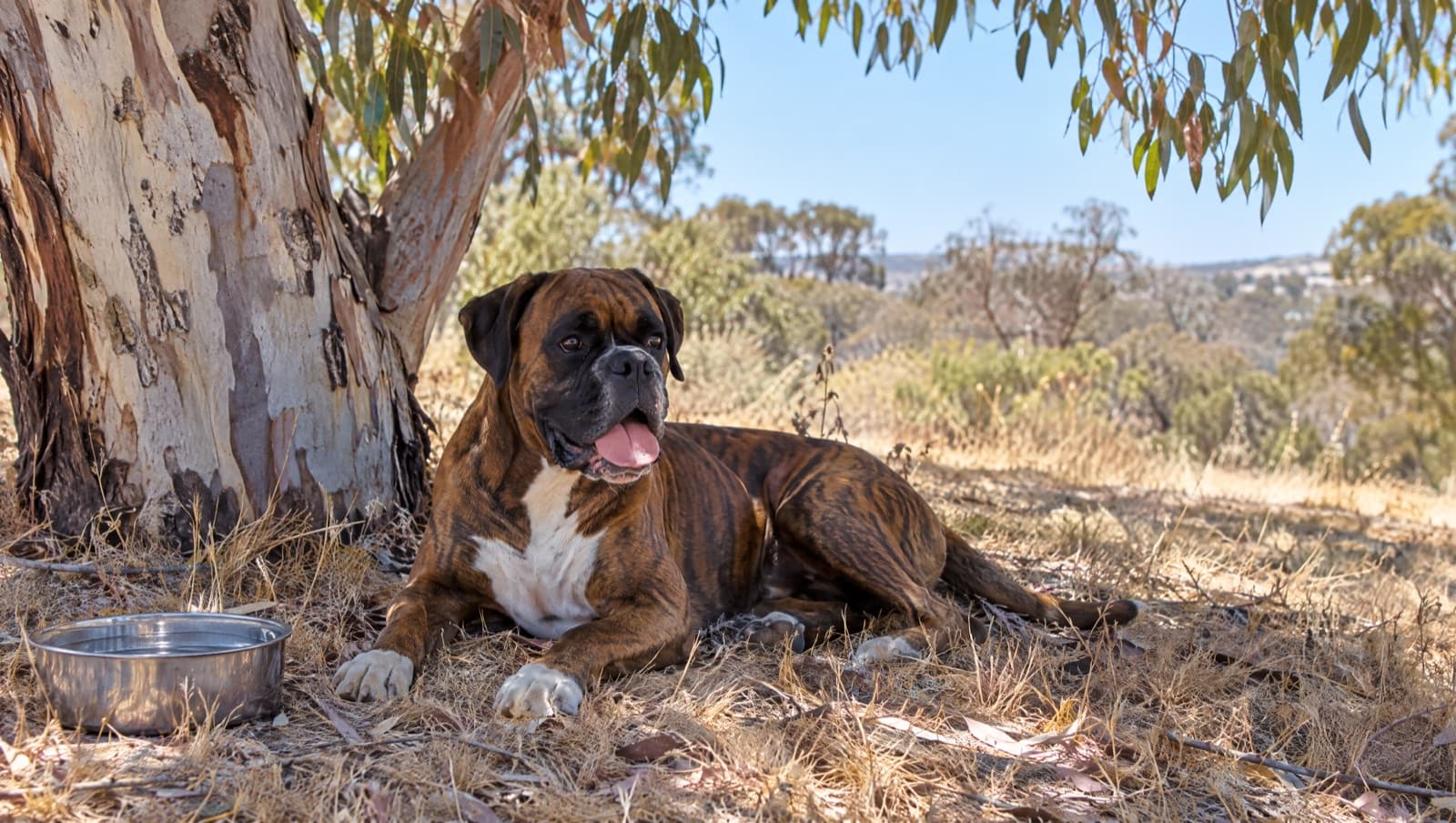
Boxers need about 90 minutes of daily exercise, but their mildly brachycephalic anatomy makes them heat-sensitive, and Perth's extreme summer temperatures compound it. Summer routine: walk before 7 am and after sundown, never in the middle of the day. Use the seven-second surface test on bitumen and beach sand before any daytime walk. Skip the walk on 40-degree heatwave days and swap in indoor enrichment. Swimming is excellent low-impact summer exercise. Watch for early heat-stress signs (panting that will not settle, bright red gums, stumbling) and act at once. Two WA outdoor hazards matter: snakes in the warmer months and 1080 baiting in reserves. Unlike the east coast, paralysis ticks are not a Perth concern. Under-exercised Boxers become destructive; over-exercised ones go into heat stroke, and the routine that works splits exercise across the cool times of day.
Why Boxer exercise is uniquely tricky in Perth
Most active breeds have high exercise needs OR heat sensitivity, not both. Boxers have both. The breed was developed in Germany as a working dog that needed substantial daily output, but selective breeding shortened the muzzle for the show ring, leaving the modern Boxer with the same energy demand as its working ancestors and reduced respiratory cooling. A hot, dry Perth summer widens that gap.
The fundamental conflict:
- Energy demand. A young adult Boxer needs around 90 minutes of vigorous activity daily. Without it the dog becomes destructive, anxious and overweight.
- Cooling limit. The shortened muzzle means each pant moves less air and evaporates less moisture, so the dog cools more slowly than a long-muzzled breed of the same size.
- Perth heat. Summer temperatures frequently in the mid-30s to 40 degrees, relentless sun, and bitumen and beach sand that get hot enough to burn paws by late morning.
The good news is that the conflict is manageable. Perth Boxer owners make it work by shifting exercise to the cool ends of the day, using water-based exercise, and accepting that on the hottest days the right call is to skip the walk entirely. The afternoon sea breeze, the Fremantle Doctor, often takes the edge off a hot evening and makes the post-sundown walk the most comfortable of the day.
How brachycephalic anatomy affects exercise
A long-muzzled dog cools by panting: moist air passes over the long surface of the nasal cavity and airway, water evaporates, and heat leaves the body. The longer the muzzle, the more cooling surface, the faster the dog cools.
A brachycephalic dog has a compressed face. The nasal cavity is shorter, the soft palate is often elongated, and the airways are narrower. Each pant moves less air, so less evaporation and less cooling, and the dog has to pant much faster to shed the same heat, which itself generates more heat from the muscle effort. Perth's dry air actually helps here, because dry air takes up evaporating moisture more readily than humid air does, so a Boxer in Perth cools better per pant than the same dog would in a tropical climate. What Perth throws at the dog instead is raw temperature: a 40-degree day with full sun overwhelms the cooling system no matter how dry the air is.
Boxers sit at the mild end of brachycephalic. Most have functional airways and real exercise capacity. But mildly brachycephalic still means cooling efficiency below a Labrador or a Greyhound. The practical implications:
- Boxers fatigue faster on hot days than non-brachycephalic breeds of the same size
- The “a fit dog can handle anything” idea does not hold; you still watch the ambient temperature
- A Boxer with full Brachycephalic Obstructive Airway Syndrome (BOAS) has much more exercise and heat limitation and needs a veterinary assessment
- Senior Boxers from about eight years often have reduced airway function even without a BOAS diagnosis
If your Boxer snores loudly, breathes noisily on moderate walks, or overheats quickly on mild days, get a BOAS assessment. The condition can be managed medically and in selected cases improved with surgery to widen the nostrils and shorten the soft palate, an area the Australian Veterinary Association covers in its brachycephalic breed health guidance. The RSPCA Knowledgebase has good general guidance on brachycephalic breeds and hot-weather care.
What 90 minutes of daily Boxer exercise actually looks like
The 90-minute target does not have to be one long session. Split sessions actually suit the breed better. A realistic Perth routine in the cooler months, roughly May through September:
- Morning walk: 30 to 45 minutes. Sniff-friendly and varied in pace. The main physical session of the day.
- Mid-day mental work: 15 minutes. A puzzle feeder, a short training session, a scent game. Mental tiredness is real tiredness for a Boxer.
- Evening walk: 30 to 45 minutes. Often a longer walk with some off-lead time at a council dog exercise area. The social and play session of the day.
Plus weekly enrichment:
- One swimming session at a dog-friendly beach or pool for low-impact cardio
- One off-lead visit to a council-listed dog exercise area for social play
- One longer walk of 60 to 90 minutes along a shaded path or river foreshore
- Several short training sessions or interactive play games
Off-lead rules in WA are set by each local government, so check your council's dog exercise areas index before assuming a park is off-lead; the City of Stirling list is one example, and its Peasholm Dog Beach at Scarborough is a council-listed off-lead dog beach. Senior Boxers from about eight years need less physical exercise but still benefit from twice-daily walks; reduce the duration and pace rather than cutting a session, because older Boxers stiffen up with too little movement.
Browse adoptable Boxers in Perth
Rescue Boxers arrive with foster carer notes on energy level and exercise tolerance. The right dog plus the right routine is the whole game.
See Available Boxers →The Perth summer routine (roughly November through March)
Perth summer changes everything for a Boxer. The single biggest shift is when you walk, not how long.
- Morning walk: 5:30 to 7:30 am. Cooler air, cool bitumen, gentler sun. This is your main exercise window in summer.
- Mid-day: indoor cool-down. The dog is in the coolest part of the house with water available, a fan or aircon going, ideally on a tile floor or cooling mat.
- Evening walk: after sundown. Even if the air is still warm, the footpath will have cooled, and the sea breeze usually helps. Bring water.
- Skip the walk on heatwave days. When the forecast is well into the high 30s or 40s, the dog does not get a walk. Do indoor scent games, puzzle feeders and short training sessions instead.
The seven-second surface test.
Before any daytime walk in summer, press the back of your hand flat onto the footpath or the sand for seven seconds. If you cannot hold it there comfortably for the full seven seconds, the surface is too hot for your dog's paws. Bitumen in the mid-50s burns paws in under a minute, and Perth summer bitumen and dry beach sand routinely get that hot by late morning.
Swimming sidesteps the heat problem. Boxers are not the strongest natural swimmers, but most enjoy water and benefit from supervised sessions. Perth options include dog-friendly beaches, quiet river spots at off-peak times, and dog-friendly pools or hydrotherapy facilities. Twenty to thirty minutes of swimming burns a lot of energy with zero joint impact and zero heat-stress risk, which makes it the ideal summer replacement when land-based exercise is off the table. Go early so the walk across the sand to the water is not itself a burn risk.
Emergency: heat stroke
Heat stroke is a life-threatening emergency, and a Boxer's shorter muzzle makes the breed one of the more at-risk dogs in the Perth heat. The early signs, where you can still turn it around, are heavy, fast panting that does not slow when the dog rests, seeking shade hard or stopping repeatedly, and a body that feels noticeably hotter than usual at the ears or belly. The progressing signs, which are a veterinary emergency, are thick, rope-like saliva, bright red or purple gums, glazed eyes, vomiting or diarrhoea, stumbling or dragging back legs, and collapse. Once a dog tips into clinical heat stroke, organ damage can start within 15 to 30 minutes.
Do both things at once: start cooling and call a vet. Move the dog into shade or an air-conditioned room immediately. Wet it with cool, not icy, water, especially over the belly, groin, armpits and paws, and get air moving over the wet coat with a fan or a breeze. Offer small sips of cool water if the dog can drink, but never force it. Do not use ice or ice-cold water, which can shut down surface blood flow and slow cooling. Phone your regular vet or a Perth 24/7 emergency hospital such as Perth Vet Emergency at Cannington while you cool, and go straight there, even if the dog seems to recover, because heat stroke can damage organs hours after apparent recovery.
Save two emergency vet numbers in your phone before summer hits, not during the emergency: your regular vet's after-hours number and the nearest 24/7 hospital. Perth's round-the-clock options include Perth Vet Emergency at Cannington, the Animal Hospital at Murdoch University, and WAVES at Success.
WA outdoor hazards: snakes, 1080, and the tick you can relax about
Two WA-specific hazards deserve a place in any Boxer exercise plan. Snakes, mainly dugites and gwardars, and tiger snakes near water, are active around Perth's bushland corridors, wetlands and the Swan and Canning river foreshores in the warmer months, roughly September to April. A fast, curious Boxer that chases or disturbs one can be bitten and needs an emergency vet immediately, so keep the dog on lead or under tight control through bushy areas and avoid letting it nose into long grass. The second hazard is 1080 baiting: the state's Western Shield program lays 1080 poison baits across many WA reserves and bushland, and the WA Government advises treating every baited area as dangerous to dogs at all times. Watch for the “1080 poison risk” signage, keep your dog leashed in reserves, and know your nearest 24/7 emergency hospital.
One thing you can worry less about in Perth than on the east coast is the paralysis tick. The Australian paralysis tick is an eastern-seaboard species and is not established in WA, so local paralysis-tick risk is low. The time to think about it is before you travel east with your dog, when you should ask your vet about tick prevention. Day to day, Perth parasite care is routine flea, worm and heartworm prevention, which your vet will set.
Why under-exercised Boxers become destructive
The other side of the equation is that an under-exercised Boxer is genuinely hard to live with. The breed was built for sustained physical work, and the energy has to go somewhere. Without an outlet it comes out as destructive chewing, anxiety, hyperactivity and weight gain.
- Destructive chewing of couches, doors, walls and leads
- Counter-surfing for food
- Excessive barking
- Obsessive jumping on people
- An inability to settle indoors
- Weight gain and joint strain from inactivity
A Boxer that gets the right routine is calm, affectionate and easy to live with. The same dog under-exercised is the one that ends up surrendered to rescue with “behavioural issues”. On heatwave days, storm days, or days life simply does not allow a long walk, indoor enrichment fills the gap: puzzle feeders and frozen food toys, short reward-based training sessions, scent games with treats hidden around the house, and long-lasting chews. Forty-five minutes of varied indoor enrichment tires a Boxer about as much as a 45-minute walk, and it keeps the day salvageable when the weather does not cooperate.
Higher-risk Boxers and the summer routine in brief
Within the breed, some dogs need extra heat care: those with full BOAS (specialist assessment essential), senior Boxers with reduced cardiac and respiratory capacity, overweight Boxers (body fat is insulation, so they heat-stress much faster), Boxers with a cardiac condition, and white Boxers, who sunburn easily on thin-coated areas in the strong WA sun. A short version of the summer routine you can pin to the fridge:
- Walk before 7 am and after sundown
- Seven-second surface test on bitumen and sand before any daytime outing
- Skip the walk on 40-degree heatwave days and swap in indoor enrichment
- Weekly early-morning swim as low-impact summer cardio
- Fresh water always available, refreshed twice daily
- A cool indoor space with aircon, a fan, a cooling mat or a tile floor
- Snake awareness in bushland in the warmer months, and watch for 1080 signage in reserves
- Never leave the dog in a parked car, even for two minutes
- Know the early heat-stroke signs and your nearest 24/7 vet; if in doubt, cool the dog first and drive to the vet second
Frequently Asked Questions
How much exercise does a Boxer need each day?
A young adult Boxer needs about 90 minutes of physical exercise daily plus mental work. Split it across two or three sessions: a morning walk of 30 to 45 minutes, an evening walk of 30 to 45 minutes, and some play or training in between. Senior Boxers from about eight years need less and do better with shorter, more frequent walks. An under-exercised Boxer becomes destructive, anxious and overweight; the breed needs the outlet, not just for fitness but for its own sanity.
Are Boxers brachycephalic and what does that mean for exercise?
Boxers are mildly brachycephalic, meaning the muzzle is shortened compared with a typical dog. Most Boxers have functional airways, but the shorter face reduces how efficiently they shed heat while working. The dog moves less air across the respiratory surface, so it cannot cool as fast as a long-muzzled breed of the same size. A Boxer that tires sooner than expected on a hot Perth walk is usually not unfit; it is heat-stressed, and that is the signal to stop.
What temperature is too hot to walk a Boxer in Perth?
As a rough guide, once it is above about 28 degrees in direct sun the risk rises, and above about 32 degrees the safer call is to skip the walk and do indoor enrichment instead. Perth summer often sits in the mid-30s to 40 degrees, and the heat is dry rather than humid, so panting still works, but the sheer temperature and strong sun push a short-muzzled dog past its limit fast. Bitumen footpaths and beach sand also heat up enough to burn paws. Use the seven-second surface test before any daytime walk.
What are the signs of heat stroke in a Boxer?
Heavy panting that does not settle when the dog stops, thick or rope-like saliva, bright red gums, glazed eyes, stumbling, vomiting, and collapse. Boxers tip into heat stroke faster than long-muzzled breeds because the shorter face limits panting efficiency, and Perth summer heat is extreme. Early warning signs to watch for are panting that will not slow down and a dog that keeps seeking shade or stopping. If you see them, stop, move to shade, offer cool (not iced) water, wet the paws, belly and inner thighs, and get to a vet straight away.
Can Boxers swim?
Most Boxers enjoy water but are not strong natural swimmers like Labradors, because the powerful chest and short muzzle make swimming more tiring. They can swim, you just supervise closely and keep sessions short. Perth has dog-friendly beaches and pools, and a supervised swim is excellent low-impact exercise in summer, when land-based walks are heat-limited. Rinse the coat afterward and keep an eye on the dog for tiredness.
Is hot sand at a Perth dog beach a risk for a Boxer?
Yes. Dry beach sand in a Perth summer can get hot enough to burn paw pads and radiate a lot of heat up at a low-slung dog, and it tires a Boxer quickly. Go early in the morning before the sand heats up, use the seven-second test by pressing the back of your hand to the sand, bring water and find shade, and keep the session short. A swim cools the dog, but the walk across hot sand to reach the water is the part that catches people out.
My Boxer pants and snores loudly. Is that normal?
Some snoring and noisier breathing is normal for the breed because of the shorter muzzle. But loud snoring you can hear across the room, open-mouth breathing at rest, breathing that sounds laboured on a moderate walk, or quick overheating on mild days can point to Brachycephalic Obstructive Airway Syndrome (BOAS). Get an assessment from a Perth vet; BOAS can be managed medically and sometimes improved surgically. Left untreated it limits the dog's exercise capacity and quality of life, which matters even more in the Perth heat.
What does a good Perth summer exercise routine look like for a Boxer?
Walk before 7 am while the air and footpaths are cool, 30 to 45 minutes. Do indoor enrichment through the middle of the day, 15 to 30 minutes, with puzzle feeders, training and sniff games. Walk again after sundown once the bitumen has cooled, 30 to 45 minutes. Add a weekly early swim at a dog-friendly beach or pool. On a 40-degree heatwave day, skip the walk entirely and substitute indoor enrichment plus a brief toilet break. This gives the dog enough exercise without heat-stress risk.
Keep reading
Adoptable Boxers in Perth
Live listings with foster carer notes on energy and heat tolerance.
Boxer Adoption Perth
Where to find one, why so many are in rescue, real cost vs a breeder.
Boxer Health Issues
Cardiomyopathy, aortic stenosis, mast cell tumours, insurance ROI.
All Dogs for Adoption in Perth
Every adoptable dog we track across Perth and WA shelters and rescues, updated regularly.