The short answer
Border Collie adolescence (around six to eighteen months) is hard because the drive ramps up faster than the self-control, which is why so many BCs are surrendered at this age. The keys to getting through it are: mental work matters more than exercise (a tired-but-bored BC is still destructive), so pair real daily exercise with dedicated brain work; manage the herding instinct with redirection and impulse-control training rather than punishment; use reward-based, force-free methods because the breed is sensitive and harmed by harsh handling; and lean on dog sports and structure. In the Brisbane heat, shift physical exercise to the cool hours and rely more on mental enrichment on hot days. Get professional help early for obsessive or reactive behaviours. The adult BC on the far side is worth every bit of it.
Why adolescence is uniquely hard
Every dog goes through an adolescent phase, but the Border Collie's is especially demanding. From around six to eighteen months, the breed's full working energy, focus and intensity come online while the dog still lacks an adult's impulse control, so you have a high-powered, problem-solving brain in a body that cannot yet regulate it. It is exactly the stretch where obsessive behaviours, reactivity, escaping and destructiveness most often appear, and, unsurprisingly, the point at which the most Border Collies land in rescue.
The reassuring part is that this is a phase, not a verdict. With structure, the right outlets and reward-based training, an adolescent BC matures into a focused, biddable, extraordinary adult. But it asks real commitment for those months, and going in expecting the challenge is half the battle. A rescue BC adopted as an adolescent is often surrendered precisely because a previous home did not expect it.
Mental work matters more than exercise
This is the single most useful thing to understand about the breed. A Border Collie that has been run for hours but has had nothing to think about is still a restless, potentially destructive dog, because it was bred to think and solve problems, not merely to move. Physical exercise is necessary, but it is the mental work that actually settles a BC.
Build both into every day: real physical exercise (walks, off-lead running, fetch with rules, a dog sport) paired with dedicated brain work (short training sessions, puzzle feeders, scent games, trick training, and a predictable job to do). In Brisbane this balance also solves the heat problem, because on hot days you can dial the physical exercise down to the cool hours and lean harder on mental enrichment indoors, keeping the dog engaged without the heatstroke risk that a driven BC courts in the sun.
The herding instinct and a sensitive temperament
The herding instinct that defines the breed can show as circling, staring, chasing and nipping at the heels of running children, cyclists, cars, joggers or other pets. It is the dog doing its job, not misbehaving, and the answer is redirection and impulse-control training rather than punishment: teach a reliable recall and a settle, give the instinct an acceptable outlet through games and sport, manage the environment so the dog is not constantly triggered, and never let it rehearse chasing cars or bikes, which is both dangerous and self-reinforcing.
Border Collies are also highly sensitive dogs, alert to noise and movement, and Brisbane's storm season can genuinely unsettle a BC. Some develop obsessive light or shadow chasing when stressed or under-stimulated, which is worth heading off with enrichment and, if it appears, professional help. The sensitivity is also why reward-based handling matters so much: this is not a breed to correct harshly.
Browse Border Collies available in Brisbane rescue
Adopting an older, foster-assessed BC whose drive and temperament the carer can describe is a great way to match the right individual to your home, and to skip the hardest of the adolescence. Live listings with foster carer notes.
See Available Border Collies →Reward-based training and dog sports in Brisbane
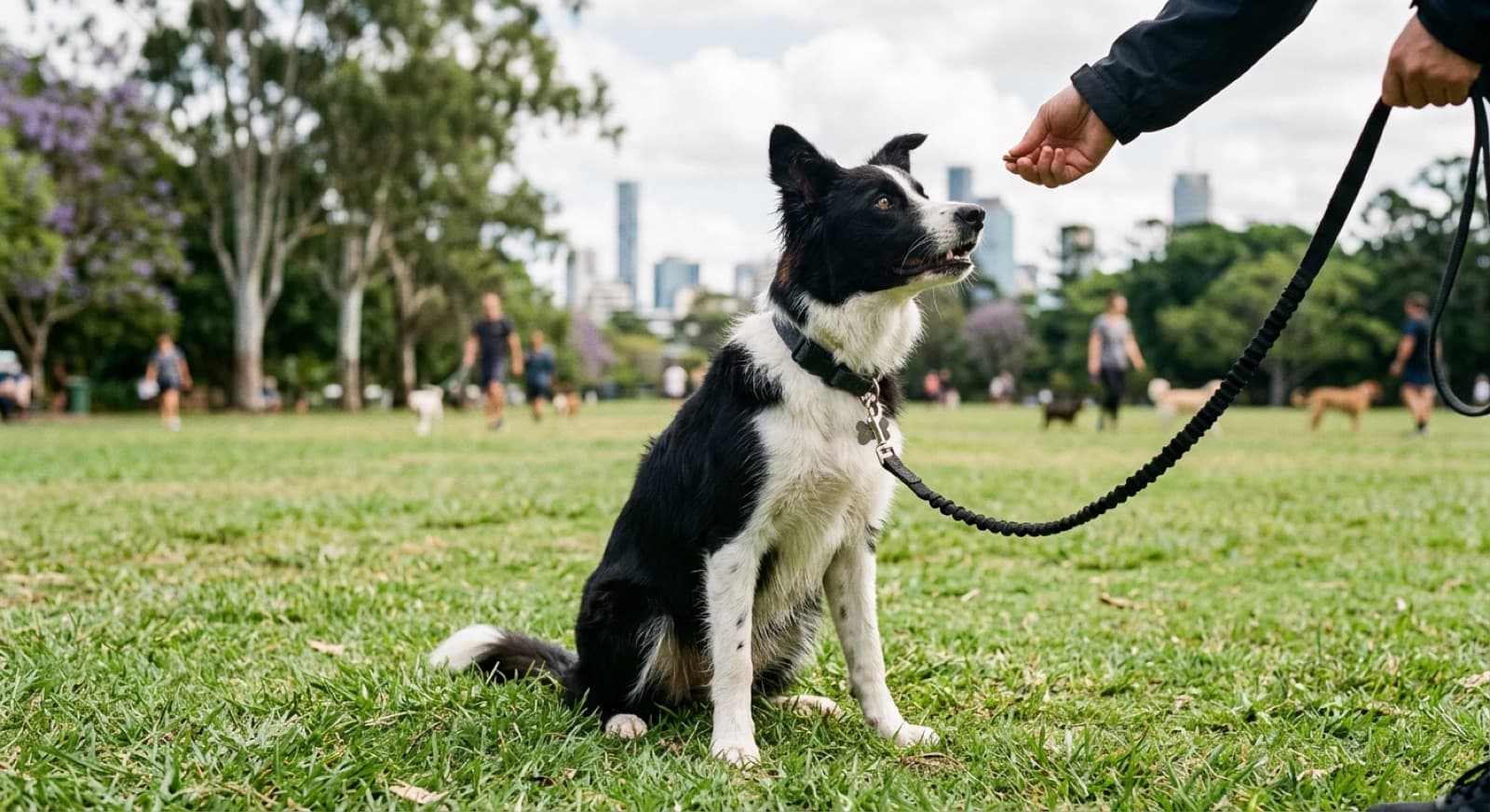
Train a Border Collie with reward-based, force-free methods and it will astonish you; the breed is among the fastest learners in dogs. Keep sessions short, varied and rewarding, build impulse control and a rock-solid recall, and use the dog's love of learning as your main tool. A reward-based training class or a good force-free trainer is a worthwhile investment through adolescence in particular.
Beyond basic training, a job is the real answer for the breed. Agility, herding, flyball, scent work, obedience, tricks and canicross all suit a Border Collie, and Brisbane has active dog-sport communities; joining a club gives the dog a serious outlet and gives you a community that understands the breed. For everyday off-lead running, Brisbane City Council maintains more than 160 off-leash areas, with examples such as Perrin Park (Toowong), Sunset Park (Bardon) and Crosby Park (Albion); off-lead status is set by council order and can change, so confirm the current zone on the Brisbane City Council off-leash dog parks index, and run the dog in the cool of the day.
When to get help, and the adult BC on the other side
Get professional help early if you see obsessive behaviours, genuine reactivity to dogs or people, escalating anxiety or aggression, or simply feel out of your depth. These patterns are far easier to change early, and a qualified force-free trainer or a veterinary behaviourist can be the difference between a manageable adolescent and a dog headed back to rescue. The RSPCA Knowledgebase has good general guidance on training and behaviour to start from.
Get through the adolescence, and the adult Border Collie is one of the great dogs: focused, deeply bonded, endlessly trainable, and a joy to share an active life with. The months of structure and mental work are an investment, and a rescue BC in the right home repays them many times over.
Frequently Asked Questions
Why is Border Collie adolescence so hard?
Because the drive ramps up faster than the self-control. From around six to eighteen months a Border Collie develops its full working energy and intensity while still lacking an adult dog's impulse control, so an adolescent BC is a high-powered brain in a body that cannot yet regulate it. This is the phase where obsessive behaviours, reactivity, escaping and destructiveness most often appear, and it is the single most common point at which BCs are surrendered to rescue. It is entirely workable with structure, exercise, mental work and reward-based training, and the dog that comes out the other side is extraordinary, but it asks a lot of the owner for those months.
Why does mental work matter more than exercise for a Border Collie?
Because a physically-tired Border Collie is not the same as a satisfied one. You can walk or run a BC for hours and still have a restless, destructive dog if its mind has had nothing to do, because the breed was built to think and problem-solve, not just to move. Training sessions, puzzle feeders, scent games, trick training and a job all engage the brain, and it is that engagement, not raw exercise, that actually settles the breed. The rule of thumb is to pair real daily physical exercise with dedicated mental work every day, and to lean harder on the mental side on hot Brisbane days when heavy exercise is unsafe.
How do I manage a Border Collie's herding instinct?
With redirection and impulse-control training rather than punishment. The herding instinct can show as circling, staring, chasing and nipping at the heels of running children, cyclists, cars or other pets, which is the dog doing what it was bred to do rather than misbehaving. Teach a reliable recall and a settle, give the instinct an acceptable outlet through games and dog sports, manage the environment so the dog is not constantly triggered, and never let it practise chasing cars or bikes. Around children, supervise and teach both the dog and the kids, and a foster carer's notes on how a rescue BC is with children are worth having.
What is the best way to train a Border Collie?
Reward-based, force-free methods, which suit the breed perfectly. Border Collies are exquisitely sensitive and extremely intelligent, so they learn fast with positive reinforcement and can be genuinely harmed by harsh or aversive handling, which tends to create the fear, reactivity and shutdown people wrongly blame on the breed. Start early, keep sessions short, varied and rewarding, build impulse control and a strong recall, and use the dog's love of learning to your advantage. A reward-based training class or a good force-free trainer is a worthwhile investment, especially through adolescence.
When should I get professional help with my Border Collie?
Sooner rather than later if you see obsessive behaviours (shadow or light chasing, spinning, flank-sucking, fixating), genuine reactivity to dogs or people, escalating anxiety, or aggression, and any time you feel out of your depth. These patterns are far easier to change early, and a qualified force-free trainer or a veterinary behaviourist can make the difference between a manageable adolescent and a dog headed back to rescue. It is not a sign of failure; the Border Collie is a demanding breed, and getting the right help through a hard patch is exactly what a responsible owner does.
Keep reading
Border Collie Adoption in Brisbane
Where to find a rescue BC, real costs vs a breeder, and what to expect.
Border Collie Health Issues
Eyes, hips, epilepsy, the MDR1 gene, and the vet budget.
Adoptable Border Collies in Brisbane
Live listings with foster carer notes on drive and household fit.
Brisbane Adoption Resources
Guides on adopting, costs, council rules and settling a rescue dog in Brisbane.